
Speciality Coatings for Packaging
24 functional and protective coatings for flexible packaging and folding cartons, from overprint varnishes and tactile finishes through slip control, product resistance, barrier and sealing.
Overview
Speciality coatings are the functional and protective layers applied over or alongside the print on flexible packaging and folding cartons. They finish the printed surface and then do a job beyond it: protecting the ink, setting how the pack feels in the hand, controlling how it slides through a machine, holding a closure shut or letting it open cleanly. Arctic Materials formulates them for flexo, gravure and roller coating on film, paper and board, over solvent and water-based ink systems.
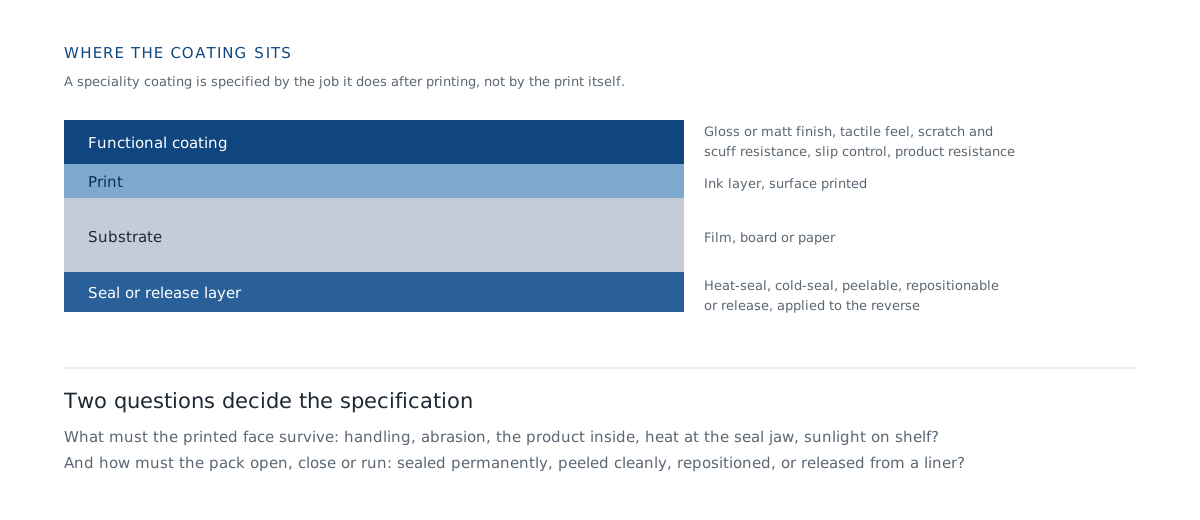
A coating is specified by what the pack has to survive, not by what it is called. The route through the range is to name the failure first, the rub in transit, the scratch from a guide rail, the oil from the filling head, the jaw that has to seal and the hand that has to open it, and then to take the grade formulated for it, because neighbouring products answer different failures and are not interchangeable. Every grade is matched to the substrate, the ink system and the line conditions the converter can actually hold, and is qualified on that structure rather than on the coating alone. Three barrier grades, moisture, oxygen and aroma, are currently in development and are not yet available for commercial supply.
The range at a glance
| Grade | Coating | Family | Status |
|---|---|---|---|
| Arclear 2G | Two-pack gloss coating, chemical resistant | Overprint varnishes | In production |
| Arclear 2M | Two-pack matt coating, chemical resistant | Overprint varnishes | In production |
| Arclear HG | High-gloss OPV | Overprint varnishes | In production |
| Arclear MT | Matt OPV | Overprint varnishes | In production |
| Arctouch SF | Soft-touch coating | Tactile finishes | In production |
| Arctouch SK | Silk-touch coating | Tactile finishes | In production |
| Arcguard AS | Anti-scratch coating | Mechanical resistance | In production |
| Arcguard SR | Scuff-resistant coating | Mechanical resistance | In production |
| Arcguard AB | Anti-blocking coating | Mechanical resistance | In production |
| Arcglide STD | Slip coating | Slip control | In production |
| Arcglide HS / LS | High-slip and low-slip coatings | Slip control | In production |
| Arcresist HT | Heat-resistant coating | Product and service resistance | In production |
| Arcresist CR | Chemical-resistant coating | Product and service resistance | In production |
| Arcresist OG | Oil and grease-resistant coating | Product and service resistance | In production |
| Arcresist WR | Water-resistant coating | Product and service resistance | In production |
| Arcbar MV | Moisture-barrier coating | Barrier coatings | In development |
| Arcbar OX | Oxygen-barrier coating | Barrier coatings | In development |
| Arcbar AR | Aroma-barrier coating | Barrier coatings | In development |
| Arcbar UV | UV-barrier coating | Barrier coatings | In production |
| Arcseal HS | Heat-seal coatings | Sealing and release | In production |
| Arcseal CS | Cold-seal coatings | Sealing and release | In production |
| Arcseal PL | Peelable coatings | Sealing and release | In production |
| Arcseal RP | Repositionable coatings | Sealing and release | In production |
| Arcrelease RL | Release coatings | Sealing and release | In production |
3 barrier grades are in development and are not available for commercial supply. Technical Data Sheets and Safety Data Sheets are issued by our technical department on request.
Overprint varnishes
Overprint varnishes are applied over the printed surface to protect the ink and to set the final appearance of the pack. Arctic Materials supplies two-component systems, which cross-link once the hardener is mixed in and are specified when the pack has to resist solvents, cleaning agents, fragrances or aggressive fillings, and single-component gloss and matt varnishes, which are chosen for appearance, rub protection and simple running on press. Gloss and matt are available in both, so the appearance decision sits separately from the resistance decision. The trade-off is between the resistance that comes with a mixing step, a limited pot life and a cure period, and a ready-to-use varnish that runs without any of them.
Two-pack gloss coating, chemical resistant
Supplied with a separate hardener and mixed before application, this gloss varnish cross-links rather than simply drying, and it is specified where the finished pack meets solvents, cleaning agents, fragrances or aggressive fillings that would soften a single-component film. It suits printed paper, board and film converted on flexo or gravure lines with adequate drying capacity, and it is a finishing layer rather than a lamination surface, because the cured film gives a laminating adhesive little to key to. Where the starting point is resistance to a named product formulation rather than a particular finish, the chemical-resistant coating in the product and service resistance range is the grade to begin from instead. The converter holds the mix ratio, works within the pot life, cleans anilox rolls, chambers and pans before mixed varnish sets in them, and lets the cure run before the pack is stacked tightly or filled, since resistance continues to build well after the film is touch dry.
Two-pack matt coating, chemical resistant
The matt grade uses the same two-component chemistry with a matting package that scatters reflected light, so cross-linked resistance to solvents, cleaning agents and aggressive contents comes with a low-sheen surface. Matting agents sit in the film, so at the same film build the matt grade will not match the gloss grade for rub and chemical resistance, and marking shows more readily on a flat surface. Matting level and film build are therefore set against the handling the pack will actually see, and rub resistance is checked on the intended substrate before a full run. Stirring after mixing and circulation through the run keep sheen even across the job, and mix ratio, pot life and cure are controlled as on the gloss grade.
High-gloss OPV
Applied in line over print, this single-component gloss varnish lifts the finish and protects the ink from rub during converting, filling and transport. No hardener and no mixing means there is no pot life to manage, which makes it the working choice wherever the pack does not face solvents or aggressive contents. It runs at a flexo or gravure coating station on printed paper, board and selected films, and on cartons it is kept clear of the glue lap so the adhesive still keys to the board. Gloss depends on how much varnish the stock absorbs, so a smooth coated board returns more gloss than an uncoated one from the same product, and gloss is assessed on the intended substrate, read at 60 degrees as is standard practice.
Matt OPV
The single-component matt varnish reduces surface sheen and gives print a flat finish with light rub protection. Like the gloss grade it is ready to use, and it is chosen for appearance and handling rather than for resistance, so packs that will meet solvents or aggressive fillings take the two-pack matt system instead. Matting agents settle, so the varnish is stirred before the run and circulated during it to hold sheen even. Scuffing shows more on a matt surface, and where handling is heavy the answer is a matt grade formulated with anti-scuff additives, not a scuff-resistant or anti-scratch topcoat applied over it, which would raise the sheen and lose the flat finish.
Tactile finishes
Tactile finishes change how a printed pack feels in the hand, and because they are low-gloss films they change how it looks as well. Arctic Materials supplies soft-touch and silk-touch coatings for folding cartons, laminated pouches and sleeve stock, applied over a printed or laminated surface by flexo, gravure or roller coater. The two differ in degree: soft-touch gives the strongest fingertip drag and the deepest matt, silk-touch a smooth satin with less drag, and a matt overprint varnish changes appearance without adding feel at all. Low gloss is where tactile chemistry gives ground on scuff, scratch and mark resistance, so these coatings are normally specified alongside an anti-scratch layer or supplied in an anti-scratch modified grade.
Soft-touch coating
Soft-touch coating gives a printed surface a dry, velvety drag under the fingertip and a deep matt appearance, and is used on cartons, laminated pouches and sleeves that are picked up and handled at the point of sale. Diffuse reflection from a matt film raises the apparent lightness of solids, so blacks and dark colours read greyer and less saturated than they do on the printed sheet, and colour is approved over the coating rather than from the sheet alone. Feel depends on how evenly the film is laid down and how completely it is cured, which puts anilox or cylinder specification, coat weight consistency and cure setting at the centre of press control, whether that is lamp dose on UV grades or dryer temperature and air volume on water-based grades. Even fully cured, a matt tactile film marks and scuffs more readily than a gloss overprint varnish, and an undercured film can also block in the stack or on the reel, so the coating is usually run with an anti-scratch layer or in an anti-scratch modified grade, with glue tabs and heat-seal areas left uncoated.
Silk-touch coating
Silk-touch coating sits between a full soft-touch film and a plain matt overprint varnish, giving a smooth satin hand with less fingertip drag and a low sheen rather than a dead matt. It is the grade to specify when a pack needs a considered feel but still has to travel through cartoning, sleeving and packing equipment, where the higher surface friction of a soft-touch film can slow transport or mark against machine guides. Carrying less surface texture, it shows scuffing and finger marking less readily than soft-touch, though it lifts the apparent lightness of dark solids in the same way and is commonly paired with an anti-scratch layer on packs that see long transit or repeated handling. Coat weight and cure need the same attention as any tactile finish, stock is fully cured before stacking or rewinding so the coated face does not block, and glue and heat-seal areas are left uncoated.
Mechanical resistance
Printed and laminated packaging is worked at the surface long before it reaches the shelf, by winding and slitting, case packing, transit and handling. Arctic Materials treats mechanical resistance as three separate problems, because scratching, scuffing and blocking have different causes and different answers in chemistry. A scratch is a single hard point cutting the surface, scuffing is repeated light rubbing that dulls it, and blocking is the surface sticking to whatever it is pressed against in the reel or the stack. Specifying by failure mode, rather than by a single hardness claim, gives a more predictable result on the line.
Anti-scratch coating
Specify this grade against a single hard point dragged across the surface, a guide rail, a knife edge, a staple or grit in a carton, cutting through ink and lacquer and leaving a visible line. The coating combines a harder, more cross-linked surface with enough lubricity that the point glides over the film rather than digging into it, and it is applied over solvent and water-based inks on film, metallised substrates and paperboard. Hardness on its own is not the answer, so surface hardness is balanced against the flexibility needed to survive creasing, folding and converting without micro-cracking. Cure is the control point for the converter, because an undercured film scratches far more readily than a fully cured one, and the cure window is confirmed against the press and the ink system before the coating is specified.
Scuff-resistant coating
Scuffing is repeated low-pressure rubbing, pack against pack in a case or web against roller, and it shows as dulling, greying or ink transfer rather than the clean cut line the anti-scratch grade answers. Resistance comes from a binder with enough cohesive strength and ink adhesion to resist being rubbed away, working with slip and wax-type additives that let surfaces glide past each other instead of gripping. Friction is set to a window rather than pushed as low as it will go, because a surface that is too slippery lets stacks slide, cases shift and reels telescope, and coefficient of friction is normally checked to ASTM D1894 on both the coated face and the reverse. Arctic Materials supplies the coating for printed film and board facing long transit, repeated handling or high-speed case packing, and matches it to heat sealing, over-printing and lamination before it is specified.
Anti-blocking coating
Blocking is the reel or the stack sticking to itself, so sheets tear or the web picks on unwind, typically after a job has been wound warm, stacked under load or stored in a hot warehouse. The defence is a binder that stays hard and non-tacky at storage temperature, supported by fine matting and anti-block particulates that hold adjacent layers slightly apart and stop intimate contact forming. That surface texture lowers gloss and changes how the surface takes over-print and seal, so the finish is agreed with the converter rather than assumed. Where the requirement is a controlled parting force against a named adhesive rather than the prevention of unintended adhesion, the release coating is the correct product, and in either case winding tension, residual solvent and stack temperature stay with the converter, since no coating compensates for a reel wound hot and tight.
Slip control
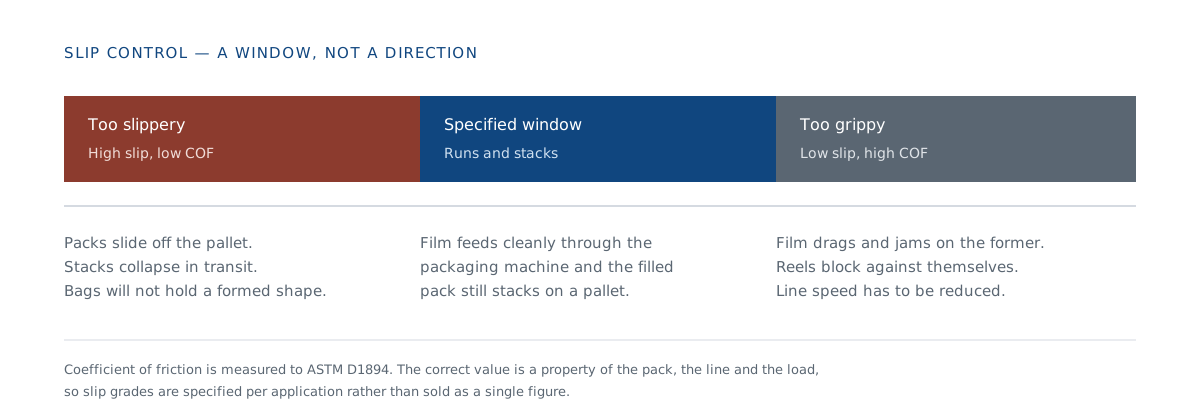
Slip control is the deliberate management of surface friction on a printed or laminated web, set to a working level rather than simply made slippery. Friction that is too low costs pack stability, so stacked cartons creep out of square and filled bags slide off a pallet, while friction that is too high makes the web drag over formers, collars and chutes until the line slows or jams. Friction is a property of the contacting pair and not of the coating alone, so face to face, face to reverse and web to metal are considered separately. Arctic Materials formulates slip coatings to hold friction inside the window that both the packaging machine and the finished pack require.
Slip coating
Slip coating is the standard grade of the range, and it holds the surface friction of a printed or overprinted web in the middle window, so the web feeds, forms and seals cleanly without the finished pack losing stability in stacking and transport. It runs in line on flexo and gravure presses over inks and varnishes on films such as BOPP, PET and PE and on paper-based substrates, and it is kept clear of glue flaps, seal panels and any area to be laminated or overprinted, because a surface formulated to resist sliding contact also resists bonding. Static and kinetic coefficient of friction are read to ASTM D1894 on film and to TAPPI T 549 or ASTM D4918 on paper and board, on conditioned samples and on the couple the machine actually presents, which is how converters fix a working window for their own line and pack format. Coat weight consistency, drying, reel tension and storage conditions stay with the converter, because under-dried coating, blocking in the reel and migration of slip additives with time and temperature all move the friction of the delivered web away from the level seen at the press.
High-slip and low-slip coatings
Where the standard slip level does not suit the machine or the pack, these grades take friction deliberately to one end or the other of the same formulating approach. High-slip is chosen where the web must run and release readily over formers, collars, plough folders and chutes, or where a case packer needs cartons to slide into collation without stalling, and it is not a substitute for a release or heat-resistant coating where the web contacts hot sealing jaws. Low-slip raises friction instead, so filled bags hold position on a pallet and stacked packs do not creep in transit, and it suits friction-fed magazines and hoppers that must pick single blanks or sheets. Both are matched to the substrate, the ink and varnish system and the line speed, and both are verified by the converter to ASTM D1894, or the equivalent paper and board method, on the finished print or laminate rather than on the coating in isolation, since over-slipping brings its own penalties in winding and reel stability.
Product and service resistance
These coatings protect the print and the pack from the product inside it and from what the pack meets in filling, transit and retail. Heat resistance is a sealing jaw and shrink tunnel problem, oil and grease resistance is the classic failure on fried and snack packs, and chemical and water resistance decide whether a pack still looks right after a spill, a washdown or a run through chilled distribution. All four sit on the printed face, so they protect that surface and the substrate beneath it and do not act as barrier layers through the structure. Each grade is specified against the actual substrate, ink system and line conditions, and is qualified on the converter’s own structure rather than assumed from the coating alone.
Heat-resistant coating
Where the web passes under a sealing jaw, through a shrink tunnel or over a hot roller, this coating stops the ink softening, picking off or transferring to hot metal. It gives the jaw a harder and more thermally stable surface to run against, so the print stays intact and the tooling stays clean through a long run. Performance depends on the ink system, the substrate and the dwell time and pressure at the jaw, so the grade is matched to the seal conditions the converter actually runs. The film must be fully dried, and on cross-linking grades fully cured, before the web meets heat, since retained solvent and incomplete cure are the usual causes of pick-off.
Chemical-resistant coating
Choose this grade when the deciding factor is the chemistry the pack will meet rather than the finish it has to carry: solvents, surfactants, household cleaners, agrochemicals and cosmetic bases, whether from a spill at the filling head or from slow contact in storage. It resists staining, softening and ink lift where the contents wet the printed surface, and the more resistant grades are two-component systems in which resin and cross-linker react on the web, so the converter mixes to the stated ratio, works within the pot life and allows the cure to develop before the pack is filled. Where a specific gloss or matt appearance is the starting point and resistance follows from it, the two-pack varnishes in the overprint range carry the same cross-linking chemistry with the finish already set. Resistance is specific to the chemistry involved, so the grade is selected against the actual product formulation and qualified by solvent rub testing and by spot or immersion contact with the filled product, and it protects the external printed face only and is not offered for direct food contact.
Oil and grease-resistant coating
Fried snacks, nuts, bakery and ready meals put oil onto the outside of the pack through filling spillage, handling and case transit, and the printed face then darkens, the ink lifts and paper-based structures stain translucent where the oil sits. The coating lies over the print and gives a surface that oil does not readily wet or penetrate, on BOPP, PET and paper-based structures, though on paper the specification depends heavily on the base sheet, since an open or poorly formed sheet will wick oil whatever sits on top. It is an external coating and does not control oil migrating from the product side, which remains the job of the sealant, the barrier layer or a grease-resistant base sheet. On paper and board, converters normally qualify the coated sheet by kit testing to TAPPI T559 and by hot oil hold tests on the finished structure.
Water-resistant coating
Condensation in chilled distribution, wet hands at retail, rain on a transit pack and washdown in the filling hall all attack an unprotected printed surface. The coating keeps print from blushing, softening or rubbing away when the pack is wet and holds the printed surface together through repeated wet and dry cycles, which is wet rub resistance rather than water repellency alone. On paper and board it slows surface wetting, so the fibre is less likely to raise under a brief spill, although it does not stop absorption through cut edges or prevent the loss of stiffness that comes with bulk moisture uptake. It is surface protection and not a moisture barrier through the structure, which remains the job of the film, the laminate or the moisture-barrier coating now in development.
Barrier coatings
Barrier coatings are applied as a liquid layer and dried or cured in line, so the barrier function is carried on a single substrate rather than by a laminated foil or metallised ply. That matters commercially as well as technically, because a coated paper or a coated mono-material film can be designed to stay within one recycling stream in a way a foil laminate cannot, although whether it does depends on the coating chemistry, the coat weight and what the receiving mill or sorting system will accept, since a coating that repels water can also resist repulping. A coating is thin and continuous by intent, so any pinhole, crater or crack at a fold becomes a direct path for whatever the barrier is meant to stop, which is why coat weight uniformity and crease performance govern the result as much as the chemistry does. The moisture, oxygen and aroma grades are in development and are not in commercial supply; the UV-barrier coating is in production.
Moisture-barrier coating
Arctic Materials is developing a moisture-barrier coating for paper, board and mono-material film, intended to slow the passage of water vapour into or out of a pack, since ingress softens board and cakes hygroscopic contents while loss dries out contents that need to hold their moisture. Unlike the water-resistant coating, which protects the printed surface itself, this layer is aimed at transmission through the structure. Performance rests on the polymer and on the continuity of the dried film together, so formulation and coat weight are being resolved as one problem, and the layer then has to survive creasing, scoring and cut edges without opening a path through itself. Blocking in the reel is the other constraint, because the soft, hydrophobic film formers that give a useful vapour barrier are also the ones most likely to tack under winding pressure and warehouse heat, and the work is at formulation and trial stage rather than in commercial supply.
Oxygen-barrier coating
Under development for paper, board and film structures, this coating is intended to restrict oxygen transmission in place of a metallised or foil ply. Oxygen drives rancidity in fats, fading in pigments and dyes and loss of active content, so the sensitivity of what is inside dictates how tight the barrier has to be. Humidity is the hard part, because the polar polymers that give a useful oxygen barrier take up water and lose performance as relative humidity rises, so a structure that behaves well in a dry laboratory can behave differently in a monsoon warehouse. Oxygen transmission rate is conventionally measured by coulometric sensor to ASTM D3985, which is run under dry conditions, with humidity-controlled work following ASTM F1927, and Arctic Materials will report against both once the development programme concludes.
Aroma-barrier coating
An aroma-barrier coating for paper, board and film is in development, to hold volatile flavour and fragrance compounds inside a pack and to keep external odours from migrating in. Both directions matter, since coffee, spice and fragrance packs lose their character when volatiles escape, and recycled fibre, retained solvent and print odour can taint the contents from the other side. Aroma compounds vary widely in molecular size and polarity, so no single transmission test settles the question, screening has to be run against the specific volatiles a given product releases, and the converter’s drying and residual solvent control weigh as heavily on the result as the coating does. The grade is at development stage and is not offered for commercial supply.
UV-barrier coating
The UV-barrier coating carries ultraviolet absorbers and is used on transparent film and on clear window areas where the print or the contents need protection from light. It slows fading of printed inks and dyes and ultraviolet-initiated degradation of light-sensitive contents while remaining clear to visible light, so the pack still shows what is inside, and the absorbers are consumed with cumulative exposure, which means the coating delays photodegradation rather than stopping it. Two things need control on press: coat weight uniformity, because absorbance depends on how much absorber sits in the light path, and layer sequence, because an absorber screens only what lies beneath it. A UV-curable ink or varnish applied over this coating cures normally, while a UV-curable layer left to be cured through it, or absorbers loaded into a UV-curable formulation alongside its own photoinitiator, will be short of cure, and Arctic Materials will advise on placement within the structure for a given film and print sequence.
Sealing and release
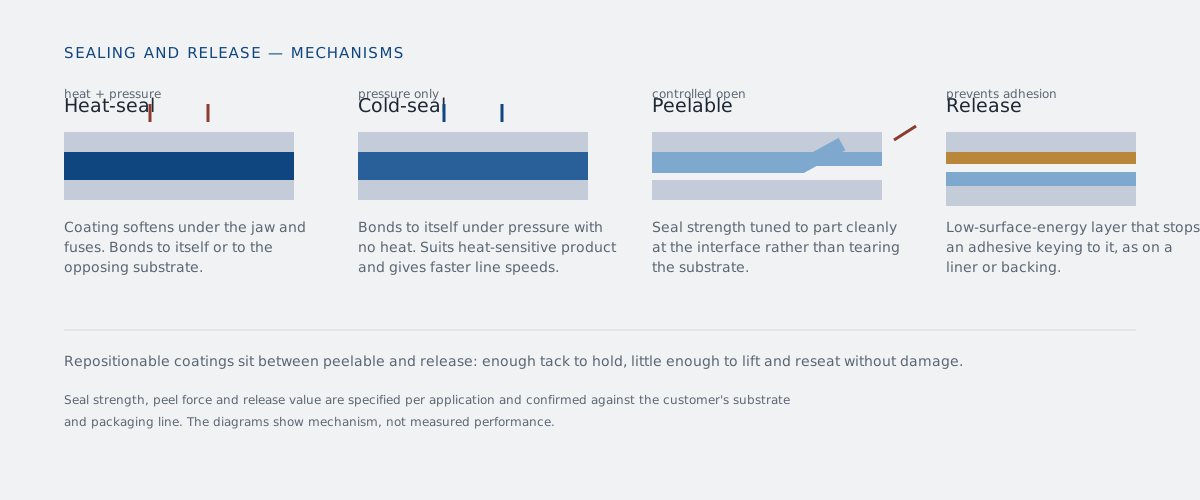
Sealing and release coatings decide how a pack closes and how it opens again. Arctic Materials supplies both sides of that job: heat-seal and cold-seal systems that form the closure, peelable and repositionable systems that control how a pack is opened or re-applied, and release coatings that hold adhesion to a controlled level where a firm bond is not wanted. Each grade is selected against the substrate pairing and the line conditions the converter can actually hold, so the sealing surface and the process are defined before the coating is chosen. Seal and release behaviour are properties of the whole construction rather than of the coating alone, so qualification runs on the converter’s own structure using the usual methods, seal strength to ASTM F88 and release force to FINAT FTM 10.
Heat-seal coatings
Heat-seal coatings give a web the ability to bond to itself or to a second surface when heat, pressure and dwell are applied at the jaws, which removes the need for a separate sealant film in many lidding and sachet formats. The grade is matched to the surface being sealed to, so a lacquer intended for PET differs from one intended for polypropylene film or for coated board, and it must also anchor properly to the face it is coated on, including print and lacquered foil. Jaw temperature, dwell and pressure stay with the converter, who also confirms that the coated stock does not block in the reel or the stack and does not pick off onto the sealing jaw. Seal strength is normally qualified on the finished structure to ASTM F88, and hot tack to ASTM F1921 where the pack is filled before the seal has cooled.
Cold-seal coatings
Cold-seal coatings bond only to themselves and do so under pressure alone, with no heat applied, so the pack closes as the jaws close. That suits heat-sensitive formats such as confectionery and bar wrapping, and it allows faster lines because there is no heating or cooling stage in the seal. The coating is applied in register to the areas that will form the seal, and the opposite face of the web carries a release lacquer so that the cold seal meets a low-adhesion surface in the wound reel instead of blocking against itself. Reel tension, storage temperature and the time between coating and use all affect how the seal performs, and food-contact suitability is not claimed and must be established separately for the finished structure.
Peelable coatings
Peelable coatings are formulated so that a seal opens by controlled failure at a chosen point, either at the interface between the coating and the sealing surface or within the coating layer itself, rather than by tearing the web, delaminating the structure or picking fibre from board. They are used on lidding for trays and pots and on flow-wrap that has to be opened by hand. The seal has to stay sound through filling, distribution and storage and still release at a force a consumer can apply, so peel is balanced against seal integrity rather than simply reduced. Behaviour depends on the substrate pairing as much as on the coating, so the grade is qualified against the specific tray or film and against the seal conditions the line will run.
Repositionable coatings
Repositionable coatings hold a low and stable tack, so a label, flap or coupon can be applied, lifted and placed again without leaving residue, picking fibre from uncoated board or lifting ink from a printed panel. They are used on promotional flaps, temporary labels and information panels carried on the outside of a pack. Adhesion tends to build with dwell, so the requirement is that tack stays inside the working window rather than climbing towards a permanent bond during storage. Coat uniformity and ageing behaviour are checked on the actual face and receiving surfaces before a run is committed.
Release coatings
Release coatings present a low-energy surface that lets an adhesive or a cold-seal lacquer be removed at a controlled force, so the two faces part predictably rather than not adhering at all, which is what separates them from the anti-blocking coating and its job of preventing unintended contact adhesion. They are used on liners and backing papers, on the face opposite the cold seal so that the reel unwinds cleanly, and wherever a coated surface would otherwise block against the layer behind it. Release level is set against the adhesive it has to face, since too easy a release lets labels lift off the liner in the reel or in transit before they are dispensed, while too tight a release makes the label hard to strip at the peel plate and can tear the face or the liner. Release force is read by standard peel methods such as FINAT FTM 10 on the actual adhesive and liner pairing, because behaviour measured against one adhesive does not carry over to another.
Application
The Speciality Coatings range is supplied as a liquid and is metered onto a moving web, dried and rewound. The coating itself is only part of the result. Coat weight, the condition of the surface it lands on, the drying available on the line, and the way the reel is wound all decide whether the finished job meets specification. The notes below describe the routes flexible packaging converters use and the variables that govern them.
Three application routes cover most work:
- Coating station on a gravure press. The coating is metered by an engraved cylinder and doctor blade. Cell volume and screen ruling set the volume the cylinder can carry, so a substantial change of coat weight means a different cylinder or a change of coating solids rather than a press adjustment. Cell volume also falls as the cylinder wears, so the engraving figure recorded when the cylinder was new is not what it delivers late in its life. Gravure application suits full-web coating at consistent weight and is the usual route for Arclear overprint varnishes and for Arcglide slip coatings, where an even film across the web is what holds coefficient of friction inside a band.
- Coating station on a flexo press. The coating is metered by an anilox roll, normally through a chambered doctor blade system, and transferred by a plate or a smooth roll. Anilox volume and line count together set the delivered film. Volume sets how much coating is carried. Line count sets how finely it is laid down and how cleanly it releases. A low line count with a large cell volume delivers weight but can leave a coarse pattern that shows in a high gloss Arclear 2G or HG finish. A high line count with a shallow cell lays down a smooth film but may not carry enough coating for Arcguard AS or AB, or for Arcresist grades, where the property depends on having sufficient film present. Delivered volume also falls as cells wear and as dried coating plugs them, so an anilox roll that has not been measured or deep cleaned is not delivering its nominal figure.
- A separate coater. A dedicated coating machine gives longer drying, more stable web tension and more control of coat weight than a press coating station. Heavier films, Arcseal cold seal and peelable grades, and the Arcbar barrier formulations now in development are better suited to a dedicated coater than to a press deck running at print speed. Water-based grades need more drying energy and longer dwell than solvent-based grades at the same coat weight, and that requirement is often what decides between a press deck and a coater.
Inline and offline application are not interchangeable. Inline, the coating is applied on the same pass as the print and enters the drying section with the ink beneath it, sometimes before that ink has fully released its solvent. The press speed is set by the print, not by the coating. Offline, the print has aged, solvent has left the ink film, and the line speed and drying can be set for the coating alone. Offline application usually gives a cleaner result for soft feel Arctouch SF and SK finishes, for heavy Arcguard films and for anything where retained solvent would cause odour or blocking. Inline is faster and cheaper and is normally sufficient for Arclear varnishing and for Arcglide slip control on clean film.
Coat weight is the single variable that governs most properties in this range, and it is the product of metering volume, transfer efficiency and coating solids. Solids and viscosity shift through a run. Solvent evaporates from the tray and the chamber, viscosity climbs, and delivered weight drifts with it. Viscosity should be checked at a fixed interval with a flow cup to ISO 2431 and recorded against temperature, because a reading taken on a cold morning and one taken in the afternoon are not the same measurement. The DIN 53211 cups still in service measure in the same way, but their times are not interchangeable with ISO 2431 times, so the cup and the target time have to be stated together. Adding solvent until the cup time returns to target restores the starting condition where the viscosity rose through evaporation. Where it rose for another reason, the addition dilutes the solids and thins the dry film while the cup time reads correct, so the correction is confirmed against a measured coat weight rather than against the cup alone. Correcting by eye is not a control at all. A drift of coat weight that is invisible on an Arclear gloss varnish will move an Arcglide coefficient of friction and will change an Arcresist CR or OG result.
Dry and cured are not the same condition. A film is dry when the solvent has left and the web can be rewound without picking. It is cured when the film has reached its final hardness, chemical resistance and surface character. For many grades in this range the two are separated in time. A reel can leave the coater touch dry and still be developing for hours or days afterwards. Chemical resistance on Arcresist CR, scratch resistance on Arcguard AS and SR, and the final tactile character of Arctouch SF and SK are all properties of the cured film. Testing a sample taken straight from the rewind will understate them. Testing should be done on a conditioned sample, and where a two component grade is used, the pot life and the crosslinking period both have to be allowed for before the reel is judged.
A coating laid over ink behaves differently from the same coating laid on bare film. Bare treated film presents a uniform surface of known surface energy and the coating wets it evenly. An inked surface does not. Surface energy varies between the ink and the unprinted film, and between one ink colour and another. Ink films are absorbent to different degrees, so part of the coating soaks in where the ink is heavy and sits on the surface where the web is bare. Solvent from the coating can soften an ink film that has not fully dried, which shows as picking, mottle or a loss of gloss over solid areas. In practice, a coat weight that gives the required result on bare film often has to be raised over heavy ink coverage, and a coating trialled only on the unprinted edge of a web is not a valid trial. Arclear MT and 2M matt finishes are particularly sensitive, because matting depends on the film drying undisturbed.
Two failures account for most of the cost converters carry on coated work. Both appear after the coating line has finished and both are avoidable at specification stage.
- Blocking in the rewound reel. A reel is a stack of coated surface pressed against the reverse of the web under wind tension, often while still warm and often for weeks. If the film is not fully dry, if residual solvent remains, if wind tension is high or if the reel is stored warm, the coating adheres to the surface it is wound against and the reel will not unwind cleanly. Blocking is worst on heavy films, on soft feel Arctouch grades and on seal coatings, and it is made worse by anything that shortens the drying available. It is controlled by giving the film the drying it needs, by reducing wind tension and taper, by letting reels cool before stacking, and by specifying Arcguard AB where the structure itself is prone to it, or Arcrelease RL where the surface the coating meets in the reel has to be given a release character. On cold seal work that surface is the printed face, not the reverse, because the cold seal is carried on the sealing side and meets the outside of the web when the reel is wound.
- Slip drifting out of specification between the coating line and the packing line. Coefficient of friction is not a fixed number. It changes as the film ages. Slip additives present in the base film migrate to the surface over days or weeks, additives in the coating bloom at their own rate, and the two act together. A reel measured at the coating line to ASTM D1894 can read inside specification and the same material can read outside it at the packing line three weeks later, in either direction. Machines that ran a previous delivery will then reject the new one. Control this by agreeing the coefficient of friction target as a range rather than a single figure, by stating whether the figure is the static or the kinetic value, by stating whether it is film to film, film to metal or coating to reverse, by agreeing the point in time and the conditioning at which it will be measured, and by measuring aged retained samples rather than fresh ones. Arcglide STD, HS and LS are formulated to sit at different points in that range, and the correct grade cannot be chosen from a fresh reading alone.
Barrier and seal performance are properties of the finished structure, not of the coating on its own. The moisture vapour and oxygen transmission of a pack depend on the base film, the laminate construction, the adhesive, the coat weight, and the creasing and handling the material receives afterwards. Seal strength and seal integrity depend on the partner polymer, the jaw temperature, dwell and pressure on the customer’s machine, and on what the fill does to the seal area. A figure measured on a coating applied to a laboratory substrate will not transfer. Arcseal grades are therefore specified against the customer’s own laminate and confirmed on that structure, and the Arcbar development work is conducted on the same basis. Barrier is measured on the finished structure, to ISO 15106 or ASTM F1249 for moisture vapour and to ISO 15105-2 or ASTM D3985 for oxygen, noting that ASTM D3985 is run dry and that a humidity-conditioned oxygen figure requires ASTM F1927. Seal strength is measured to ASTM F88 on samples prepared at the jaw conditions the packing line actually runs.
Specifying this range
Arctic specifies a coating against the structure it will sit on and the line it will run on, not against a description of the finish alone. The questions below are the ones that have to be answered before a grade can be recommended. Where an answer is not known, it is better to say so than to estimate, because an estimate carries through to a trial that then has to be repeated.
The substrate
- What is the base film or board, by polymer and grade? Polyester, oriented polypropylene, cast polypropylene, polyethylene, nylon, metallised film, paper or carton board all present different surfaces and different demands on adhesion.
- Is the surface treated, and to what wetting tension in dynes per centimetre, measured with the test solutions of ASTM D2578? That method is written for polyethylene and polypropylene film, so on polyester, nylon or a metallised surface the same solutions are used and the figure is recorded as the method used rather than as a result to that standard. Has the treatment been checked on the reel that will actually be coated rather than at the film supplier? Corona treatment decays in storage, and a film that left the supplier adequately treated may not be by the time it is coated.
- Does the film carry slip or antiblock additives, and at what level? This governs the choice within Arcglide STD, HS and LS, and it determines whether Arcguard AB is needed at all.
- Is the coating going onto the print side, the reverse, or both?
The press and the coating station
- Is the coating applied on a gravure press, on a flexo press, or on a separate coater?
- For gravure, what is the engraving on the coating cylinder, by cell volume and screen ruling? For flexo, what is the anilox volume and line count, and is the station chambered or open tray?
- How worn is that cylinder or anilox roll, and when was the roll last volume checked or deep cleaned? A worn or partly plugged roll delivers below its engraving figure.
- What coat weights has the station delivered on previous work with a comparable coating? A known delivered weight is more useful than the nominal engraving figure.
- Is the coating applied inline with the print or offline on a later pass? If inline, how many decks separate the last ink deck from the coating station?
Line speed and drying
- What is the intended running speed, and what is the slowest speed the job can tolerate commercially?
- What is the drying capacity after the coating station, by oven length, air temperature and air volume? Is the coating water based or solvent based, since a water based film needs more energy and longer dwell at the same coat weight?
- Is retained solvent measured on the finished reel, and against what limit? Retained solvent is the common root of both odour complaints and blocking.
- Is there a chill roll before rewind, and what temperature does the web reach at the wind-up? Warm reels are the most common cause of blocking.
- What wind tension and taper are used, and how long will reels be stored before conversion?
Over ink or onto bare film
- Does the coating run over ink, onto bare film, or over a mixture of both across the same web?
- What ink system is used, and is it solvent based or water based?
- How heavy is the coverage, and are there solid areas of dense colour or metallic and white bases? Arclear MT and 2M matt finishes and Arctouch SF and SK soft feel finishes are the grades most likely to show a difference between printed and unprinted areas.
- Is the gloss or matt level being matched to an existing reference sample, and can that sample be supplied? Gloss is compared to ISO 2813 or ASTM D523, and the angle has to be agreed, normally 60 degrees, with 20 degrees used for high gloss and 85 degrees for matt finishes.
Slip, if slip matters
- What coefficient of friction is required, as a range rather than a single figure, measured to ASTM D1894, and is the requirement the static or the kinetic value? The method returns both and they differ.
- Is it coating to coating, coating to film reverse, or coating to metal?
- At what point is it measured, in days after coating, and at what conditioning temperature and humidity?
- What is the coefficient of friction of the material currently running successfully on the packing line? This is usually the most reliable target available, and it routes the specification to Arcglide STD, HS or LS.
Sealing, if the coating seals
- What is the seal partner, by polymer and by surface? Sealing to itself, to a sealant web, to lacquer or to a treated reverse are different problems.
- What are the jaw conditions on the packing machine, by temperature, dwell time and pressure, and are the jaws flat or profiled?
- Is the requirement a permanent seal, a peelable seal with a defined peel force, a cold seal applied without heat, or a repositionable bond? This separates Arcseal HS, CS, PL and RP.
- What seal strength is required and by what method, normally ASTM F88, and is seal through contamination expected where product falls into the seal area?
- Is hot tack a requirement, as it is where the seal carries the fill before it has cooled on a vertical form fill seal machine? Hot tack is a separate property from seal strength and is measured separately, normally to ASTM F1921.
The fill and the process
- What goes into the pack? Dry, oily, fatty, acidic, alcoholic and solvent-containing fills each attack a coating differently and route to Arcresist OG, CR or WR.
- Is the pack filled hot, retorted, pasteurised, frozen or held at ambient? What peak temperature does the coated surface see, and for how long? This determines whether Arcresist HT is required.
- Is the pack wiped, washed, condensed on, or handled wet in distribution?
- What abrasion does the pack see in transit and on shelf, and is scuffing on print the concern or scratching of the film itself? Arcguard AS and SR are specified against a rub test such as ASTM D5264, with the number of strokes and the load agreed in advance.
Shelf life and barrier
- What shelf life is required, and what is the failure mode that ends it? Moisture pick-up, oxidation, aroma loss and light damage each require a different answer.
- What is the full laminate construction, layer by layer, including adhesive and any metallised or coated layer already present?
- What transmission rate does the finished structure have to achieve, and by which method, at what temperature and humidity? Moisture vapour is normally measured to ISO 15106 or ASTM F1249. Oxygen is normally measured to ISO 15105-2 or ASTM D3985, and ASTM D3985 is run dry, so a humidity-conditioned oxygen requirement is measured to ASTM F1927 instead.
- What barrier does the current structure achieve? A coating is being asked to close a gap, and the size of that gap has to be known.
Compliance
- What regulatory regime does the finished pack have to satisfy, and in which markets is it sold?
- Is the coating on the outside of the pack or on a surface that contacts the product?
- Does the brand owner impose its own restricted substance list or supplier specification beyond the statutory requirement?
- Are there recycling or recyclate stream requirements the coating has to be compatible with?
Arcbar MV, OX and AR are development-stage formulations and are not available product. They can be discussed as development work against a defined structure and a defined target, with the understanding that the result is not yet established and no supply commitment attaches to them. Arcbar UV and the remaining families in the range are in production.
Answers to the questions above allow a grade and a coat weight to be proposed. They do not replace a trial. Barrier and seal results in particular are properties of the finished structure and are confirmed on the customer’s own laminate, run on the customer’s own line, before a specification is fixed.
Data sheets and documentation
A Technical Data Sheet is issued for every production grade, carrying the application method, substrate requirements, coat weight window, drying or curing schedule, storage conditions and shelf life confirmed for that grade. Safety Data Sheets are supplied with the product and on request, and Statements of Composition for packaging compliance work are released under a mutual non-disclosure agreement.
Because seal strength, release force, coefficient of friction and barrier performance are properties of the whole construction rather than of the coating alone, confirmed figures are issued against your substrate, ink system and line conditions rather than published as a single catalogue value. Send us the structure and the process window and we will qualify against it.
None of these coatings is offered for direct food contact.