
Wood and Furniture Coatings
Coating systems for furniture, kitchen units, flooring and architectural joinery, from traditional nitrocellulose lacquers through two-component polyurethane to UV-curable lines.
Overview
Wood moves. It takes up and gives off moisture with the seasons, and a coating that cannot accommodate that movement will crack, cloud or lose adhesion. A panel that is stable in a Greater Noida winter will swell through the monsoon and shrink again by April, and the film sitting on it has to stretch and recover every time. Wood coating is therefore as much about elasticity and moisture management as it is about appearance, and the first failures always appear where movement concentrates: mitred joints, frame and panel shoulders, drawer fronts and unsealed panel edges.
The substrate is rarely one material. A single kitchen unit can carry solid rubberwood rails, a veneered door, an MDF gable and a particle board carcass, and each of those absorbs coating differently. Solid timber and veneer have directional grain and open vessels that draw sealer away from the surface. MDF drinks at the cut edge and raises fibre when wetted. Particle board presents a coarse, variable surface that shows through a thin film. This is why the build sequence matters more than any single product: seal, sand, then topcoat, with the sealer doing the work of closing the grain, locking down raised fibre and giving the topcoat a uniform, non-absorbent surface to sit on. On open-pore species such as teak, oak and ash, skipping or under-applying the sealer produces sinkage, pinholing and a patchy sheen that no amount of extra topcoat will correct.
Our range spans the routes used in Indian furniture manufacturing, with the sealers, stains and fillers that go beneath them. Nitrocellulose remains in use because it dries by solvent release, is easy to apply and can be repaired or reversed on site, which suits made-to-order joinery and field touch-up. Acid-catalysed lacquer buys hardness and chemical resistance from a condensation cure, at the cost of a free formaldehyde release during drying that has to be managed with ventilation and a full cure before stacking. Two-component polyurethane cures by reaction of hydroxyl resin with isocyanate and gives the durability wanted on kitchen, bath and flooring surfaces, where water, cleaning agents and abrasion are routine. Water-based lacquers and stains cut solvent emission in the spray booth and are the usual answer where plant emissions or in-plant exposure govern the specification. UV-curable flatline coatings serve board production on a roller line, where the coating is applied, gelled and cured within a few metres of conveyor and the driver is throughput rather than repairability.
Exterior joinery is a separate problem. A window or a door in service is a moisture pump, and an exterior film has to let vapour out faster than liquid water gets in, which is what microporous behaviour means in practice. Timber has to be at the right moisture content before the first coat goes on, because coating wet wood traps that water behind the film. End grain is where almost every exterior system fails first: it wicks water along the vessels at many times the rate of a face, so joints, tenon ends, sill undersides and cut-outs have to be sealed deliberately rather than taking whatever the face coat happens to reach. Arctic supplies over 550 products, and our technical centre and laboratory in Greater Noida works with furniture and joinery manufacturers on build sequence, film thickness and line conditions rather than on the topcoat alone.
The build sequence
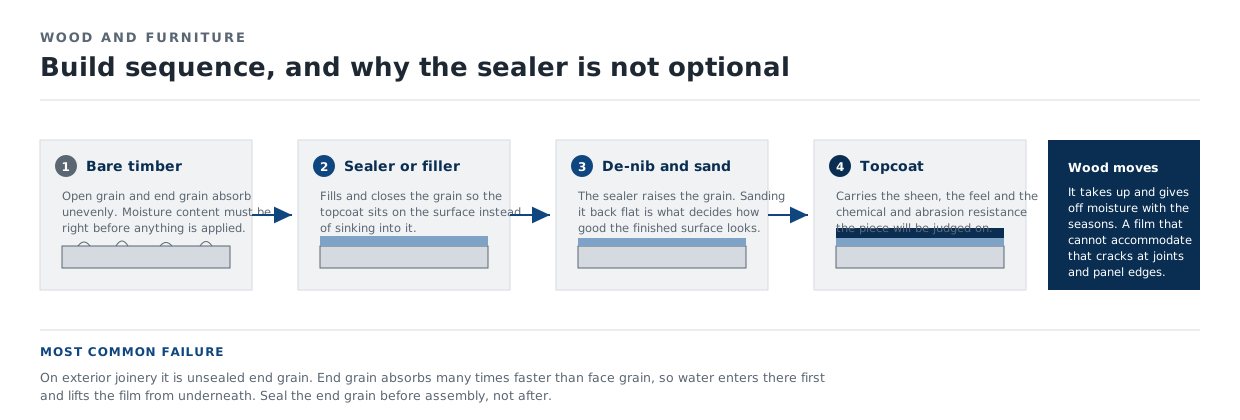
Sealer, sand, topcoat. Skipping the sealer on open-grain species is the usual cause of a poor finish.
The Arcwood range
12 products in 6 families. Each is specified against the substrate, the process and the service conditions of the job rather than supplied from a fixed catalogue.
Arcwood SL sanding sealers and grain fillers
Substrate preparation. These products close the grain, lock down raised fibre on MDF and veneer, and build a sandable, non-absorbent base so the topcoat lays uniformly and does not sink into open pores.
Arcwood SL 120 Nitrocellulose Sanding Sealer
A fast-drying single-pack nitrocellulose sealer that dries to a dry, powdery sand within about thirty to forty-five minutes at shop temperature. It is used on closed and medium-pore species, on veneer and on MDF faces and edges to lock down raised fibre before the topcoat. It is the light-build member of the SL family, chosen where the priority is a quick sand-and-recoat cycle. Because a nitrocellulose sealer stays the softest and most solvent-sensitive layer in the build, it is specified under nitrocellulose topcoats and under polyurethane only on interior dry work.
Substrates Solid timber of closed and medium pore, sliced and rotary veneer, MDF faces and machined edges, particle board with a fine surface.
Process Spray or wipe 1 to 2 coats at 15 to 25 microns dry per coat. Air dry 30 to 45 minutes at 30 degrees C, then sand with 320 to 400 grit. Recoat with Arcwood NC topcoats, or with Arcwood PU topcoats on interior dry work. Where the finished surface will meet water, alcohol or cleaning agents, seal with Arcwood SL 260 instead, because a nitrocellulose sealer limits the resistance of the system above it.
Arcwood SL 260 Two-Component Grain Filler and High-Build Sealer
An isocyanate-cured polyurethane sealer with high solids and high film build, formulated to fill the open vessels of teak, oak, ash and similar species in one or two coats. Because it cures chemically rather than by solvent release, it shrinks far less as it hardens and does not sink back into the pore as the panel ages, which is the usual cause of a patchy sheen appearing weeks after despatch. It is the high-build member of the SL family and the correct base under Arcwood PU topcoats on open-pore work.
Substrates Open-pore solid timber and veneer, teak, oak, ash and mahogany, MDF edges requiring a filled profile, particle board carcass faces.
Process Mix with the supplied hardener, spray 1 to 2 coats at 40 to 60 microns dry per coat. Allow 4 to 6 hours before sanding with 320 to 400 grit. Overcoat within the recoat window stated on the technical data sheet.
Arcwood NC nitrocellulose and acid-catalysed amino resin lacquers
Traditional solvent-release and condensation-cured finishes. Nitrocellulose for fast drying, feel and on-site repairability, acid-catalysed amino resin for hardness and chemical resistance where the cure schedule and ventilation can be controlled.
Arcwood NC 140 Nitrocellulose Clear Lacquer
A single-pack nitrocellulose lacquer that dries by solvent release, supplied from matt through satin to gloss. It builds quickly, has the soft hand feel associated with traditional furniture work, and can be repaired or fully reversed on site because fresh coats re-dissolve into the existing film. It is the repairable option in the NC family and is specified for indoor furniture that does not meet standing water, alcohol or aggressive cleaning agents.
Substrates Sealed solid timber, veneered panel, MDF and particle board previously coated with Arcwood SL 120.
Process Conventional, HVLP or airless-assisted spray, 2 to 3 coats at 20 to 30 microns dry per coat. Touch dry 20 to 30 minutes, handleable in 2 to 4 hours, stackable after 24 hours at 30 degrees C. Do not spray at high humidity, because moisture condensing into the drying film causes blushing.
Arcwood NC 360 Acid-Catalysed Lacquer
A two-pack amino resin lacquer cured by an acid hardener, giving markedly higher hardness, block resistance and chemical resistance than nitrocellulose at a comparable film build. Despite the NC family code it contains no appreciable nitrocellulose film former and is not reversible with solvent. The condensation cure releases a small quantity of free formaldehyde while the film dries, so booth and drying area ventilation, the stated hardener addition and a full cure before stacking or wrapping are all part of the specification, not optional.
Substrates Sealed solid timber and veneer, MDF and particle board, kitchen and wardrobe components, interior doors.
Process Add acid hardener at the stated ratio, spray 2 to 3 coats at 25 to 35 microns dry per coat. Pot life 6 to 8 hours at 30 degrees C. Ventilated cure, do not stack before 24 to 48 hours, full chemical resistance develops over 7 days.
Arcwood PU two-component polyurethane topcoats
Isocyanate-cured clear and pigmented topcoats for surfaces that meet water, cleaning agents and abrasion in normal service, including kitchen, bath, table tops and flooring.
Arcwood PU 220 Two-Component Polyurethane Clear Topcoat
An isocyanate-cured clear topcoat for general furniture and joinery, available from matt to high gloss and formulated for clarity over stained and figured timber. It carries the water and cleaning resistance that nitrocellulose lacks while remaining straightforward to spray in a conventional booth. It is the general-purpose member of the PU family, below Arcwood PU 440 in film build and pigmented performance.
Substrates Sealed solid timber and veneer, MDF, particle board, table tops, wardrobe and bedroom furniture.
Process Mix with polyisocyanate hardener at the stated ratio. Spray 2 coats at 30 to 40 microns dry per coat, pot life 3 to 6 hours at 30 degrees C. Dust free in 30 to 60 minutes, stack after 24 hours, full cure 7 days.
Arcwood PU 440 High-Build Pigmented Two-Component Polyurethane
A high-solids pigmented polyurethane topcoat that builds 40 to 60 microns per coat, aimed at kitchen and bath fronts, flooring and heavy-use horizontal surfaces. An aliphatic isocyanate version is supplied for whites and pale colours, where the aromatic grades used elsewhere in the range will yellow under light. It is the top of the PU family on film build, abrasion and colour stability.
Substrates MDF and particle board fronts and gables, primed solid timber, engineered flooring, commercial worktops and reception joinery.
Process Mix with the specified hardener, thin to spray viscosity and apply 2 coats at 40 to 60 microns dry per coat over a filled and sanded base. Pot life 3 to 4 hours at 30 degrees C. Spray vertical faces in two passes to avoid sagging at this build. Stack after 24 to 48 hours, full cure 7 days.
Arcwood WB water-based lacquers and stains
Low-solvent stains, basecoats and hardener-cured lacquers for plants working to emission or in-plant exposure limits, and for pale finishes where solvent-borne systems yellow.
Arcwood WB 130 Water-Based Stain and Basecoat
A water-borne pigment and dye stain for spray, wipe or dip application, formulated with grain-raising control so the surface can be de-nibbed with a single light sand rather than a full re-cut. It gives the even colour lay-down needed on veneered panel where a solvent stain would flash off unevenly across a large face. It is the colouring member of the WB family and is overcoated by water-based, UV or two-component polyurethane systems.
Substrates Solid timber, sliced veneer, MDF faces and edges, board components requiring uniform colour before sealing.
Process Spray, wipe or dip. Sprayed application is 60 to 100 g/m2 wet, leaving roughly 5 to 10 microns dry. Flash off 15 to 20 minutes, force dry at 30 to 40 degrees C where available, de-nib with 320 grit and seal within 24 hours.
Arcwood WB 320 Water-Based Two-Component Polyurethane Lacquer
A water-borne polyurethane lacquer cured with a water-dispersible polyisocyanate, reaching hardness, block resistance and chemical resistance close to the solvent-borne two-component grades while cutting solvent content in the booth substantially. It stays water-white over pale timber and painted bases, which makes it the usual choice on white and light grey furniture. It is the performance member of the WB family, above Arcwood WB 130 in the build sequence and used as the topcoat over it.
Substrates Sealed solid timber and veneer, MDF and particle board, institutional and contract furniture, interior joinery, white and pale painted bases.
Process Mix with the water-dispersible hardener, spray 2 coats at 30 to 40 microns dry per coat. Pot life 2 to 4 hours. Hold relative humidity below about 70 per cent so the film coalesces, and use forced air at 30 to 40 degrees C where the line allows. Stack after 24 hours.
Arcwood UV UV-curable flatline coatings for board
High-solids roller and curtain coatings for flat panel lines. Applied, gelled and cured in line, they give high hardness and abrasion resistance at board-line throughput.
Arcwood UV 150 UV Roller Sealer and Filler
A solvent-free, high-solids roller coating for flatline board production, applied and cured in line to fill the porosity of MDF and particle board before topcoating. It is formulated to stay sandable after cure so the belt can cut it back to a flat, closed surface without loading. It is the base member of the UV family and carries most of the film build that the UV topcoat sits on.
Substrates MDF, high-density fibreboard, particle board, plywood and veneered panel on a flatline roller coater.
Process Roller applied at 8 to 20 g/m2 per pass, typically 2 to 4 passes with intermediate gelling. Cure under mercury or UV LED lamps at the dose stated on the technical data sheet, then sand with 320 to 400 grit on a wide-belt sander before topcoating.
Arcwood UV 380 UV Topcoat for Board and Flooring
A roller or curtain applied UV topcoat that cures to high surface hardness and abrasion resistance in line, supplied from deep matt to gloss. It is the finish layer on engineered flooring, wardrobe shutters and flat panel furniture where throughput and scratch resistance govern the choice rather than field repairability. It is the top of the UV family and is applied only over a cured and sanded Arcwood UV 150 base.
Substrates Sanded UV sealer on MDF, particle board, plywood, veneered panel and engineered flooring blanks.
Process Roller applied at 8 to 15 g/m2, or curtain applied at 20 to 40 g/m2, cured under mercury or UV LED lamps at the stated dose and line speed. Panels are stackable directly off the line. Matt grades require lamp output and line speed to be held within the stated window to hold the sheen.
Arcwood EX exterior and joinery systems
Microporous basecoats and flexible topcoats for windows, doors and external joinery, formulated to release vapour, resist liquid water and keep elasticity through seasonal dimensional change.
Arcwood EX 210 Microporous Exterior Basecoat
A penetrating, vapour-permeable basecoat for external joinery, supplied translucent and opaque, designed to wet into the timber rather than sit on it. It is applied by dipping or flow coating so that end grain, rebates and tenon shoulders take up coating before assembly, which is where exterior systems normally fail. It is the penetrating member of the EX family and is always overcoated by Arcwood EX 460.
Substrates Exterior solid timber joinery, window frames and sashes, external doors, cladding and garden furniture, at the moisture content stated in the specification table.
Process Dip, flow coat or brush 1 to 2 coats at 20 to 30 microns dry. Seal all end grain and machined cut-outs before assembly. Dry 4 to 6 hours, de-nib with 240 to 320 grit, overcoat within the stated recoat window.
Arcwood EX 460 High-Build Flexible Exterior Topcoat
A high-build exterior topcoat containing ultraviolet absorbers and hindered amine light stabilisers, formulated to stay elastic so that it follows seasonal swelling and shrinkage instead of cracking at the joints. It keeps a controlled vapour transmission rate, so moisture that enters the timber can leave again rather than lifting the film. It is the top of the EX family on film build, weathering and elasticity, and is specified over Arcwood EX 210 rather than direct to bare timber.
Substrates Basecoated exterior joinery, windows, doors, screens and cladding, translucent over show timber or opaque over primed joinery.
Process Spray, brush or flow coat 2 coats at 40 to 60 microns dry per coat, giving a complete system of 100 to 150 microns dry with the basecoat. Recoat after 6 to 8 hours at 30 degrees C. Do not apply below 10 degrees C, above 80 per cent relative humidity, or when the timber surface is less than 3 degrees C above the dew point.
Typical operating window
The figures below are the typical operating window for this range, not a measured result for any one batch. Confirmed values are issued with the Technical Data Sheet and Certificate of Analysis by our laboratory.
| Property | Typical operating window | Method |
|---|---|---|
| Non-volatile content by mass | 20 to 30 per cent nitrocellulose, 30 to 45 per cent acid-catalysed, 45 to 60 per cent two-component polyurethane, 30 to 40 per cent water-based, 95 to 100 per cent UV | ISO 3251 |
| Supply viscosity | 14 to 25 s on a 4 mm flow cup at 30 degrees C for spray grades. Roller and curtain UV grades are quoted as rotational viscosity, 400 to 1200 mPa.s | ISO 2431 flow cup, ISO 2884-2 rotational |
| Density at 30 degrees C | 0.90 to 1.10 g/cm3 clear solvent-borne, 1.10 to 1.30 g/cm3 pigmented solvent-borne, 1.00 to 1.25 g/cm3 water-borne and UV | ISO 2811-1 |
| Pot life of two-component grades at 30 degrees C | 2 to 4 h water-borne, 3 to 6 h solvent-borne polyurethane, 6 to 8 h acid-catalysed | ISO 9514 |
| Dry film thickness, complete system | 60 to 120 microns interior furniture, 100 to 150 microns high-build pigmented and flooring systems, 100 to 150 microns exterior joinery | ISO 2808 |
| Specular gloss at 60 degrees | 5 to 15 matt, 25 to 40 satin, 60 to 75 semi-gloss, 85 to 95 high gloss | ISO 2813 |
| Konig pendulum damping hardness at 7 days | 40 to 80 s nitrocellulose and water-based, 70 to 110 s two-component polyurethane and acid-catalysed, 120 to 160 s UV | ISO 1522 |
| Pencil hardness | HB to H nitrocellulose, H to 2H two-component polyurethane and acid-catalysed, 2H to 4H UV | ASTM D3363 |
| Cross-cut adhesion | Classification 0 to 1 on correctly prepared and sealed substrate | ISO 2409 |
| Resistance to cold liquids, water, 48 per cent ethanol, coffee, vegetable oil | Rating 4 to 5 for two-component polyurethane, acid-catalysed and UV topcoats. Nitrocellulose is typically rated lower against alcohol and is not specified for these surfaces | EN 12720 |
| Resistance to dry heat at 70 degrees C | Rating 4 to 5 for two-component polyurethane and UV topcoats | EN 12722, or ISO 4211-3 |
| Taber abrasion, CS-17 wheels, 1 kg load, 500 cycles | 20 to 60 mg mass loss for flooring and board topcoats | ASTM D4060 |
| Water vapour transmission rate, exterior systems | 15 to 150 g/m2 per day, medium permeability class, for microporous joinery systems | EN ISO 7783 |
| Timber moisture content at time of application | 8 to 12 per cent interior furniture, 12 to 15 per cent exterior joinery | EN 13183-2, electrical resistance method |
Application
The build sequence governs the result far more than the choice of topcoat. The sequence is sand the substrate, stain if colour is required, seal, sand the sealer, then topcoat, and each step exists to fix a problem the next step cannot fix. Raw timber and veneer are cut to 180 to 240 grit, working with the grain, and dusted off with clean compressed air or a tack cloth. MDF edges are cut finer and sealed more heavily than faces because a machined edge absorbs several times what a face absorbs. Particle board carcass faces need the sealer film to bridge a coarse surface rather than to penetrate it.
Sealing the grain is the step that is most often cut short. On open-pore species the vessels are effectively open tubes, and topcoat applied over an unsealed or under-sealed pore is drawn down into the timber over the following days and weeks. The panel leaves the factory looking correct and arrives at site with a sunken, uneven sheen and visible pinholing along the pore lines. The fix is film build in the sealer, not in the topcoat: use Arcwood SL 260 at 40 to 60 microns dry per coat on teak, oak and ash, allow the full sanding time, and cut it back flat with 320 to 400 grit before the topcoat goes on. Sanding the sealer is not cosmetic. It removes the fibre the sealer has stood up and raised, gives the topcoat a mechanical key, and levels the pore fill. Match the sealer to the topcoat as well as to the substrate, because a nitrocellulose sealer under a polyurethane topcoat becomes the weak layer and caps the water and chemical resistance of the finished build.
Chemistry follows the service condition rather than the appearance. Nitrocellulose is applied where the piece will be repaired in the field, because fresh lacquer re-dissolves the existing film and a damaged panel can be blended in place. It is also the system most sensitive to humidity at the gun: moisture condensing into a fast-evaporating film produces blushing, so avoid spraying nitrocellulose in wet conditions without a retarder. Acid-catalysed lacquer is applied where hardness and chemical resistance are wanted from a sprayable single-line process, with the understanding that the condensation cure releases free formaldehyde while the film dries: ventilate the booth and the drying area, hold the hardener addition exactly, and do not stack or wrap panels before the stated cure time. Two-component polyurethane is applied where the surface meets water, cleaning agents and abrasion in ordinary use, and pot life is a real constraint on the line, so mix to the batch the shift will actually use. Water-based systems are applied where plant emission or in-plant exposure governs. Their limit is water release rather than solvent release: above roughly 70 per cent relative humidity the film dries slowly and coalesces poorly, which shows as a soft, milky or print-marking surface, so forced air at 30 to 40 degrees C earns its place.
UV flatline coating is a line process, not a booth process. Panels run through a roller coater, the film is gelled and cured under mercury or UV LED lamps, and the panel is stackable at the end of the line. Film weight is set by roller gap and speed, not by operator technique, so the controls that matter are coat weight in grams per square metre, line speed, lamp output and lamp age. A lamp that has dropped output will under-cure the film, which shows as a soft, marking surface that passes a visual check and fails in service. Matt UV topcoats are the most sensitive: sheen depends on the cure profile, so holding lamp output and line speed inside the stated window is what holds the gloss reading.
Exterior joinery has three controls that decide whether the system lasts. First, moisture content at application, 12 to 15 per cent for external joinery measured to EN 13183-2, because coating over wet timber traps that water behind the film and the film lifts. Second, microporous behaviour, meaning the system resists liquid water from outside while allowing vapour out, which is why film build is specified as a window and not as a maximum: too thin and water gets in, too heavy and the timber cannot dry. Third, and the usual point of failure, end grain. End grain wicks water along the vessels at many times the rate of a face, so tenon ends, sill undersides, drainage cut-outs, glazing rebates and every site-made cut have to be sealed deliberately with Arcwood EX 210 before assembly or immediately after cutting. Dipping or flow coating before assembly is the reliable way to achieve this, because a spray gun cannot reach into a joint that is already closed.
Across all systems, condition the shop as well as the coating. Work between 15 and 35 degrees C, keep relative humidity below about 70 per cent for water-based and two-component grades, keep the substrate at least 3 degrees C above the dew point on exterior work, filter the material at the stated mesh before spraying, and allow the full stacking time before panels are wrapped or bundled. A film that is handleable is not a film that is cured, and most block, print and edge-crush complaints come from panels stacked before the cure was complete.
Specifying this range
Wood coatings cannot be specified from a performance target alone, because the substrate, the plant and the service condition all constrain the answer. Arctic asks for the following before recommending a system.
- What is the substrate, exactly? Solid timber, sliced veneer, MDF, high-density fibreboard, particle board or plywood, and whether a single assembly mixes several of them. Name the species if it is solid or veneer, because open-pore and closed-pore species take different sealer builds.
- Interior or exterior, and what is the exposure? Interior dry, interior wet as in kitchen and bath, flooring, or external joinery. For exterior, state the orientation and whether the joinery is under an overhang or fully exposed.
- What is the timber moisture content at the point of coating, and how is it measured? Give the figure and the method. This decides whether the exterior system will hold and whether interior panels will move after despatch.
- How is the coating applied? Conventional, HVLP or airless-assisted spray, flatline roller or curtain coater, dipping, flow coating or brush. For a flatline, state the line speed, coat weight and whether the lamps are mercury or UV LED.
- What cure and handling time does the line allow? Time to sand, time to recoat, time to stack and time to pack. A plant that must stack within four hours cannot use a system that needs twenty-four.
- What are the booth conditions? Temperature and relative humidity range across the year, whether forced drying or an oven is available, and what ventilation the drying area has. This is decisive for water-based and acid-catalysed grades.
- Does the finish have to be repairable on site? Field repair pushes the specification towards nitrocellulose. Crosslinked systems are harder and more resistant but are repaired by recoating a whole face, not by blending.
- What is the required appearance? Gloss level at 60 degrees, clear or pigmented, translucent or opaque, and whether the colour is white or pale, which rules out aromatic isocyanate grades on yellowing grounds.
- Which resistance properties are contractual? Name the properties and the test methods that will be used to accept the work, for example cold liquids to EN 12720, dry heat to EN 12722 or abrasion to ASTM D4060, and state the rating required.
- Are there emission or in-plant exposure limits to work to? State the limit and whether it applies to the coating as supplied, to the plant emission or to the finished article. This determines whether the system is solvent-borne, water-borne or UV.
- What documentation is needed? Technical data sheets, safety data sheets, batch certificates of analysis and a compliance dossier are issued on request against a defined scope.
With those answers, Arctic will specify the sealer, the intermediate and the topcoat as a system, with film builds, sanding grits and cure times, and will trial the build on the customer’s own substrate and line conditions at our technical centre and laboratory in Greater Noida before the specification is fixed.
Documents and specification
The Technical Data Sheet, Safety Data Sheet and regulatory declaration for any grade in this range are issued by our laboratory against the substrate and process you are running. Tell us the job and we will specify against it.