
Decorative and Special Effect Coatings
Arcvista is the Arctic range of decorative and special effect coatings, built to create the visual effect on the press rather than in a separate decoration pass. The range covers drip-off matt and gloss contrast, UV metallics, pearlescent and interference finishes, structure and relief, patterned optical effects, glitter and photoluminescent decoration.
Overview
Arcvista coatings are specified for what they make the pack look like. Each grade is formulated to produce a defined optical or tactile result on a printed substrate, applied from an existing coater, flexo unit or screen station, so that the decoration is produced inside the print run instead of in a separate converting step. That is the boundary that defines the range: Arctouch and Arclear are functional finishes, soft-touch feel and protective gloss or matt, while Arcvista exists to create a visual effect that stands in for a separate decoration step such as foil, metallised board or an embossing die.
The drip-off system shows how an effect of this kind is generated. A matt oil-based effect primer is printed from an offset unit in the exact pattern that is to read matt, and a gloss UV overprint varnish is then flooded over the whole sheet from the coater, wet on wet. The two are not chemically reactive with one another. The primer forms a low surface energy film that the higher surface tension varnish cannot wet, so the varnish retracts from the primed areas while it is still open. It does not leave the primer bare: it pulls back into a thin, uneven film that scatters light and reads matt, against the fully levelled gloss everywhere else. Because the pattern is carried by the plate that lays the primer, the contrast needs no register step of its own, and the two products are formulated, supplied and bought as a matched pair. A primer from one supplier and a varnish from another will not hold the contrast reliably.
The other effects follow the same principle, that the mechanism sits in the application as much as in the pigment list. Structure coatings are cured in two stages: a short wave source skins the surface first, then the full cure shrinks the bulk beneath it and the skin wrinkles into a controlled texture, so lamp type, cure sequence and line speed set the texture as firmly as the applied weight does. Pearlescent and interference coatings use platelet pigments that must orient parallel to the substrate surface to develop lustre, so application method and wet film thickness govern the result more strongly than pigment loading does. The patterned optical effect grade lays a matt and gloss contrast down in a fine regular pattern, so the printed area appears to shift as it is tilted, and it is specified as decoration, not as an authentication feature.
Two commercial points are stated plainly. A printed metallic does not reach the specular brilliance of hot foil, cold foil or metallised board, and what it does return depends heavily on substrate smoothness, so a result achieved on cast-coated board will not repeat on a rough recycled liner. The case for a printed effect against foil has to be calculated per job, taking coverage, the number of passes, press speed and waste into account, because the answer changes with the design. Arctic supplies the coating and the application window, and a press trial on the customer press and the production substrate is required before any effect is committed to a production specification.
How drip-off works
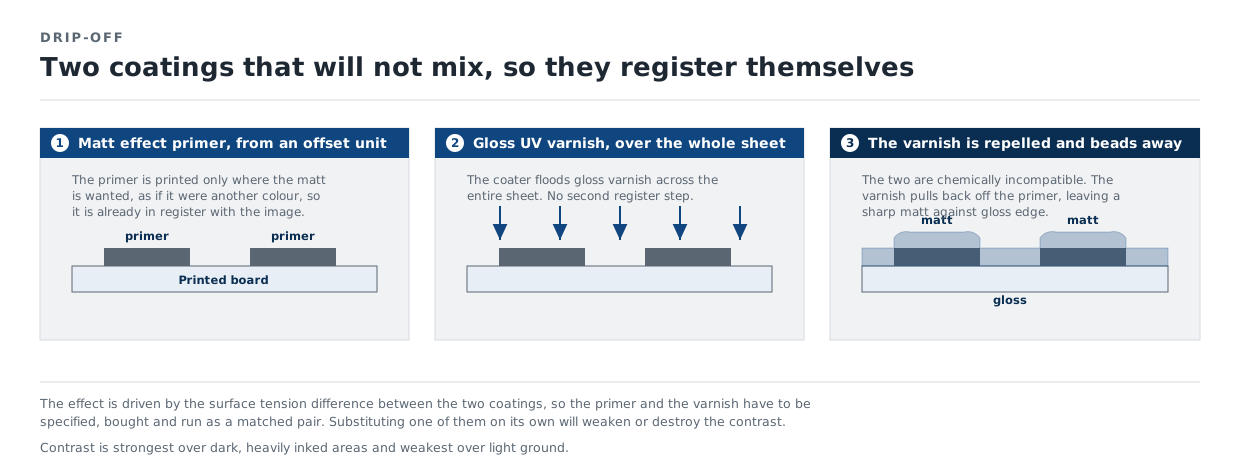
The gloss varnish is repelled by the matt primer, so the two self-register with no separate step.
The Arcvista range
12 products in 7 families. Each is specified against the substrate, the process and the service conditions of the job rather than supplied from a fixed catalogue.
Drip-off systems
Matched pairs of matt effect primer and gloss overprint varnish that produce a self-defining matt against gloss contrast through a surface energy difference, with no register step of their own.
Arcvista DO 110 Matt Drip-Off Effect Primer
An oil-based matt effect primer printed from a conventional offset inking unit in the pattern that is to read matt. It forms a low surface energy film, well below that of the partnering overprint varnish, so the varnish retracts from the printed areas and the matt pattern defines itself. It sets by absorption and oxidation, so it is specified on absorbent coated stock, and it is supplied only as the matched pair with Arcvista DO 120 and must not be combined with a gloss varnish from another system.
Substrates Coated folding boxboard, cast-coated board and coated litho papers; gloss laminated and other non-absorbent surfaces on trial only
Process Offset printing unit, sheetfed, as a conventional or hybrid ink film from the last available station ahead of the coater
Arcvista DO 120 Gloss Drip-Off Overprint Varnish
A UV gloss overprint varnish flooded over the whole sheet from the coater, wet on wet over the Arcvista DO 110 primer. It retracts over the primed areas into a thin uneven film that scatters light and reads matt, and levels to full gloss everywhere else, so the contrast between the two fields is the product. Higher film weight raises gloss in the open areas and sharpens the edge of the matt pattern, and the pair is formulated, batched and specified together.
Substrates Coated folding boxboard, cast-coated board and coated litho papers; gloss laminated and other non-absorbent surfaces on trial only
Process Chambered doctor blade coater or coating unit, flood applied, UV cured
UV metallic coatings
Printed silver and gold metallic effects applied from the coater or a flexo unit, offered where an in-line metallic field is wanted and the design and run length support it, without matching the specular brilliance of foil.
Arcvista MS 210 UV Metallic Silver Coating
A UV curing silver metallic coating carrying leafing aluminium pigment, specified where a metallic field is wanted in line rather than by foil. The pigment has to float and orient at the coating surface to give mirror character, so anilox volume, press speed and cure are set to protect that orientation. It does not reach the specular brilliance of hot foil, cold foil or metallised board, and the result it does give is limited by the substrate, with a smooth cast-coated or gloss laminated surface returning a markedly brighter field than an uncoated or recycled stock.
Substrates Cast-coated board, high-gloss coated board, coated papers, pre-coated recycled liners and gloss laminated film
Process Coater or flexo unit with a low line count, high volume anilox, UV cured, sheetfed or narrow web
Arcvista MS 220 UV Metallic Gold Coating
A UV curing gold metallic coating built on the same leafing pigment platform as Arcvista MS 210, transparent tinted to a gold shade and applied at a slightly higher film weight to carry the colour without dulling the metal. Shade is assessed on the production substrate, because the board white and any underlying print both read through the metal. Like all leafing metallics it presents a low energy surface, so anything printed, glued, laminated or foiled on top of it is trialled before the sequence is fixed.
Substrates Cast-coated board, high-gloss coated board, coated papers and gloss laminated film
Process Coater or flexo unit with a low line count, high volume anilox, UV cured, sheetfed or narrow web
Pearlescent and interference coatings
Platelet pigment coatings that develop lustre and colour travel when the pigment orients parallel to the surface, for soft pearl and shifting interference finishes.
Arcvista PL 310 Pearlescent Satin Coating
A pearlescent coating carrying fine mica based platelet pigment that develops a soft satin lustre over print and over plain board. Lustre depends on the platelets lying flat and parallel to the surface, so an even wet film and controlled levelling matter more than raising the pigment load. It is the quieter of the two pearl grades and is used where the effect should read as a sheen rather than as a colour change.
Substrates Coated folding boxboard, coated papers, labelstock and coated laminated liners
Process Coater or flexo unit with a medium to high volume anilox, UV cured
Arcvista PL 320 Interference Effect Coating
An interference coating using coated platelet pigment that reflects one colour and transmits its complement, so the field appears to travel in colour as the pack is turned. The effect is strongest over a dark or solid printed ground, which absorbs the transmitted light, and weakest over white board, which scatters it back. Film thickness sets the strength of the travel, so the applied weight is fixed as part of the effect specification rather than left to the coater setting.
Substrates Coated folding boxboard, coated papers, labelstock, and printed solids on board or film
Process Coater or flexo unit with a high volume anilox, UV cured; screen application where a heavier film is wanted
Structure and relief coatings
High film build coatings cured to hold a raised texture, from fine wrinkle structure through to heavy screen-applied relief that adds height on the surface of the sheet.
Arcvista RF 410 Fine Structure Coating
A UV structure coating cured in two stages, so that a short wave source skins the surface before the full cure shrinks the bulk beneath it and the film wrinkles into a fine, even texture. Because the texture is produced by the cure sequence and not by a filler, lamp type, power, distance and line speed are recorded as part of the specification alongside the applied weight. It is applied from a high volume anilox and suits all over textured fields and large background panels.
Substrates Coated folding boxboard, coated papers, laminated board and coated liners
Process Flexo or coating unit with a high volume anilox, two-stage UV cure, short wave surface cure followed by full cure
Arcvista RF 420 Heavy Relief Coating
A high film build relief coating applied by screen to create a raised, clearly tactile pattern that holds its edge after cure. It carries the heaviest applied weight in the range and is used where a design would otherwise need an embossing die, with the qualification that it adds height on the surface and does not deform the board, so it cannot reproduce a deboss or a structure that runs through the caliper. Relief height is governed by mesh, deposit and cure, and is agreed as a target on the production substrate before the job is specified.
Substrates Coated folding boxboard, cast-coated board, laminated board and rigid coated sheet
Process Screen printing unit, flat bed or rotary, UV cured with a cure set for depth at full film build
Patterned matt and gloss optical effect coatings
A fine regular matt and gloss pattern that appears to move as the pack is tilted, produced within the print run rather than by a separate decoration process, and specified as decoration only.
Arcvista MO 510 Patterned Optical Effect Coating
A coating system that lays a matt and gloss contrast down in a fine regular pattern, so that the printed area appears to shift and move as the pack is tilted under a light source. The result depends on the pattern being carried accurately at the cell or screen level and on a clean contrast between the matt and gloss fields, so plate or screen specification is set together with the coating and the pattern pitch and orientation are confirmed by trial. It is specified as a decorative effect, and Arctic makes no authentication or security performance claim for it.
Substrates Coated folding boxboard, cast-coated board, coated papers and laminated board
Process Flexo, screen or coating unit with a patterned image carrier, UV cured
Glitter and coarse-particle effects
Coatings carrying visible reflective particles, from fine sparkle applied through a high volume anilox to heavy coarse-particle effects applied by screen.
Arcvista GT 610 Fine Glitter Coating
A UV coating carrying fine reflective particles that give a discrete sparkle across a printed or plain field, applied from a low line count, high volume anilox on a standard coating unit. Particle size is held well below the cell opening so the coating passes through the anilox and the chamber without settling or blocking cells, which is what separates it from the coarse grade. As with the metallics, the sparkle reads far more strongly on a smooth substrate than on a rough recycled surface.
Substrates Coated folding boxboard, coated papers, labelstock and gloss laminated film
Process Coating unit or flexo with a low line count, high volume anilox and a suitable chamber, UV cured
Arcvista GT 620 Coarse Particle Glitter Coating
A screen applied coating carrying large reflective particles for a visible glitter effect at heavy film build. The particle size rules out anilox application, so it is laid down through an open mesh and cured with enough energy to anchor the particles through the full depth of the film. Rub and scuff performance follows from how well the particles are locked in, so cure and downstream handling are checked in the trial.
Substrates Coated folding boxboard, cast-coated board, laminated board and rigid coated sheet
Process Screen printing unit with an open mesh, flat bed or rotary, UV cured
Photoluminescent decorative coatings
Coatings that absorb ambient light and re-emit it as a visible glow after the light source is removed, used for graphic effect on pack and not as a safety marking.
Arcvista LU 710 Photoluminescent Decorative Coating
A photoluminescent decorative coating carrying strontium aluminate pigment that absorbs ambient light and re-emits it as a visible glow once the light source is removed, used as a graphic effect on pack. Brightness and decay rise with pigment loading and applied film weight, so it is laid down heavy, normally by screen, and over a white or light ground; the pigment itself absorbs UV and competes with the photoinitiator, so the cure is set for depth at that film build and confirmed on the job. The pigment is moisture sensitive, the coating is not a safety or escape route marking, and afterglow is measured to DIN 67510-1 against a target agreed before the job is specified.
Substrates Coated folding boxboard, coated papers, labelstock and laminated board
Process Screen printing unit at high deposit, UV cured; coater application at reduced effect where film build is limited
Typical operating window
The figures below are the typical operating window for this range, not a measured result for any one batch. Confirmed values are issued with the Technical Data Sheet and Certificate of Analysis by our laboratory.
| Property | Typical operating window | Method |
|---|---|---|
| Viscosity at 23 °C, UV coater and flexo grades | 250 to 1,200 mPa·s, the metallic and pearlescent grades sitting at the upper end | ISO 2884-1 (cone and plate) |
| Viscosity at 23 °C, screen applied RF, GT and LU grades | 3,000 to 15,000 mPa·s at low shear, thixotropic, so that the deposit holds its edge before cure | ISO 2884-1 (cone and plate) |
| Flow and tack of the oil-based drip-off effect primer | 15 to 60 Pa·s falling rod viscosity; tack 5 to 10 at 400 rpm and 30 °C, set below the tack of the ink set running ahead of it | ISO 12644 (falling rod viscometer) and ISO 12634 (rotary tackmeter) |
| Density at 20 °C | 1.00 to 1.15 g/cm³ on the clear and effect grades; up to 1.25 g/cm³ on the metallic and glitter grades; 1.4 to 1.8 g/cm³ on the photoluminescent grade, which carries a high density pigment | ISO 2811-1 |
| Non-volatile matter | 96 to 100 %, the UV grades and the oil-based effect primer both being supplied effectively solvent free | ISO 3251 |
| Surface energy of the cured effect primer film | 22 to 28 mN/m on the matt primer against 36 mN/m and above on the surrounding printed and open substrate, which is the difference the drip-off effect depends on | Test inks to ASTM D2578, a method written for polyolefin film and used here as the comparative check, with contact angle to ISO 19403-2 where a measured surface energy value is required |
| Gloss at 60° | 10 to 25 GU on the matt field and 75 to 95 GU on the gloss field of the drip-off pair, with the matt field cross-checked at 85° | ISO 2813 |
| Applied coat weight, dry | 1.5 to 4 g/m² for the drip-off varnish and the pearlescent grades from a coater; 4 to 8 g/m² for the UV metallics and fine glitter; 6 to 15 g/m² for fine structure; 20 to 60 g/m² for heavy relief, coarse glitter and photoluminescent screen application | in-house, gravimetric |
| Adhesion of the cured film on the specified substrate | No removal at tape test, 4B to 5B; classification 0 to 1 by cross-cut where the substrate is a film, a laminate or a rigid sheet, since a cross-cut on board tears fibre and does not measure the coating | ASTM D3359 (tape test) and ISO 2409 (cross-cut) |
| Rub resistance, cured film | No transfer or loss of effect after 50 cycles at 2 lb (0.9 kg) load | ASTM D5264 |
| Coefficient of friction, cured film | 0.25 to 0.55 static and dynamic on coater applied grades; relief, glitter and screen grades are assessed on the job because the surface is not continuous | ASTM D1894 |
| Afterglow luminance and decay, LU grade | Excitation for 5 minutes under the standard source, with the 10 minute and 60 minute luminance values reported against the agreed target | DIN 67510-1 |
Application
The table above is the typical operating window for the range and not a measured result for any one grade. Confirmed values are issued with the Technical Data Sheet and Certificate of Analysis by our laboratory.
Drip-off
Arcvista DO 110 is printed from an offset unit in the matt pattern, normally from the last available ink station, and Arcvista DO 120 is flooded over the whole sheet from the coater immediately afterwards, wet on wet. The pair must run together. The contrast collapses if the primer film is too thin, if the primer is over-powdered, or if the varnish film is heavy enough to bridge the primer instead of retracting over it. Ink sequence, fount chemistry and IR settings all move the surface energy balance, so the pair is trialled with the actual ink set that will run the job. The primer sets by absorption and oxidation, so a non-absorbent laminated or pre-coated surface is treated as a separate trial. Matt and gloss edges are judged on the sheet at press speed, not on a hand proof.
Metallics, pearlescents and glitter
Leafing and platelet pigments need to reach the surface and lie flat, which means enough wet film, a smooth substrate and a cure that does not disturb the film before the pigment has settled. Anilox volume is chosen for the grade, chambers and screens are checked for settling at stoppages, and the coating is stirred back to uniformity before and during the run. Glitter above fine particle size cannot pass an anilox and is screen applied. Brilliance is substrate driven and a printed metallic does not match foil or metallised board, so a result on cast-coated board will not repeat on a rough recycled liner and each substrate is treated as a separate trial.
Structure, relief and patterned optical effect
Fine structure is produced by curing the surface before the bulk, so that the film wrinkles as the full cure shrinks it. Lamp type, cure sequence, power, distance and line speed are recorded as part of the effect specification, because a change in cure changes the texture even when the applied weight is unchanged. Heavy relief is screen applied and needs a cure with enough depth of penetration to harden the full film, not only the surface. For the patterned optical effect grade, the accuracy of the image carrier governs the result, so plate, screen and pattern pitch are specified together with the coating.
Downstream and handling
Effect coatings change how a sheet behaves after the press. Check slip and stacking on relief and glitter work, check folding and creasing on heavy films, and confirm that glue lines are either kept free of coating or are compatible with the adhesive in use. The matt, structure and leafing metallic grades cure to a low energy surface, so where the pack is foil blocked, hot stamped, laminated or overprinted later, the full sequence is tested rather than assumed. A press trial on the customer press and the production substrate is required before any effect is committed to a production specification.
Specifying this range
Arctic specifies an Arcvista grade against the job, not against the effect name alone. The following is what we need to know.
- What is the effect meant to replace, if anything: cold foil, hot foil, metallised board, an embossing die, or a separate decoration pass?
- What is the exact substrate, including coating type, board grade, absorbency, recycled content and any lamination or pre-coat? Name the production stock, not the proofing stock.
- Which units are available and in what order: how many ink stations, how many coaters, is there an in-line screen unit, and what anilox line counts and volumes are on hand?
- What is the cure on the line: UV lamp type, installed power, number of lamps, and whether an interdeck, short wave or two-stage cure is available?
- For drip-off, what ink set, fount solution and powder settings will run the job, and is the matt pattern a small highlight or a large field?
- What relief height, particle size or lustre level is the target, and is there a physical sample or an agreed reference to work to?
- What happens to the sheet afterwards: die cutting, creasing, folding, gluing, foil blocking, lamination or overprinting, and where do the glue lines fall?
- What are the run length, press speed and coverage, so the commercial case against foil or metallised board can be calculated for this job?
- What is the end use of the pack, and which regulations must the finished pack satisfy? A compliance dossier or declaration is issued on request with the Technical Data Sheet.
- What test methods and acceptance limits will be used at incoming inspection, so the Certificate of Analysis is issued against the right properties?
Documents and specification
The Technical Data Sheet, Safety Data Sheet and regulatory declaration for any grade in this range are issued by our laboratory against the substrate and process you are running. Tell us the job and we will specify against it.