
Coil and Extrusion Coatings
On a coil line the paint is cured before the metal is formed, so the film has to take every bend the roll former and the press brake put into it, and it has to reach full cure in seconds. On an extrusion the profile comes first, and the coating has to match the sheet it will stand beside.
Overview
Coil coating is a continuous process, and the line is built so that the process section never stops. Metallic coated steel, either galvanised or zinc-aluminium alloy coated, or aluminium strip, is uncoiled and stitched to the tail of the coil ahead of it, with an entry accumulator feeding the line while the join is made. The strip is cleaned, rinsed, chemically pretreated and dried, then roll coated. Most lines coat in two stages: the prime coater applies primer to both faces, the strip runs through the first oven and is quenched, then the finish coater applies the topcoat to the front face and the backing coat to the reverse, and the strip runs through the second oven. Cure is set by peak metal temperature, not by oven air temperature, and the strip is in each oven for seconds rather than minutes. Line speed, oven length and oven temperature together fix that window, so the coating has to reach full cure inside it, and it has to hold its viscosity, its wetting and its colour across a run that may last hours. After the final oven the strip is quenched, dried and recoiled. Cutting to length, profiling and roll forming happen afterwards, normally on separate lines.
Order of operations is what separates this range from Powder Coatings and General Metal Finishing. Those ranges coat a finished part: the component is fabricated first, then cleaned, coated and cured, and the film is never asked to bend afterwards. Coil reverses that sequence. Paint is cured on flat strip, and every bend, roll form, profile, lock seam and punched edge that follows happens in a film that is already hard. Route a fabricated component to powder or to general metal finishing, and route flat strip that will be formed after painting to this range. Flexibility here is measured rather than assumed. T-bend to ASTM D4145 and EN 13523-7 records the tightest bend the film will take without cracking, and a tape pull across the bend shows whether adhesion survives the deformation. Reverse impact to ASTM D2794 and EN 13523-5, pencil hardness to ASTM D3363, solvent rub resistance to ASTM D5402, cross-cut adhesion to ISO 2409 and specular gloss to ISO 2813 fix the remaining film and mechanical properties. Durability is taken separately, by neutral salt spray to ASTM B117, humidity to ISO 6270-2, accelerated ultraviolet to ASTM G154 and natural weathering to ISO 2810. Accelerated exposure ranks systems against each other, it does not convert into years in service, so a long-life claim has to rest on outdoor data rather than on cabinet hours.
Chemistry is chosen against service life, forming severity and the climate the sheet will sit in. Polyester covers general building sheet, shutters and appliance stock. Silicone-modified polyester raises gloss and colour retention on exposed roofing and hardens the film against the abrasion it picks up in transit and on site, and the same hardness makes it less forgiving to form, so its bend limits are tighter. Polyvinylidene fluoride, normally a 70:30 blend of PVDF and acrylic, holds colour and resists chalking on architectural cladding over long exposure, and it is the chemistry architectural specifications are usually written around. Plastisol gives a thick, embossed film with the impact and abrasion resistance that industrial roofing and deep profiles need, and of the four it is the most sensitive to heat and ultraviolet, which limits it in fully exposed service in hot locations. The reverse face carries its own coat, either for blocking resistance in the recoiled state or for adhesion to the polyurethane foam core of a sandwich panel.
These are applicator products, and the infrastructure they need is specific. A coil coating cannot be applied on site or in a general paint shop: it goes to a coil coating line with a stitcher, an accumulator, roll coaters, ovens able to hold the peak metal temperature the chemistry needs at the running line speed, and a quench. Liquid coatings for architectural aluminium extrusions need a spray line and an oven of the same order, and powder is the more common route for extrusions in this market, so a liquid system suits an applicator already set up to spray and bake. Coil-applied stock for can making sits outside this range and is covered by Metal Packaging Coatings, where the film is specified against the pack contents and the process cycle rather than against outdoor exposure. Colour continuity between coil coated sheet and spray coated profile has to be agreed on approved panels before production, because the two routes lay down different films. Where a project specification names a third-party approval scheme, that requirement sits with the specified system and the applicator and has to be settled before the order is placed. Arctic formulates and colour matches these systems at its technical centre and laboratory in Greater Noida, Uttar Pradesh, and manufactures them on a production line built for batch-to-batch consistency.
How a coil line runs
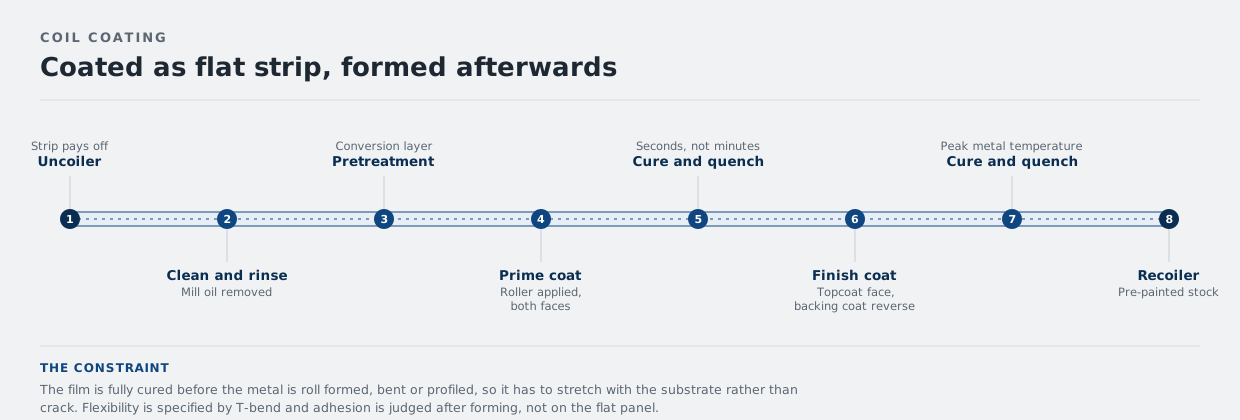
The film is cured on flat strip. Every bend that follows happens in a coating that is already hard.
The Arccoil range
10 products in 6 families. Each is specified against the substrate, the process and the service conditions of the job rather than supplied from a fixed catalogue.
Arccoil PR coil primers and backing coats
Thin-film primers applied to both faces of the cleaned and pretreated strip at the prime coater, and reverse-face backing coats that control blocking in the recoiled state and, where specified, adhesion to a polyurethane foam core. Chromate-free inhibitor packages are the default for new work. The primer sets the corrosion performance of the system and the adhesion base the topcoat forms over, so it is selected against the topcoat chemistry and the substrate together.
Arccoil PR 210 Chromate-Free Coil Primer
A chromate-free polyester primer for both faces of the strip, applied at the prime coater at five to seven microns and pigmented for adhesion and corrosion inhibition. It is the standard adhesion base under Arccoil PE and Arccoil SP topcoats on galvanised and zinc-aluminium alloy coated steel. It stays flexible after cure so that the primer does not become the limiting layer in the T-bend of the finished system.
Substrates Hot-dip galvanised steel, zinc-aluminium alloy coated steel and aluminium strip, cleaned, rinsed, chemically pretreated and dried on the line.
Process Roll coated at the prime coater to five to seven microns dry, cured in the first oven to a peak metal temperature of 210 to 232 degrees Celsius, then quenched and dried before the finish coater.
Arccoil PR 250 Epoxy-Modified Primer and Backing Coat
A chromate-free epoxy-modified primer at five to eight microns, for systems where corrosion resistance and cut edge performance rank above the widest possible forming latitude, and the matched primer under Arccoil PV topcoats. The same binder is supplied as a reverse-face backing coat, in a blocking-resistant version for recoiled stock and in a version formulated for adhesion to a polyurethane foam core in sandwich panel production. Selecting the reverse-face variant is a separate decision from the primer and has to be made when the coil is ordered.
Substrates Hot-dip galvanised steel, zinc-aluminium alloy coated steel and aluminium strip; the foam-adhesion variant is used on the reverse face of sandwich panel facings.
Process Roll coated at five to eight microns dry, front face and reverse face, cured in the first oven to a peak metal temperature of 216 to 241 degrees Celsius and quenched. Under a fluoropolymer topcoat the primer is cured to the PVDF window of 232 to 249 degrees Celsius, because it sees the peak metal temperature the topcoat needs. The backing coat is applied at the reverse-face station of the finish coater where the line is configured that way.
Arccoil PE polyester coil topcoats
The general-purpose topcoat band for building sheet, shutters, profiled decking and appliance stock. Polyester takes tighter bends than either silicone-modified grade at ordinary coil film builds, and it is specified where the project does not call for extended gloss and colour retention. Two grades separate interior and sheltered exterior work from exposed exterior work.
Arccoil PE 310 Polyester Coil Topcoat
The general-purpose polyester topcoat, applied over Arccoil PR 210 at eighteen to twenty microns and matched to the colour the specification calls for. It is formulated for forming latitude first, so it takes tighter bends than either silicone-modified grade at ordinary coil film build and suits shutters, profiled decking, partitions and appliance stock. It is specified for interior and sheltered exterior service, and for exterior work where the specification does not call for extended gloss and colour retention.
Substrates Primed galvanised steel, zinc-aluminium alloy coated steel and aluminium strip.
Process Roll coated at the finish coater to eighteen to twenty microns dry over primer, cured in the second oven to a peak metal temperature of 224 to 241 degrees Celsius, quenched, dried and recoiled.
Arccoil PE 350 Exterior Durable Polyester Coil Topcoat
A polyester topcoat at twenty to twenty-five microns built on a polyester resin selected for exterior durability and pigmented with durable organic and inorganic complex pigments, for roofing sheet and wall cladding in open exterior service. It holds gloss and colour longer than Arccoil PE 310 and carries the higher film build that exterior specifications usually ask for, while staying inside polyester forming latitude. Choose it over Arccoil SP where the roll former needs a softer and more formable film than a silicone-modified polyester allows.
Substrates Primed galvanised steel, zinc-aluminium alloy coated steel and aluminium strip.
Process Roll coated to twenty to twenty-five microns dry over primer, cured to a peak metal temperature of 224 to 241 degrees Celsius, quenched and recoiled. The higher film build may require a reduction in line speed to hold the peak metal temperature.
Arccoil SP silicone-modified polyester topcoats
Polyester backbones modified with silicone resin for higher gloss retention, colour retention and film hardness in high ultraviolet and high ambient heat. The harder film resists the abrasion sheet picks up in transit and on site. The trade-off is forming latitude: a silicone-modified polyester needs more generous bend radii than a polyester, typically one T step higher, and the limit has to be agreed with the roll former before the coil is booked.
Arccoil SP 410 Silicone-Modified Polyester Coil Topcoat
A silicone-modified polyester topcoat at twenty to twenty-five microns for exposed roofing and cladding in high ultraviolet and high ambient heat, where a standard polyester chalks early. The silicone modification raises gloss retention, colour retention and surface hardness against transit and site abrasion. Bend radii have to be more generous than for Arccoil PE 350, typically one T step higher, and have to be agreed against the actual roll forming schedule.
Substrates Primed galvanised steel, zinc-aluminium alloy coated steel and aluminium strip.
Process Roll coated to twenty to twenty-five microns dry over Arccoil PR 210 or PR 250, cured to a peak metal temperature of 232 to 249 degrees Celsius, quenched and recoiled.
Arccoil SP 450 High Silicone Content Polyester Coil Topcoat
A higher silicone content version of the same chemistry, for the hottest and highest ultraviolet exposures in the range short of a fluoropolymer, and for sheet that is stacked, handled and site-cut repeatedly. It gives the hardest film of the polyester-based grades and higher gloss retention than Arccoil SP 410. It is the least forgiving grade in the range to form, so it should be specified only for shallow profiles and generous bend radii, with forming trials agreed before the coil is booked.
Substrates Primed galvanised steel, zinc-aluminium alloy coated steel and aluminium strip.
Process Roll coated to twenty to twenty-five microns dry over primer, cured to a peak metal temperature of 232 to 249 degrees Celsius, quenched and recoiled.
Arccoil PV polyvinylidene fluoride architectural topcoats
Topcoats built on a 70:30 polyvinylidene fluoride and acrylic binder with ceramic and other inorganic complex pigments, for cladding, rainscreen and curtain wall where long-term colour, gloss and chalk resistance govern the specification. The film is flexible and soft rather than hard, so it forms well and marks more easily than a silicone-modified polyester. The fluoropolymer needs a higher peak metal temperature to coalesce, which sets a lower maximum line speed than a polyester, and gloss is limited by the chemistry to low and medium levels.
Arccoil PV 510 PVDF Coil Topcoat, Solid Colours
A two-coat 70:30 polyvinylidene fluoride and acrylic topcoat in solid colours, applied over Arccoil PR 250 at a nominal twenty microns, for architectural cladding, rainscreen and curtain wall specified on long-term colour, gloss and chalk resistance. Pigmentation is built on ceramic and other inorganic complex pigments, with selected high performance organic pigments only where the colour cannot be reached inorganically, and those colours carry a shorter colour retention expectation. Gloss is limited by the chemistry, so the grade is supplied low to medium gloss rather than high gloss.
Substrates Primed aluminium strip, and primed galvanised or zinc-aluminium alloy coated steel where the specification allows a steel substrate.
Process Roll coated to nominally twenty microns dry over five to eight microns of Arccoil PR 250, cured to a peak metal temperature of 232 to 249 degrees Celsius and quenched. The higher peak metal temperature sets a lower maximum line speed than a polyester.
Arccoil PV 550 PVDF Metallic Coil System, Three Coat
A three-coat PVDF system of primer, metallic or mica pigmented basecoat and a clear fluoropolymer top layer, for metallic and pearlescent architectural finishes where a two-coat film would not protect the effect pigment or hold an even orientation. Total film build is higher than Arccoil PV 510 and, on a conventional two-coater line, the coil has to run twice, which roughly halves effective output. Metallic finishes are directional, so panel orientation has to be fixed on the drawing and carried through fabrication and installation.
Substrates Primed aluminium strip, and primed steel strip where the specification allows it.
Process Roll coated in two passes on a two-coater line: primer at five to eight microns and basecoat at nominally twenty microns in the first pass, clear coat at ten to fifteen microns in the second. Each oven section is run to a peak metal temperature of 232 to 249 degrees Celsius and the strip is quenched after each.
Arccoil PL plastisol coil coatings
PVC plastisol applied at high film build, gelled and fused in the oven and embossed in line. It gives the impact and abrasion resistance industrial roofing and deep profiles need, in a film that is plasticised rather than crosslinked and that is the most forgiving in the range to form. Heat and ultraviolet resistance sit below silicone-modified polyester and PVDF, cut edges need protecting, and fully exposed service in hot, high ultraviolet locations should be specified against outdoor data.
Arccoil PL 610 PVC Plastisol Coil Coating
A PVC plastisol applied at one hundred to two hundred microns over a plastisol-specific adhesive primer, gelled and fused in the oven and embossed in line to a leather grain or similar texture. The thick, plasticised film carries the impact and abrasion resistance industrial roofing, cladding and deep profiles need, and it takes bends that would crack a thin crosslinked film. Heat and ultraviolet resistance sit below Arccoil SP and Arccoil PV, so cut edges need protecting and fully exposed service in hot, high ultraviolet locations should be specified against outdoor data rather than assumed.
Substrates Hot-dip galvanised steel and zinc-aluminium alloy coated steel strip, over a plastisol-specific adhesive primer.
Process Roll coated over primer to a fused film thickness of one hundred to two hundred microns, gelled and fused at a peak metal temperature of 204 to 232 degrees Celsius, embossed in line while the film is hot and before quenching, then cooled and recoiled. The plastisol carries no solvent to flash off, so applied and fused thickness are effectively the same and under-fusion, not under-cure, is the failure mode to watch.
Arccoil EX liquid coatings for architectural aluminium extrusions
Spray-applied liquid systems for window, door, shopfront and curtain wall profiles, cured in an oven to the metal temperature the binder needs. Powder is widely used for extrusions in this market, so these liquid systems suit an applicator already set up to spray and bake. Colour is matched to the coil coated sheet on the same building as closely as two different application routes allow.
Arccoil EX 710 Liquid Coating for Architectural Aluminium Extrusions
A spray-applied liquid coating for window, door, shopfront and curtain wall profiles, supplied on a polyester binder for general architectural work and on a 70:30 PVDF and acrylic binder where the specification matches the coil coated sheet on the same building. It is applied over a chromate-free conversion coating and a matched primer, then oven cured to the metal temperature the binder needs. It exists to serve applicators running a liquid spray line and oven, where powder is not the specified route.
Substrates Architectural aluminium extrusions, cleaned, etched and chromate-free conversion coated, then primed.
Process Primer at five to ten microns and topcoat at twenty to thirty microns dry, sprayed wet on wet or with an intermediate flash off, then oven cured. The polyester binder cures at a metal temperature of about 180 to 200 degrees Celsius held for ten to twenty minutes; the PVDF binder needs about 230 to 245 degrees Celsius metal temperature held for around ten minutes. Confirm the bake with the extruder against the alloy and temper, because a long bake at fluoropolymer cure temperature can soften a 6000 series temper.
Typical operating window
The figures below are the typical operating window for this range, not a measured result for any one batch. Confirmed values are issued with the Technical Data Sheet and Certificate of Analysis by our laboratory.
| Property | Typical operating window | Method |
|---|---|---|
| Dry film thickness | Primer 5 to 8 microns; polyester, silicone-modified polyester and PVDF topcoats 18 to 25 microns; PVDF clear coat 10 to 15 microns; plastisol 100 to 200 microns fused; liquid system on extrusion, primer 5 to 10 microns and topcoat 20 to 30 microns | EN 13523-1; ASTM D7091 for the magnetic induction or eddy current check on the line |
| Peak metal temperature at oven exit | Primer 210 to 232 degrees Celsius; polyester and silicone-modified polyester topcoats 224 to 249; PVDF 232 to 249; plastisol gel and fusion 204 to 232 | Strip-attached thermocouple or peak metal temperature recorder read on the line. There is no dedicated published test standard, so this is a line measurement and not a laboratory result |
| Specular gloss, 60 degrees | Polyester 30 to 80 gloss units; silicone-modified polyester 30 to 70; PVDF 25 to 40; plastisol 10 to 30 depending on emboss | ISO 2813, ASTM D523, EN 13523-2 |
| Colour difference against the approved panel | Delta E commonly specified at not more than 1.0 for solid colours; for metallic and pearlescent finishes the tolerance and the viewing geometry are agreed separately because a single Delta E does not describe an effect finish | ASTM D2244, EN 13523-3 |
| T-bend flexibility, no cracking with a tape pull across the bend, on 0.5 mm strip | Polyester 1T to 2T; silicone-modified polyester 2T to 3T; PVDF 0T to 1T; plastisol 0T | EN 13523-7, ASTM D4145 |
| Reverse impact, no cracking or adhesion loss | 9 to 18 joules on 0.5 mm strip, set against the substrate thickness and the forming schedule | EN 13523-5, ASTM D2794 |
| Pencil hardness | Polyester F to 2H; silicone-modified polyester H to 2H; PVDF HB to F, because the fluoropolymer film is soft by design; plastisol not applicable | EN 13523-4, ASTM D3363 |
| Solvent resistance, methyl ethyl ketone double rubs | 50 to 100 double rubs without exposure of the primer on the crosslinked grades, used as a cure check on the line. Not applicable to plastisol, which is plasticised rather than crosslinked | EN 13523-11, ASTM D5402 |
| Cross-cut adhesion on the flat panel | Classification 0, no removal at the cut edges or intersections | ISO 2409 |
| Adhesion after indentation, cupping test | No removal of the film from the deformed area; used for thick plastisol films and after forming, where a cross-cut is not meaningful | EN 13523-6 |
| Neutral salt spray resistance | 500 to 1000 hours with creep from the scribe not more than 2 mm and no field blistering, set by chemistry and film build | ISO 9227, ASTM B117, EN 13523-8 |
| Accelerated ultraviolet exposure, fluorescent UV-A 340 lamps with condensation | 1000 to 2000 hours with gloss retention and colour change agreed for the grade. Cabinet hours rank systems against each other and do not convert into years in service | EN 13523-10, ISO 16474-3, ASTM G154 |
| Blocking and pressure marking resistance of the reverse face in the recoiled state | No transfer or face damage after the agreed time at 50 degrees Celsius under the agreed pressure, commonly 1 to 4 hours | EN 13523-24 |
| Foam adhesion of the reverse-face backing coat | Failure in the foam rather than at the coating interface, at the peel strength agreed with the panel maker | EN 13523-20 |
Application
These are applicator products for a continuous coil coating line or, in the case of Arccoil EX 710, for a liquid spray line with an oven. They cannot be applied on site or in a general paint shop. The coil line must have a stitcher and an entry accumulator, a clean, rinse, chemical pretreatment and dry section, roll coaters, ovens able to hold the peak metal temperature the chemistry needs at the running line speed, and a quench.
A two-coat system runs in a single pass down a line with two coater and oven sections. The prime coater applies Arccoil PR 210 or PR 250 to both faces, the strip runs through the first oven and is quenched. The finish coater then applies the topcoat to the front face and the backing coat to the reverse, and the strip runs through the second oven, is quenched, dried and recoiled. Arccoil PV 550 is a three-coat system, so on a two-coater line the coil runs twice, primer and basecoat in the first pass and the clear coat in the second, which roughly halves effective output. Arccoil PL 610 is gelled and fused rather than crosslinked, and is embossed in line while the film is hot and before quenching. Cutting to length, profiling and roll forming happen afterwards, normally on separate lines.
Cure is set by peak metal temperature, not by oven air temperature, and the strip is in each oven for seconds rather than minutes. Line speed, oven length and oven temperature together fix that window. Verify peak metal temperature with a strip-attached thermocouple at the start of a run and after any change of line speed, gauge or width, and confirm cure with a solvent rub check to EN 13523-11 rather than by appearance. Under-cure shows first as a low rub count and as adhesion loss after forming, not as a defect on the flat panel. On Arccoil PL 610 the same check does not apply, because the film is plasticised: judge fusion by the specified hardness, impact and abrasion checks instead.
What governs a good result on the line:
- Pretreatment. A clean, correctly weighted conversion coating is the foundation of the corrosion result. No primer recovers a contaminated or under-treated strip.
- Coater setup. Roll speed ratio, nip pressure and pick-up roll condition set film build and film build uniformity across the width. Check thickness at both edges and the centre.
- Supply viscosity and temperature. Hold the supply at the agreed viscosity and coater temperature and correct with the supplied thinner only, to the supplied ratio. Solvent added off specification changes wetting, flow and the cure window together.
- Peak metal temperature. Hold it inside the grade window. Over-cure embrittles a polyester and shows as a failed T-bend; under-cure shows as poor solvent resistance and as adhesion loss after forming. Under-fusion of a plastisol shows as a soft, easily marked film.
- Forming validation. Judge flexibility by T-bend to EN 13523-7 or ASTM D4145 with a tape pull across the bend, and judge adhesion after forming rather than on the flat panel. Remember the order: plastisol is the most forgiving film in the range, PVDF and polyester form well, and the silicone-modified grades need the most generous radii. Run a forming trial on the actual roll former before committing a production coil.
- Reverse face and recoiling. Confirm that the backing coat matches the duty, blocking resistance to EN 13523-24 for recoiled stock or foam adhesion to EN 13523-20 for sandwich panel, and that the strip is cool enough at the recoiler for the backing coat specified.
- Colour continuity. Hold colour against the approved panel across the run and record it to ASTM D2244. Colour continuity between coil coated sheet and spray coated extrusion has to be agreed on approved panels before production, because the two routes lay down different films.
Accelerated exposure ranks systems against each other and does not convert into years in service, so a long-life claim has to rest on outdoor data. Where a project specification names a third-party approval scheme, that requirement sits with the specified system and the applicator and has to be settled before the order is placed. A compliance dossier for a specified system is issued on request.
Specifying this range
Arctic specifies from the substrate, the forming schedule and the service environment together. The following need to be answered before a grade and a film build can be fixed.
- Substrate and coating mass. Galvanised steel, zinc-aluminium alloy coated steel or aluminium, the zinc or alloy coating mass, the strip gauge and width, and the pretreatment already running on the line.
- Order of operations. Is the strip formed after painting? If the component is fabricated first and coated afterwards, the enquiry belongs in Powder Coatings or General Metal Finishing rather than here.
- Forming severity. The tightest bend radius, the profile depth, whether there are lock seams, reverse bends or punched edges, and the T-bend rating the roll former will accept. This decides between polyester, silicone-modified polyester, PVDF and plastisol as much as the environment does.
- Service environment and expected life. Interior, sheltered exterior or fully exposed; ultraviolet load and ambient peak temperature; coastal, industrial or inland atmosphere; and the design life the specification names.
- Specification driver. Whether the project is written around a fluoropolymer, around a durable polyester, or around a performance class, and whether a named third-party approval scheme applies.
- Colour, gloss and effect. The colour reference, the 60 degree gloss target, the Delta E tolerance, and whether the finish is solid, metallic or pearlescent. Metallic finishes are directional and need the orientation fixed on the drawing.
- Film build. The primer and topcoat thickness the specification calls for, and for plastisol the fused thickness and the emboss pattern.
- Reverse face duty. Blocking resistance for recoiled stock, adhesion to a polyurethane foam core for sandwich panel, or a finished reverse-face colour for exposed soffits and liners.
- Line capability. Target line speed, oven length, the peak metal temperature the ovens can hold at that speed, the number of coater passes available, and coater roll condition. A PVDF or three-coat system will not run at polyester line speed.
- Formulation constraints. Whether chromate-free is mandatory, and any restricted substance list the customer applies to its own supply chain.
- Batch and continuity. Coil tonnage, call-off pattern, and whether repeat orders must match the first production coil rather than the master panel.
- Approval route. Who signs off colour, gloss and texture on production panels, and whether forming trials on the customer roll former are part of that sign-off.
For Arccoil EX 710 the questions change at the application end: alloy and temper, and the bake the temper will tolerate, because a liquid fluoropolymer cures far hotter and longer than a liquid polyester; profile length and section; the conversion coating in use; spray equipment and transfer efficiency; oven capacity and the metal temperature and dwell it can hold; and the coil coated sheet the profile has to be matched to.
Documents and specification
The Technical Data Sheet, Safety Data Sheet and regulatory declaration for any grade in this range are issued by our laboratory against the substrate and process you are running. Tell us the job and we will specify against it.