
Twenty developments reshaping industrial coatings
Coatings are moving from passive barriers toward systems that sense damage, respond to their environment and repair themselves — while the sustainability side moves to waterborne, powder, high-solids, radiation-curable and bio-based chemistry in parallel.
Why we track this list
Most of what changes a coatings business does not arrive as a new product. It arrives as a regulation that withdraws a raw material, a customer whose substrate will no longer tolerate the cure schedule, or an asset owner who wants to know a tank is corroding before an inspector finds it. The formulation work follows.
What follows is the set of developments our laboratory follows most closely, with what is actually being developed in each and where it is likely to be used first. Some are in production somewhere in the industry today; others are several years from commercial viability. We have written what each one demands of a coating rather than what it promises.
The twenty
| # | Innovation | What is being developed | Potential industrial application |
|---|---|---|---|
| 01 | Self-healing coatings | Coatings that repair cracks and scratches using microcapsules, dynamic bonds and vitrimer chemistry | Automotive, infrastructure, machinery, pipelines |
| 02 | Self-reporting / corrosion-sensing coatings | A coating that changes colour or fluorescence, or generates a signal, as corrosion begins | Tanks, bridges, pipelines, aerospace |
| 03 | Self-healing plus self-reporting | A single coating that both detects damage and repairs it | High-value equipment |
| 04 | Bio-based coating resins | Vegetable oil, lignin, cellulose and bio-polyol feedstocks | Industrial, wood, packaging |
| 05 | Ultra-low-VOC waterborne coatings | High-performance waterborne acrylic, polyurethane, epoxy and hybrid systems | General industrial, machinery |
| 06 | Next-generation UV / LED coatings | UV-LED curing, dual-cure and oxygen-tolerant systems with faster cure | Wood, electronics, metal, plastics |
| 07 | Low-temperature powder coatings | Powder systems curing substantially below conventional schedules | Automotive components, appliances, MDF |
| 08 | PFAS-free superhydrophobic coatings | Fluorine-free water and oil repellency through alternative surface chemistry | Industrial, textile, packaging, electronics |
| 09 | Nano-barrier anticorrosion coatings | Graphene, nanoclay, silica, LDH and MOF nanostructures | Steel, aluminium, infrastructure |
| 10 | Advanced anti-fouling coatings | Non-toxic foul-release and low-surface-energy surfaces | Marine, water systems |
| 11 | Electrically conductive coatings | Graphene, carbon nanotubes, conductive polymers and metal particles | EMI shielding, electronics, batteries |
| 12 | Thermal-management coatings | Heat-reflective, thermally conductive and thermal-barrier surfaces | EVs, electronics, industrial equipment |
| 13 | Cool and reflective industrial coatings | Solar-reflective pigments and infrared management | Buildings, tanks, warehouses |
| 14 | Antimicrobial coatings | Non-leaching antimicrobial surfaces using inorganic and organic technologies | Healthcare, food equipment, HVAC |
| 15 | Functional nanocomposite coatings | Multiple properties from nano-fillers in a polymer matrix | Aerospace, automotive, electronics |
| 16 | Battery and energy coatings | Protective, conductive, thermal and dielectric coatings | EV batteries, energy storage |
| 17 | 3D-printable and additive-manufacturing coatings | UV, EB and thermally curable functional materials for AM | Aerospace, tooling, electronics |
| 18 | AI-designed coatings | Computational chemistry and machine learning to predict formulations and properties | Faster formulation development |
| 19 | Design-for-recycling coatings | Coatings that can be removed, debonded or recycled at end of life | Automotive, packaging, electronics |
| 20 | Multifunctional one-coat systems | Corrosion, scratch, UV, antimicrobial and hydrophobic performance in a single layer | High-value industrial components |
Self-healing
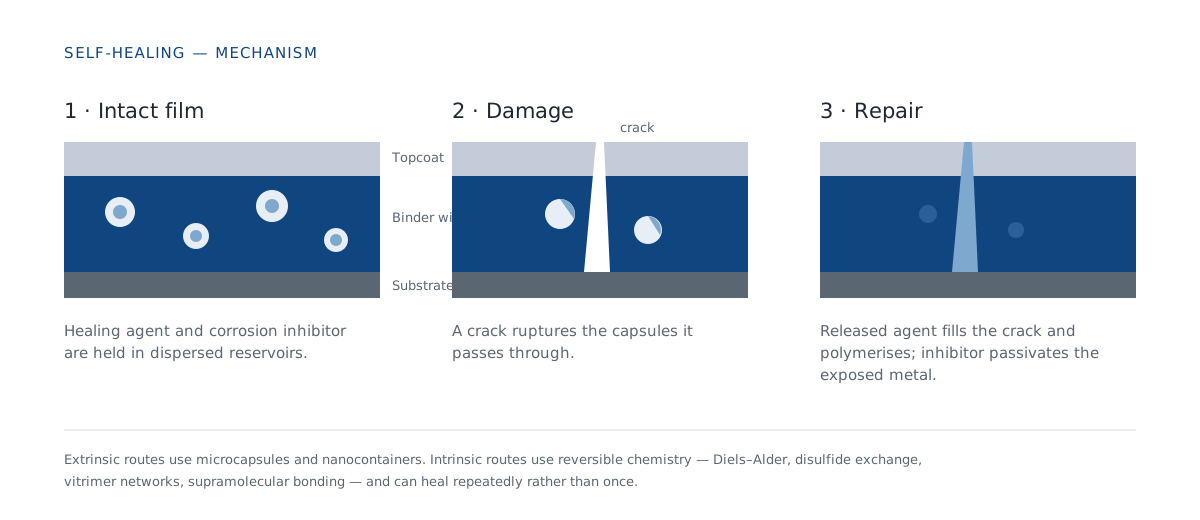
This has moved well beyond the idea of a coating that simply fills a scratch. Current work runs along two routes. Extrinsic systems disperse reservoirs through the film — microcapsules, nanocontainers and corrosion-inhibitor carriers — which rupture when a crack passes through them. Intrinsic systems build reversibility into the polymer itself through dynamic covalent bonds: Diels–Alder chemistry, disulfide exchange, vitrimer networks, supramolecular interaction and shape-memory polymers.
The practical difference matters. An extrinsic capsule heals a given site once, because the reservoir is spent. An intrinsic network can heal the same site repeatedly, but generally needs a stimulus such as heat to do it. Recent reviews identify intrinsic and extrinsic healing, inhibitor release and stimulus-responsive systems as the three directions worth following.
The most interesting product concept combines them: epoxy with nanocontainers, a corrosion inhibitor and a dynamic polymer network. It behaves as a conventional barrier until it is damaged, then responds.
Self-reporting
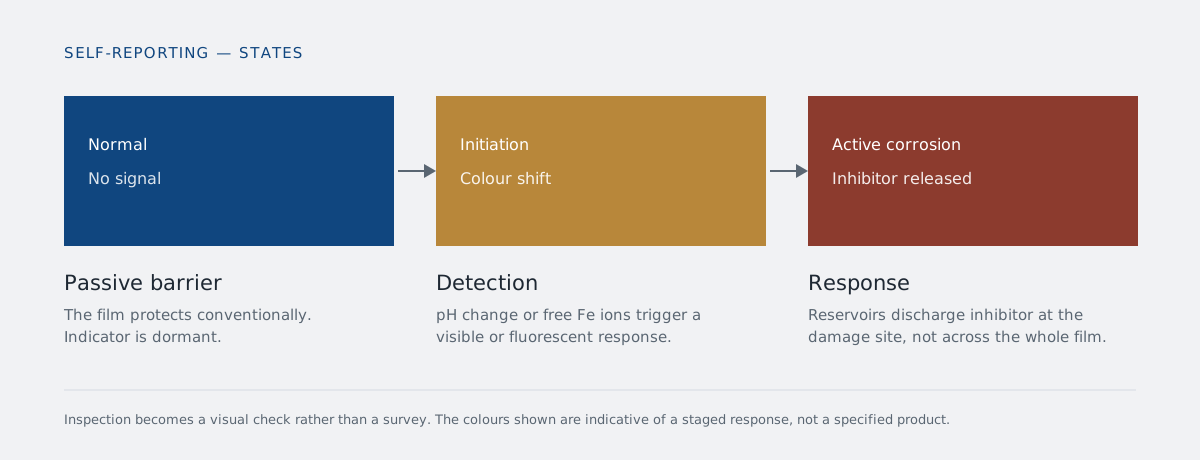
Corrosion is usually found by inspection, which means it is found late. A self-reporting coating shifts that: the film itself signals the transition from sound, to corrosion initiating, to active corrosion.
Research is investigating pH-sensitive and iron-ion-sensitive indicators, and fluorescent or colour-changing systems including aggregation-induced-emission chemistry. The commercial concept is straightforward to describe — a coating where the original colour means sound substrate, a colour change means corrosion has started, and inhibitor is released at the same moment.
The natural next step, and already an active research area, is to combine reporting with healing so that the coating detects damage, announces it and repairs it.
PFAS replacement
PFAS has been the default answer whenever a specification demanded exceptional water repellency, oil repellency, chemical resistance and low surface energy together. Regulatory pressure is removing that answer, most rapidly in Europe, and restrictions continue to widen.
That makes PFAS-free oil and water repellency one of the clearest R&D openings in the industry. Candidate routes include modified acrylics, polyurethane hybrids, sol-gel systems, bio-based hydrophobes and engineered nanostructured surfaces. EU-funded programmes are already developing fluorine-free repellent coatings using bio-based thermoplastic powder and hybrid sol-gel approaches.
This is a case where the regulation arrives before the replacement chemistry is mature, which is precisely when it is worth being early.
UV and LED curing
The next generation is not simply a UV coating under a UV lamp. It is the combination of UV-LED, dual cure, low migration and oxygen tolerance in one system.
LED curing brings instant switching, no warm-up, no mercury and a fraction of the energy draw. The formulation difficulty is photoinitiator response inside the narrow LED emission band, which makes LED-optimised photoinitiator packages a research area in their own right. Dual-cure systems add a second mechanism so that shadowed geometry still cures, and oxygen-tolerant chemistry removes the need for inert blanketing.
The product territory is wide: LED metal and wood coatings, plastic coatings, industrial clear coats, primers, texture, high-gloss, anti-scratch and soft-touch finishes.
Low-temperature powder
Conventional powder coating needs a cure schedule that many substrates simply cannot survive. Lowering the cure temperature opens powder — with its near-zero VOC and high transfer efficiency — to materials that have always been wet-coated.
The markets that follow are substantial: MDF and engineered wood, plastics, aluminium, electric-vehicle components and heat-sensitive machinery parts. Low-cure powder is already identified across the industry as a significant expansion area.
Nano-barrier
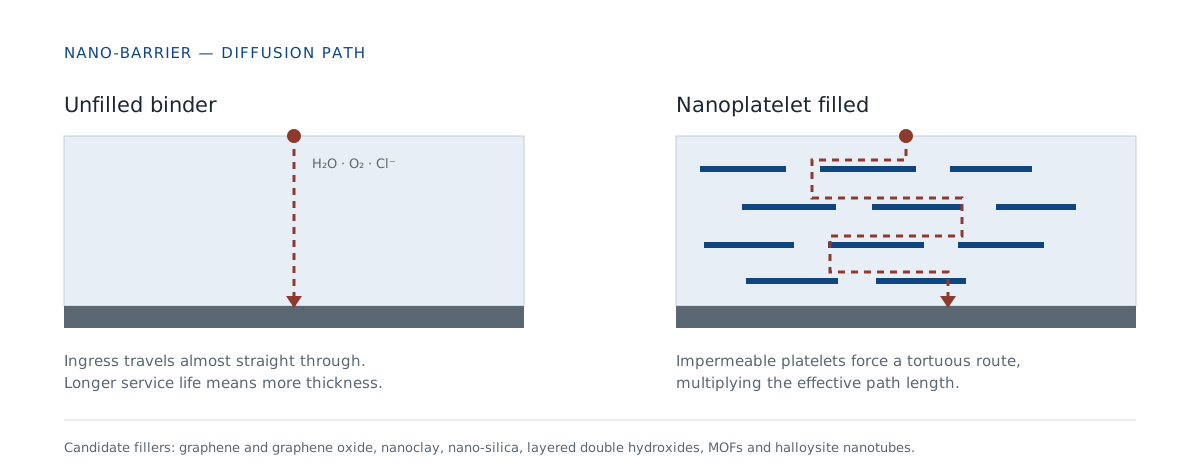
The conventional way to extend corrosion protection is to add thickness. The nano-barrier approach instead makes the path harder to travel: impermeable platelets dispersed through the film force water, oxygen and chloride ions along a long, tortuous route rather than straight through.
Candidate fillers include graphene and graphene oxide, nanoclay, nano-silica, layered double hydroxides, metal-organic frameworks and halloysite nanotubes. Recent work identifies nanofillers specifically as the route to better barrier performance and longer protective life at equal or lower film build.
Smart inhibitor release
Loading a large quantity of corrosion inhibitor uniformly through a coating is wasteful and can compromise film properties. The alternative is to hold inhibitor in reservoirs and release it only where and when it is needed.
Triggers under investigation include pH shift, chloride ion concentration, moisture, temperature, mechanical damage and electrochemical potential. MOFs, layered double hydroxides, silica and halloysite nanotubes are all being studied as the reservoir. This is among the areas worth watching most closely, because it improves protection and reduces inhibitor loading at the same time.
Conductive and EMI shielding
Demand here is being pulled by electric vehicles, electronics, 5G and 6G equipment, data centres, aerospace and batteries — all at once.
The materials set combines graphene, carbon nanotubes, conductive carbon, conductive polymers and metal fillers. The product set that follows is well defined: conductive primers, EMI shielding coatings, ESD and antistatic coatings, and battery enclosure coatings.
Thermal management
These are coatings specified to control heat absorption, heat dissipation and infrared radiation, rather than appearance.
The technologies include thermally conductive fillers, ceramic fillers, infrared-reflective pigments, phase-change materials and thermal-barrier systems. Applications concentrate wherever heat is now a design constraint: EV battery packs, motors, transformers, electronics, industrial machinery and data centres.
AI-designed formulations
This changes less about the coating and more about how quickly a coating can be arrived at. The traditional loop is formulate, test, modify, test again. The emerging loop is database, model prediction, formulate, test, and feed the result back into the model.
The parameters that can be optimised computationally are the ones a formulator balances by hand today: resin selection, pigment loading, dispersant level, viscosity, hardness, adhesion, gloss, flexibility, cure speed and corrosion resistance. The gain is a sharp reduction in the number of laboratory iterations needed to reach a specification.
One architecture, six functions
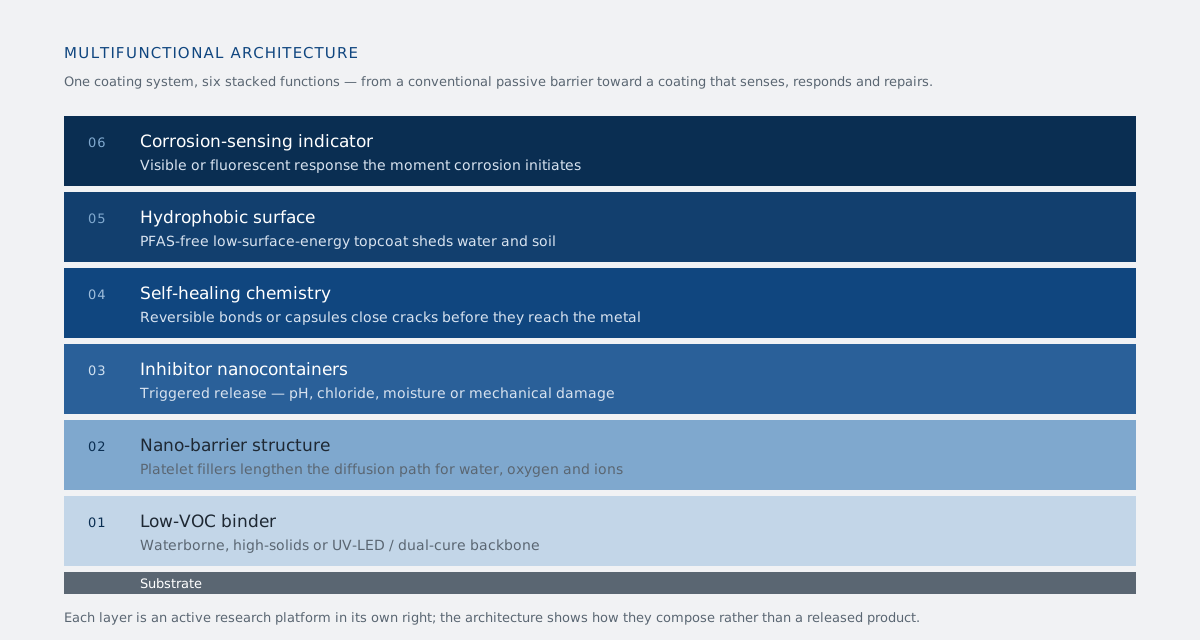
Taken individually these are research platforms. Taken together they describe a single coating architecture that moves from a conventional passive film toward a smart coating system — a low-VOC or radiation-curable binder, a nano-barrier structure, inhibitor nanocontainers, self-healing chemistry, a hydrophobic surface and a corrosion-sensing indicator.
The scientific literature is moving in exactly this direction: coatings that do not merely act as barriers, but sense damage, respond to environmental triggers and repair themselves.
Five themes we are working through
The twenty developments above are what the industry is moving towards. These five themes are the ones that shape what actually enters our own development programme, each broken into the specific problems behind it. They are development themes rather than products, and no delivery date is implied.
Regulation-driven reformulation: developing replacements before the restriction lands
Restriction usually arrives before a replacement is ready. Arctic’s technical centre and laboratory in Greater Noida treat regulation-driven reformulation as a standing development theme, because the substances now under pressure in coatings and inks were selected in the first place for properties that no single replacement reproduces, and because India’s Plastic Waste Management Rules and Extended Producer Responsibility obligations are changing what a converter can put on a substrate at the same time as global restriction lists are changing what a formulator can put in a can.
Fluorine-free oil and grease repellency for fibre-based food service
Per- and polyfluoroalkyl substances hold oil off paper and board by lowering the surface energy of the fibre itself, which works at very low add-on, leaves the sheet open and porous, and does nothing to stiffness or repulpability. Every non-fluorinated route works the other way round: it stops oil by building a continuous film or by blocking the pore structure, so grease resistance becomes a barrier property rather than a surface property. That change in mechanism brings the trade-offs with it, because a closed film raises coat weight, alters the fold and crease behaviour of the board, changes how the blank runs through forming and heat sealing, and interacts with repulping and with the recycled fibre stream the EPR framework is trying to protect. Development work therefore has to hold several methods in view at once, kit rating and hot oil holdout for the grease side, and separate assessment of creasing, sealing and defibration, since a formulation that passes one and fails the others is not a substitution. The harder cases are hot, wet and oily together, such as fried food held in a closed carton, where the film is being softened and the oil is being driven into it at the same time.
Bisphenol replacement in metal packaging linings
Epoxy-phenolic linings based on bisphenol A diglycidyl ether were adopted because they combine adhesion to tinplate, tin-free steel and aluminium with enough flexibility to survive drawing, wall ironing and seaming, and enough chemical resistance to survive retort against acidic, saline and sulphur-bearing fillings. The candidate replacement chemistries each give up part of that set: polyesters can be formed well but are exposed to hydrolysis at retort temperatures and pH, acrylics are hard and can craze on severe forming, and olefin-based dispersions need different application, flash-off and cure conditions than an existing coating line was built around. Cure chemistry is a second problem, because the crosslinkers that were convenient with epoxies are themselves under scrutiny, so the resin and the crosslinker often have to change together. Assessment runs on enamel rater porosity after forming, cross-hatch and boiling-water adhesion, blush and blistering after retort, and sulphur staining against model fillings, with the forming step done first so the coating is tested in the state the can will actually be in. Arctic treats this as a resin and cure development theme only, and makes no statement here about food contact suitability or any approval.
PVC and phthalate replacement in closure liners and in inks
Plasticised PVC earned its place in closure liners because a plastisol flows into the cap shell, gels into a compressible seal, and holds sealing force through pasteurisation and long storage with low compression set. Polyolefin and thermoplastic elastomer liner compounds seal by a different balance of hardness and recovery, so the application method, the fill pattern in the shell, the lubricity that sets removal torque and the resistance to the product all shift together, and a liner that seals adequately but raises opening torque past what a consumer manages is not a working replacement. In inks, vinyl and vinyl-modified resins are used for adhesion to treated films and in metal decoration, and the phthalate plasticisers that made them workable are being replaced by citrates, adipates, benzoates and polymeric plasticisers that differ in volatility, extractability, viscosity stability in the can and resistance of the dried film. The waste side reinforces both cases, since chlorine in the stream complicates thermal treatment and contaminates polyolefin recycling, which is exactly the outcome the Plastic Waste Management Rules and EPR reporting push converters away from.
MOSH and MOAH reduction in printed packaging
Mineral oil saturated and aromatic hydrocarbons reach packaging by more than one route, so removing them is not a single reformulation. Mineral oil distillates are used as the vehicle in sheetfed and coldset offset inks, recycled fibre carries residues of earlier printing ink through the mill, and further contributions come from press and machine lubricants, from release and antidust agents, and from oils used in sack and bag production. The aromatic fraction is the one of concern, and it is measured against the saturated fraction by hyphenated liquid chromatography with gas chromatography and flame ionisation detection, a method that is also interfered with by polyolefin oligomers, so analytical work has to separate the question of what is present from the question of where it came from. Replacing mineral oil vehicles with vegetable esters or with highly refined synthetic fluids changes setting speed, tack development, misting at the roller nip, rub resistance and the behaviour of the ink in the fount balance, so the press side of the change is as large as the chemistry side. Where the contamination is in the recycled fibre rather than in the ink, the development question becomes a functional barrier layer instead, and the barrier then has to be assessed for its own effect on recyclability.
Heavy metal and chromate elimination in primers and pretreatment
Hexavalent chromium, in conversion coatings and in chromate pigments, does something that a barrier coating does not: it is slightly soluble, it migrates to a defect, and it repassivates bare metal at a scratch or a cut edge. The accepted replacements are zirconium and titanium fluoride conversion layers, silane and phosphate pretreatments, and inhibitive pigments based on phosphates, borates and ion-exchanged silicas, and most of them shift the system from active inhibition towards passive barrier plus weak inhibition, which shows up first as scribe creep and edge corrosion rather than as field blistering. Lead chromate, molybdate and cadmium pigments raise a parallel problem on the colour side, because the organic pigments that replace them differ in opacity, heat stability during stoving and bleed resistance, so hiding power has to be rebuilt through pigment loading or an opacifying underlayer. Evaluation should not rest on continuous salt spray alone, since that test ranks chromate replacements poorly against their real field behaviour, and cyclic corrosion, filiform and impedance spectroscopy give a more usable picture. Substrate sensitivity is greater than with chromate, so a pretreatment that performs on one aluminium alloy or one galvanised grade cannot be assumed to perform on another.
Toluene and ketone reduction in packaging inks
Toluene was used in rotogravure because it dissolves nitrocellulose and polyurethane resins well, releases cleanly from a deep engraved cell, and evaporates at a rate that suits high press speeds, and methyl ethyl ketone plays a similar role in laminating and surface print systems. The pressures against both are retained solvent and odour in the finished pack, workplace exposure limits, and the economics of solvent recovery. Moving to ester and alcohol blends changes the solvency balance first, which affects resin solution viscosity, pigment dispersion stability and adhesion to treated films, and it changes the evaporation profile second, which affects dot transfer, trapping between stations and shade drift as the faster component leaves the ink duct. Water-based and solvent-free systems remove the problem at source but introduce surface tension and wetting constraints on low energy films, higher drying energy demand, and sensitivity to substrate treatment level that the converter must hold steady. The practical development target is a system where retained solvent is low enough to be measured reliably rather than one where it is assumed to be absent, and retained solvent by headspace gas chromatography is the method that decides it.
Substitution when the replacement changes more than one property
A raw material is never one property in a formulation, and this is the reason regulation-driven reformulation is slow. A plasticiser is also a viscosity control, a film former, a wetting aid and a glass transition modifier, a chromate is also a pigment, and a solvent is also the thing that sets rheology, levelling and adhesion, so removing any of them moves several performance axes at once and the replacements for each axis interfere with each other. That pushes development towards structured screening and designed experiments rather than one-for-one swaps, and towards holding the application conditions of the real line fixed while the chemistry moves, because a formulation that only works with a different cure schedule or a different anilox is not a drop-in. Two further constraints sit on top: accelerated ageing correlates imperfectly with shelf life and field exposure, so some questions cannot be answered faster than real time, and a replacement chosen only because it is currently unrestricted may itself be restricted later, which is why structural class and not just current listing status has to be part of the selection. Arctic’s production line is built for batch-to-batch consistency, and that matters here because a reformulated system usually has a narrower processing window than the one it replaces, so variation that the old formulation absorbed becomes visible in the new one.
Designing for the recycler
Recycling applies tests a coating was never designed for: a hot alkaline pulper, a shredder, a near infrared sorter, a twin screw extruder. The themes below are the questions Arctic’s technical centre in Greater Noida is working through at that end of the life of a pack, and they are development directions rather than products, with no availability and no timing implied.
Mono-material structures and the coating that replaces a barrier layer
A conventional laminate takes its barrier from a foreign layer, a metallised polyester, a polyamide or an aluminium foil, bonded to a polyethylene sealant. That mixture is what defeats mechanical recycling, because polyester and polyamide do not melt in a polyethylene stream and survive it as infusible inclusions. A mono-material structure keeps every layer in one polymer family and asks a coating of a few grams per square metre to supply the oxygen or water vapour barrier the foreign layer used to provide. The development problem has three parts at once: reaching a useful barrier figure at a coat weight small enough to stay inside recycling thresholds, drying or curing below the shrink temperature of a machine direction oriented polyolefin film, and holding that barrier after the web has been folded, sealed and abraded. Barrier is reported as oxygen transmission rate and water vapour transmission rate by ASTM and ISO methods, and the number means little unless the flex and crease history of the specimen is stated with it.
What the sorting plant actually sees
Automated sorting identifies polymer type from near infrared light reflected off the surface of a fragment, so a coating with full web coverage sits between the detector and the substrate the detector is trying to read. Heavily pigmented layers absorb across the working band, carbon black most severely, and a fragment that returns no usable signature is sent to residue regardless of what it is made of. Density is the second sorting stage, and a mineral filled coating can lift a polyolefin fragment above the density of water and lose it in a sink and float separation that assumes polyolefins float. Work on this theme is about pigment selection, coat weight and coverage pattern, including detectable black pigments in place of carbon black, and about verifying the outcome on sorting equipment instead of predicting it from the formulation. A coating can be entirely compatible with a reprocessing line and still fail the pack, because the fragment never reaches that line.
Repulpable coated board and fibre recovery
Extrusion coated polyethylene gives board its water and grease resistance and then survives the pulper as a sheet of plastic that has to be screened out, carrying fibre with it and, at many mills, disqualifying the grade at the gate. A dispersion coating aims to deliver comparable resistance at lower coat weight and to break up in a hot alkaline pulper so that the fibre is recovered and the reject fraction stays small. The chemistry is contradictory by design: the binder has to resist water and grease in service, then redisperse when the mill raises pH and temperature, which usually means an alkali sensitive functionality that is held inactive until the recycler activates it. The measurements that decide the case are reject rate, fibre yield and the count and size of polymer fragments that pass the screens, because fine fragments deposit as stickies on wires, felts and dryer surfaces and cost the mill more than the recovered fibre is worth. TAPPI repulping and screening methods give those numbers, and crease and fold testing has to run alongside them, since a barrier that cracks at the score is not a barrier.
De-inking and de-varnishing in the recovered paper stream
Flotation de-inking depends on the printed film detaching from the fibre and then fragmenting into particles the process can remove, broadly in the range of tens to a few hundred micrometres. Fragments finer than that stay suspended and grey the pulp, which appears as lost ISO brightness and as residual ink measured by image analysis, while fragments much coarser than that survive as visible specks in the finished sheet. A crosslinked varnish or lacquer over the ink changes the outcome twice, first by shielding the ink film from the alkaline chemistry that would release it, and second by setting the size of the flakes that do come away. The development target is therefore the fragment size distribution itself, chosen through binder selection and crosslink density so that the layer lifts as sheets rather than being milled into specks. The same reasoning applies to overprint varnish on board, where a layer that will not detach is not a finishing decision but a contamination load carried into every mill that takes the grade.
Compatibility with the polymer stream the coating ends up in
When a coated film is collected and reground, the coating is not removed, it becomes a minor phase in someone else’s melt. Two polymers that do not mix form droplets with weak interfaces, and the recyclate loses elongation at break and impact strength well before anyone sees a change in appearance. Crosslinked coatings behave worse, because they do not melt at all: they appear as gels and unmelts, they raise pressure across the melt filter and they print through as specks in film. Three routes are under investigation, selecting the coating chemistry from the family it will be recycled into, holding coat weight low enough that the second phase stays at a low single figure percentage, and building in a compatibilising segment that locates at the interface and lowers interfacial tension. Assessment has to be done on recyclate compounded at realistic addition levels and passed through several extrusion cycles, tracking melt flow rate, gel count, yellowing, odour and retained mechanical properties, because a single pass hides most of what goes wrong.
Design for recycling guidance as a specification input
Industry associations in several markets publish design for recycling guidance that sets thresholds: maximum coat weight, restricted pigments, limits on barrier and adhesive layers, label and sleeve constraints, and a categorisation of the resulting structure. These documents are not legislation and they are not certification, but they act as the first screen a new pack design has to pass, and a structure that fails the screen is usually never trialled at all. Treating them as a specification input means the thresholds enter the development brief alongside gloss, rub resistance, seal strength and shelf life, so the question becomes what performance is achievable inside the limit rather than what performance is achievable. The complication is that the guidance is revised, it differs between markets, and one structure can be categorised two ways in two countries, so any specification written against it has to name the document version and the market it was written for.
The limits of what a coating can claim
Recyclability is a property of a whole structure inside a particular collection, sorting and reprocessing system, and it is never a property of a coating on its own. The same coated film can be recovered where there is a film collection, a sorting plant configured for it and a reprocessor willing to buy the bale, and go to residue a few hundred kilometres away where one of those three is missing, and in India the difference between organised and informal collection shifts the answer again. Laboratory protocols understate the problem because they are clean, modelling one reprocessing route with sorted, dry, single source material, while a real bale carries mixed structures, moisture, product residue and material that has already been round once. The defensible statement is narrow, that this coating, at this coat weight, on this substrate, under this named test protocol, gave this result, and every qualifier in that sentence is load bearing. Anything broader is a claim about infrastructure that Arctic does not operate and cannot verify.
Digital and data-driven formulation
Formulation development is changing in how it is done, not only in what it produces. This cluster covers the data, measurement and control methods now entering coatings development, and where each of them genuinely shortens the work rather than replacing the press trial that still decides.
Where machine learning narrows a formulation search
A coating formulation carries a large number of adjustable variables: resin type and molecular weight distribution, pigment and filler loading, wetting and slip additives, crosslinker ratio, and the solvent or water balance. Trained on enough historical laboratory records, regression and classification models can rank candidate combinations by predicted viscosity, gloss or block resistance, and remove the clearly unworkable regions of that space before anyone weighs a sample. What they do not do is predict how a coating behaves at 200 m/min on an anilox three months into its service life, against a substrate lot whose surface energy has drifted by 2 mN/m. The defensible position is that a model narrows a search space and orders the queue of trials, and the trial still decides. Any development programme that treats a predicted value as a release criterion will fail at the first scale-up.
Structured laboratory data as the limiting factor
Most of the difficulty in applying models to formulation is not the model, it is the record. Laboratory notebooks describe trials in free text, batch sheets sit in spreadsheets with inconsistent units, and the failures, which carry most of the information, are often not written down at all. A usable dataset needs the full composition including the additive at 0.2 percent, the mixing and curing conditions, the substrate lot, the test method named by its standard number, and the measured result with its repeatability. Building that record is slow, unglamorous capture work that runs for years before any model is worth training. Development attention here goes to data structure and method discipline first, because a model trained on inconsistent gloss readings only reproduces the inconsistency.
High-throughput screening of raw material combinations
High-throughput screening replaces the sequential one-at-a-time trial with arrays of small samples prepared and tested in parallel. Automated dispensing can build dozens of variants at gram scale on a single plate, draw them down at controlled wet film thickness, and read gloss, colour, haze and adhesion in one pass. The value lies in the negative results: a screen can eliminate three quarters of a candidate set in a day, which leaves laboratory time for the few combinations worth scaling. The constraint is that small-scale application does not reproduce the shear history, drying profile or film build of a real coating head, so a screen ranks candidates rather than qualifying them. Correlating a plate result with a machine result is itself a development problem, and the correlation has to be established separately for each property and each application method.
Digital colour management and spectral matching
Matching colour across substrates is a spectral problem, not a visual one. A colour that matches under D50 on white coated board can separate visibly on a metallised film or a kraft liner, because the substrate contributes its own reflectance and the ink film is not fully opaque. Spectral matching, measured under ISO 13655 conditions and evaluated as CIEDE2000 rather than by eye, allows a formulation to be computed for a given substrate and film thickness instead of corrected on press afterwards. The harder part is process transfer: the same colorant set laid down by flexography at one film weight and by gravure at another will not return the same spectrum, so a digital match needs a characterisation for each process and substrate combination. Work in this area is largely about building and maintaining those characterisations, including how often they must be remeasured as raw material lots change.
Inline measurement and closed-loop control on press
Coat weight and colour are still commonly controlled by sampling: an operator pulls a sheet, measures it offline, and adjusts. Inline instruments, beta or infrared gauges for coat weight and spectrophotometers mounted in the web path, shorten that loop from minutes to seconds and make variance visible rather than inferred. Closed-loop control then drives doctor blade pressure, pump speed or ink feed directly from the measurement. Two things limit this in practice: the measurement must stay stable on a moving and sometimes flexible web under varying tension and temperature, and the loop must not chase noise, which means the instrument’s own repeatability has to be quantified and the control damped accordingly. Seen from formulation, the requirement is a material whose response to the controlled variable is monotonic and reasonably fast, because a coating with a complicated shear and time dependence makes the loop unstable.
What digital print growth demands of coatings
Digital printing moves the coating requirement from receptivity in one defined process to receptivity across several very different deposition mechanisms. Inkjet lays down low-viscosity fluid as discrete drops that must wet, pin and dry without coalescing or feathering, so surface energy, absorbency and the time constant of absorption become the controlling properties, all inside the tens of milliseconds between adjacent drops. Electrophotographic processes ask instead for a surface that accepts and anchors a fused toner layer under heat and pressure without blistering or losing adhesion. Primers and receptive coatings for these processes are developed against drop spreading and pinning behaviour rather than against a print density target alone, and they must still survive the finishing steps of lamination, varnishing and creasing. Short-run digital work also compresses the qualification window, since a job may exist for a single production run, so the coating has to be predictable across substrates instead of tuned job by job.
Digital product passports and batch-level traceability
Traceability is moving from a document supplied on request to a structured data record that travels with the product. A digital product passport, in the forms now being specified, carries composition information, substance declarations, recycled content and end-of-life handling in a machine-readable file attached to the item. For a coatings supplier this pushes requirements upstream: every raw material lot needs an identifier that resolves to its own declaration, and the formulation record has to produce a per-batch answer rather than a generic one. The technical work sits in batch-level linkage, connecting the raw material lots actually consumed to the finished batch and then to the converter’s job, which most manufacturing records are not structured to support. This is a coming requirement rather than a present capability, and the open development question is what the data model must look like before the specification is fixed.
Functional and responsive surfaces
A coating that only protects and decorates is finished once it has dried, and everything worth measuring about it can be measured on a stable film. This cluster covers the other case, surfaces that carry an active function through the life of a pack or a part, and it sets out the development and characterisation problems that arise when a coating has to respond to oxygen, heat, light, current or touch rather than simply resist them.
Active packaging: oxygen scavenging and freshness indication in a printed layer
An oxygen scavenger consumes the residual oxygen left in a sealed pack and the oxygen that permeates into it, and moving that function out of a sachet or a co-extruded resin layer and into a printed coating changes the arithmetic completely. A coating applied at a few grams per square metre carries a small absolute mass of active, so its capacity, expressed in millilitres of oxygen per square metre, has to be set against both the headspace oxygen present at sealing and the transmission rate of the finished structure, measured by a method such as ISO 15105-2 or ASTM D3985. The harder problem is activation control: an iron based or photo-activated system that begins reacting on the printed reel is partly spent before the pack is ever filled, so the development work concerns triggering and the protection of the active in storage as much as the scavenging reaction itself. Freshness indication is the mirror image, a layer that reports a condition instead of altering it, usually a dye system responding irreversibly to headspace carbon dioxide, to amines released by protein spoilage, or to the oxygen ingress that indicates a failed seal. Arctic’s interest in both sits at the level of coating chemistry, dose uniformity and measurement, and no part of this work addresses direct food contact, migration behaviour or approval for use with food.
Antimicrobial and easy-clean surfaces, and the constraint on biocidal claims
An antimicrobial coating only works where the active is present at the surface and available, which sets up a direct conflict with durability: silver ion, quaternary ammonium and copper systems need controlled mobility to reach the interface, and a coating tough enough to resist cleaning tends to lock the active away. Efficacy is not a matter of opinion, it is a laboratory result under a defined protocol such as ISO 22196 on non-porous surfaces, run against named organisms at a stated inoculum and contact time, and a result obtained that way says nothing about performance on a real handled surface in service. The regulatory position is the binding constraint: in most jurisdictions a stated or implied claim that a surface kills or inhibits micro-organisms turns the coating into a biocidal product with registration obligations, so the discipline in development is to characterise the mechanism and report the test method and result, and to make no protective, hygienic or health claim of any kind. Easy-clean behaviour is separate physics and carries no such burden, since it concerns soil release from a low surface energy film, characterised by water and hexadecane contact angle, by soil retention after repeated cleaning cycles, and by whether the low energy surface still accepts overprint and adhesive. Both lines are treated in the laboratory as measurement problems first, because a surface property that cannot be reproduced batch to batch is not a property, it is an anecdote.
Thermochromic and photochromic indication
A reversible thermochromic ink is usually a microencapsulated three component system, a leuco dye, a colour developer and a solvent, and the colour change occurs when the solvent melts and breaks the dye to developer association, which means the switch temperature is chosen by the solvent, not by the dye. Two properties then dominate the development work: hysteresis, because the temperature at which colour returns on cooling is not the temperature at which it is lost on heating, and fatigue, because each cycle and each hour of ultraviolet exposure degrades a fraction of the dye until the contrast falls below anything a user would notice. The capsules themselves are a printing constraint, with a diameter in the low single figure micrometres that sets a floor on screen mesh and anilox volume, and the systems are weakly opaque, so a printed indicator generally needs a designed underprint to give it a contrasting state. Photochromic systems built on spirooxazine and naphthopyran chemistry raise the same ageing question in a harsher form, since the activating ultraviolet light that drives the switch also drives the decomposition, and cycle life rather than initial colour strength is the property that decides whether an application is viable. The useful outputs of this work are therefore a measured switch temperature with a stated tolerance, a hysteresis width, and a contrast retention curve against cycles and against accelerated light exposure by a method such as ISO 4892-2.
Conductive coatings and compatibility with printed electronics
Conductivity in a printed layer is a percolation effect, so the property that matters is sheet resistance in ohms per square at a defined coat weight, and it depends less on how much conductive material is present than on whether the silver flakes, carbon particles or polymer domains are in continuous contact once the film has released solvent and shrunk. That makes rheology, drying profile and cure shrinkage into electrical variables, which is unfamiliar territory for a coatings laboratory, and it is why the same formulation can measure an order of magnitude apart on two substrates or two line speeds. Flexible substrates cap the cure temperature well below the point at which metal particles would sinter, so the development route runs through binder selection, particle morphology and packing rather than through thermal processing. A printed conductor also has to survive the rest of the stack: it must adhere to treated polyester or coated paper, hold its resistance through creasing and flexing, and not be attacked or lifted by the dielectric or graphic layers printed over it. Characterisation therefore combines four point probe sheet resistance for the low resistance end, surface resistivity by ASTM D257 for antistatic and dissipative ranges, and resistance measured again after defined flex, crease and humidity conditioning.
Anti-counterfeit coatings and covert taggants
Security printing works in layers, an overt feature a person can verify without equipment, a covert feature visible only under a defined excitation such as ultraviolet or near infrared, and a forensic marker read only by instrument, and a coating can carry the second and third of these. The technical difficulty is that a covert taggant has to be invisible under normal light at a loading low enough not to disturb colour, gloss or rheology, and yet give a clean, unambiguous signal on reading, which is a narrow window when the loading is measured in fractions of a percent. Substrate and formulation interference is the usual failure: optical brighteners in board, titanium dioxide and many organic pigments quench or mask fluorescent emission, and an infrared readable marker has to sit in a spectral window that the rest of the printed structure leaves clear. Because the signal depends on the loading, batch-to-batch consistency in the ink stops being a quality target and becomes the security property itself, since a marker that reads on one reel and not the next teaches verifiers to ignore it. Control of the taggant supply chain, of who holds the reader and of how a negative read is handled is as much a part of the system design as the chemistry, and this work is being developed with that whole chain in view.
Haptic surfaces specified by coefficient of friction and roughness
Tactile finishes are normally specified by adjectives, which is unworkable, because a description of how a surface feels cannot be sent to a production line or checked on an incoming reel. The measurable substitutes are static and kinetic coefficient of friction by ASTM D1894 or ISO 8295, surface roughness as Ra and Rz by contact or optical profilometry to ISO 4287 or ISO 25178, and specular gloss by ISO 2813, and the development question is which combination of those numbers corresponds to the tactile response a customer accepted in a hand sample. Roughness in a matt or tactile coating comes from matting agent particle size, loading and the degree to which the particles protrude as the film shrinks on drying, so the same three variables that set the feel also set the scuff behaviour, and low friction and rub resistance by a method such as ASTM D5264 tend to move in opposite directions. The converting line imposes its own limits from the other side, since the coefficient of friction has to stay inside the band where sheets feed and stack without slipping or blocking, and a finish that feels correct in the hand but sits outside that band will be rejected on press. The output of this work is therefore not a single number but a window, a coefficient of friction range and a roughness range within which both the tactile response and the machine handling are satisfied, plus the test conditions under which those ranges were established.
Qualifying a function that depletes
Every theme in this cluster shares a problem that conventional coatings do not have: the function has its own shelf life, separate from the shelf life of the film, and the film can be entirely sound while the function has gone. A scavenger has a finite capacity and consumes it whether or not the pack is in use, an indicator dye photobleaches, a silver flake network oxidises at the particle contacts and drifts upward in resistance, and a thermochromic capsule loses contrast with every cycle. Qualification therefore needs three things that a normal specification omits: a defined end-of-function criterion agreed in advance, accelerated ageing under conditioned storage and light exposure with a stated correlation to real time, and measurement taken on the converted structure rather than on a laboratory drawdown, because lamination, heat sealing and creasing all change the result. There is a second consequence for production, in that a function tied to the mass of active present makes coat weight variation into functional variation, so grammage control moves from a cosmetic tolerance to part of the functional specification. These are development themes under characterisation in the technical centre and laboratory in Greater Noida, they are not available products, and no timescale for any of them is stated or implied.
Lower-energy curing and application
Most of the energy and emission associated with a coating is not consumed where it is made, it is consumed where it is cured, in ovens, lamps, dryers and the air handling that serves them. This cluster covers development work aimed at that part of the footprint: curing and application routes that reach the same film performance at lower temperature, lower power draw and lower solvent load, and the formulation constraints that come with each of them.
LED-UV in place of mercury arc, and what changes in the photoinitiator package
A mercury arc lamp emits across a broad band that includes short-wavelength UVC, and most conventional UV ink and varnish formulations rely on that short-wavelength output to cure the top few microns of film against oxygen inhibition. An LED array emits a narrow band, typically around 385 to 405 nm, so initiators that absorb below about 340 nm contribute almost nothing and the package has to be rebuilt around longer-wavelength absorbers such as acylphosphine oxides, usually with a sensitiser and an amine synergist to carry the surface. That rebuild brings consequences the formulator has to manage: greater initial yellowing, competition for light from pigments that absorb in the same narrow band, with white and black the hardest cases, and a different balance between surface cure and through cure because longer wavelengths penetrate deeper into the film. The energy case is that an LED array draws power only while the job is running, needs no warm-up or standby, produces no ozone so extraction duty falls, and runs the web cooler, which is what makes thin heat-sensitive film practical in the first place. Development work here concentrates on initiator and sensitiser combinations that hold surface cure at commercial line speeds without pushing yellowing or residual odour, assessed by measured conversion rather than by a thumb-twist on the press.
Low-temperature and ultra-low-cure powder for heat-sensitive substrates
Conventional thermosetting powder is scheduled around a metal temperature near 180 to 200 C held for ten to fifteen minutes, which rules out medium density fibreboard, most thermoplastics, and any assembly containing seals, bearings or electronics. Lowering the schedule towards 140 C, and in the ultra-low case towards 120 C, requires resins of lower glass transition temperature, more reactive crosslinker chemistry and catalysis, and in some routes a decoupling of melt from cure so the film flows thermally and then crosslinks under radiation. The cost of that reactivity appears upstream rather than in the oven: powder that reacts readily at low temperature also sinters in the bag, so storage stability, blocking resistance and warehouse temperature become formulation constraints instead of logistics details. Film performance has to be watched as well, because a lower cure temperature often means lower crosslink density, and chemical resistance, hardness and edge coverage can fall with it. The question under investigation is how far the schedule can drop while residual exotherm by differential scanning calorimetry still indicates full cure and the mechanical requirement is still met.
High-solids and solvent-free systems: cutting emission and oven load together
Most of the energy on a solvent-borne coating line is not spent curing the film, it is spent heating and exhausting the large volume of dilution air needed to hold the oven safely below the lower explosive limit, and spent again if that exhaust passes through a thermal oxidiser. Raising solids content attacks both at once, because there is less solvent to evaporate, less dilution air to heat and less load on abatement equipment. The formulation problem is viscosity: solids and viscosity rise together, so high-solids systems depend on lower molecular weight resins, a narrower molecular weight distribution and reactive diluents that become part of the film rather than leaving it. Those changes shorten pot life and narrow the window between sagging and poor levelling, which is why high-solids work is usually also work on application, plural-component metering, heated spray and film build control. Solvent-free two-pack and 100 percent solids systems remove the oven from the calculation altogether for some applications, at the price of much tighter mixing and timing discipline at the point of use.
Water-based where performance allows, and an honest account of where it does not
Water-based is often assumed to be the lower-energy option and per kilogram of carrier it is the opposite, because the latent heat of vaporisation of water is roughly five times that of a typical organic solvent, so drying can demand more heat unless the formulation carries less water and the dryer is rebuilt around airflow and humidity rather than temperature alone. Where the performance requirement allows the substitution, the emission benefit is real and the engineering effort goes into matching line speed to dryer capacity rather than into chemistry. Where it does not allow, the reasons are specific and worth stating: film formation depends on coalescence, so a cold plant or a cold site can leave a film that never fully knits, coalescing aids put volatile content back into the formulation, low surface energy and metallised substrates resist wetting, and flash rust, freeze-thaw stability and high chemical resistance remain difficult. The defensible position is that water-based replaces solvent-based within a defined band of applications and not across the board, and the work worth doing is widening that band rather than pretending it is already universal. Development effort is directed at binders that coalesce at lower temperature without volatile aids, and at wetting and adhesion packages for difficult film surfaces.
Ambient and moisture cure for field-applied protective work
Field-applied protective work on tanks, structural steel, pipework and civil concrete has no oven, and forcing cure with hot air enclosures or dehumidification is expensive and frequently impractical on a live site. Standard two-pack epoxies slow sharply below about 10 C and can effectively stop crosslinking, which is why winter conditions and night work drive so much of the programme risk on a maintenance contract. Ambient-cure routes address this with chemistries that do not depend on applied heat: polyaspartic esters, moisture-cure urethanes and silane-terminated polymers that take their cure from atmospheric humidity, and low-temperature epoxy adducts that keep reacting where conventional amine cures stall. Each brings its own constraint, and they have to be designed against: humidity-driven systems can gas and pinhole at high film build because the reaction releases carbon dioxide, pot life and cure speed pull against each other, and recoat windows tighten as cure accelerates. The development theme is a wider temperature and humidity envelope for a single coat, so that a maintenance window is set by access and safety rather than by the weather.
Induction and infrared assisted cure: heating the film, not the building
A convection oven heats the air, the conveyor, the jigs and the whole substrate in order to cure a film perhaps thirty microns thick, and most of the fuel goes into everything except the coating. Induction inverts that by generating heat inside a ferrous substrate, so the film cures from the metal outward with no oven air to heat and effectively no warm-up period, and the equipment can be short enough to retrofit into an existing line. Infrared couples radiant energy directly to absorption bands in water and in the resin, giving a fast ramp, zone control and instant switching, which suits both a pre-flash stage that removes carrier before the main oven and a full cure on flat, uniform work. Both are geometry-sensitive: edges, thin sections and areas of differing emissivity overheat while recessed areas lag, so process control moves from an air temperature set point to direct substrate temperature measurement and profiling. The most practical application is usually hybrid, an infrared or induction boost that lets an existing oven run shorter, cooler or faster, rather than a wholesale replacement of the oven.
Proving cure when the energy margin is smaller
Every route described in this cluster takes energy out of the process, and taking energy out also takes out the margin that a long, hot, over-specified oven used to provide without anyone measuring it. A line that cured adequately because it was generously specified will not tolerate a lower schedule on assumption, so cure verification has to move from operator judgement to a stated method: solvent rub resistance to ASTM D5402, cross-cut adhesion to ISO 2409, residual exotherm by differential scanning calorimetry for powder, and infrared measurement of acrylate conversion for radiation-cured films. Substrate temperature profiling matters as much as any laboratory result, because the variable that governs a powder cure is the metal temperature and its hold time, not the oven set point on the panel. The useful unit for comparing these routes against each other is energy consumed per square metre of coated substrate at a stated line speed and a stated cure result, which makes the trade between chemistry and plant visible to the engineer signing off the change. Arctic’s interest in this area is in defining the process window alongside the formulation, so that a converter changing cure route knows the limits before the line is committed to them.
Where the industry is going
Eight topics covering the regulations, the recycling systems and the process changes that decide what can be formulated next.
The regulatory horizon
What PFAS, BPA, mineral oil, phthalate and heavy metal restrictions actually ask a coatings and ink formulator to rebuild, and what each substitution costs.
Designing for recycling
How an ink or a coating decides whether a pack repulps cleanly, deinks, washes off a bottle, and lands in a recovery stream that exists where the pack is actually collected.
Barrier without plastic
Replacing extruded polyethylene, foil and metallised film with coatings is a trade: some barrier given up for a chance at fibre recovery. What that trade costs, and what has to be tested before it is claimed.
Bio-based and renewable raw materials
Bio-based carbon, mass balance and drop-in molecules are three different claims, and a renewable percentage means nothing without its basis and its method.
Lower-energy curing
Most of the energy a coating accounts for is usually spent drying or curing it at the customer’s plant rather than making it, which is where the reductions have to come from.
What digital printing changes
Digital printing moves the technical work off the ink and onto the primer under it and the coating over it. What that changes for formulation.
How we research and develop
The development path from a customer constraint to qualified supply, and what the laboratory at Greater Noida actually does.
New developments
Ten research platforms under development, with the products each is aimed at. Development programmes, not catalogue items.
Bring us a problem, not a product code
A large part of what we make began as a customer describing a constraint we had not met before — a substrate that would not survive the cure, an asset that had to report its own condition, a specification that had just lost its fluorochemistry. Tell us what is coming and we will formulate against it.