
Electrocoat
Waterborne electrodeposition coatings applied by immersing the part in a bath and passing current through it, so the film builds into recesses, weld seams and box sections as well as on open surfaces. Supplied for plants running an installed e-coat line on repeat production, where the tank is held on one colour and kept running continuously.
Overview
Immersion and current, not spray, deposit the film in electrocoat. The metal part is immersed in a waterborne paint bath and made one electrode of a direct current circuit. Current passing through the bath electrolyses water at the surface of the part and shifts the pH there, so the charged resin and pigment that have migrated to the part lose their solubility and deposit as a coherent film. The part is then rinsed and cured in a bake oven. Like powder, electrocoat is an application technology rather than a market: the same tank finishes automotive components, off-highway machine parts, appliance chassis and general metal fabrication, and on most lines it is the primer beneath a powder or liquid topcoat rather than the visible finish. Arctic’s electrocoat range covers cathodic epoxy for corrosion priming, cathodic acrylic where the e-coat is also the finish, anodic materials for decorative work and components of moderate corrosion demand, and the feed materials and additives an operating tank consumes.
The defining behaviour is that deposition self-limits. As the film forms it insulates the surface, current through that area falls, and deposition continues wherever the film is still thin, so coating carries on into the inside of box sections, the back of flanges, blind holes and weld seams that a spray gun cannot see. That is the reason to choose the process. It is throwing power rather than perfect uniformity: build falls with distance into a cavity, so an interior surface finishes thinner than the outside, and the bath has to be able to enter and drain, which means closed cavities need access and drain holes if they are to be coated at all. Because the bath is a closed loop, with ultrafiltration and permeate rinses returning dragout to the tank, transfer efficiency is high by the nature of the process, and the material is waterborne, so solvent content is low compared with conventional liquid spray. The limits follow from the same physics. The substrate must conduct, and the part must be hung so that current reaches every surface. It must arrive clean and correctly pretreated, and the finished film owes as much to the pretreatment stages as to the coating itself. The film is thin by comparison with powder, so electrocoat is a corrosion primer or thin finish rather than a build coat. The tank also holds one colour at a time, so a line is committed to that colour until the bath is emptied and recharged, which is why most e-coat lines run a black or grey primer.
Electrocoat cannot be added to a spray booth, and the plant it requires is worth setting out in full. A line needs multi-stage pretreatment with cleaning, rinsing and a phosphate or zirconium conversion coating, with effluent treatment for those rinses; the e-coat tank itself with continuous circulation, filtration and temperature control; DC rectifiers feeding counter electrodes housed in their own cells, anolyte cells in a cathodic system and catholyte cells in an anodic one, the cell circuit removing the acid or amine released at the counter electrode so bath pH stays in control; ultrafiltration and permeate rinse stages; a demineralised water rinse; and a bake oven. Parts need jigs that hold them in reliable electrical contact and let the bath drain out of cavities. Industry practice is to cure conventional cathodic electrocoat in the region of 175 °C to 190 °C metal temperature, with lower bake grades formulated below that, and that figure describes general practice rather than any Arctic grade. The tank is a live chemical system that has to be circulated, monitored and replenished continuously rather than run in batches, and it deteriorates if it is left standing. For that reason e-coat suits high volume repeat production of similar parts. It does not suit job-shop work or short runs, and where the volumes do not justify a line, a powder or liquid system is the more sensible route. Electrocoat is a new capability area for Arctic Materials, supplied against the customer’s own bath control and analysis regime, with a Technical Data Sheet and a Safety Data Sheet for each grade.
How e-coat deposits
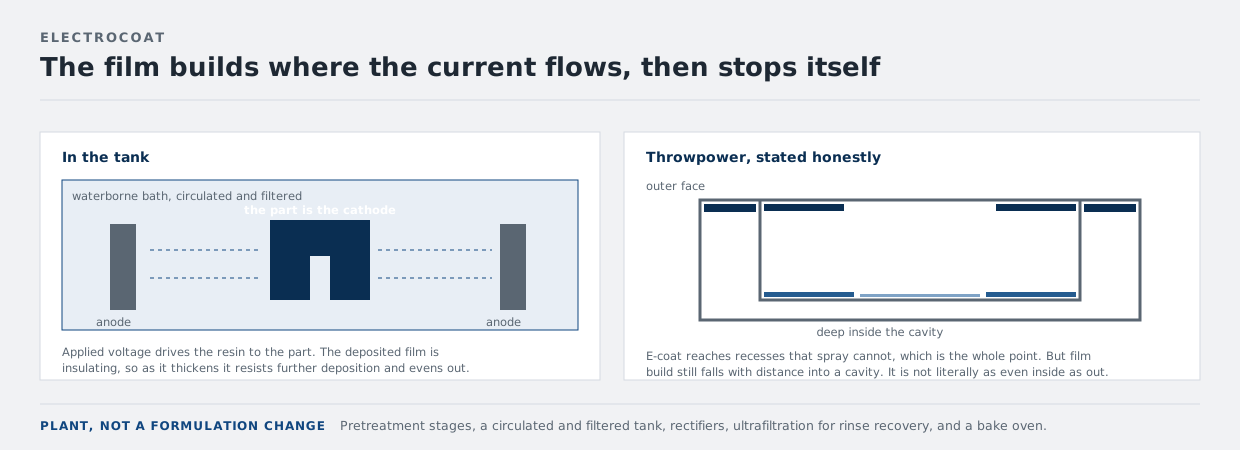
The film insulates as it builds, so deposition self-limits and evens out. Throwpower has limits worth stating.
The Arcdip range
8 products in 4 families. Each is specified against the substrate, the process and the service conditions of the job rather than supplied from a fixed catalogue.
Arcdip CE Cathodic Epoxy Electrocoat
Cathodic epoxy grades for corrosion priming of pretreated steel fabrications. These are the corrosion grades of the range, deposited at the cathode so no metal dissolves from the part into the film. Epoxy binders chalk and lose gloss under sunlight, so a CE grade is normally the primer beneath a liquid or powder topcoat, or the finish on parts that are not exposed.
Arcdip CE 220 Cathodic Epoxy Electrocoat Primer
The standard cathodic epoxy corrosion primer for a tank held on one colour and run continuously. Deposition self-limits as the film insulates the surface, so build evens out across open faces and continues into seams, flanges and box sections after the outer surfaces have coated. It is the reference grade in the subfamily: CE 340 is chosen over it only where throw into cavities or film build on the open surface is the governing requirement.
Substrates Zinc phosphated cold rolled steel, hot rolled and pickled steel, hot dip and electrogalvanised steel, and steel fabrications and castings that hang in reliable electrical contact and drain freely. Closed cavities need access and drain holes or the bath cannot reach them.
Process Immersion in a circulating cathodic bath at 28 °C to 32 °C, 150 V to 250 V DC applied over 120 s to 180 s, ultrafiltrate rinse followed by a demineralised water rinse, then bake at 175 °C to 190 °C metal temperature for 15 min to 25 min at temperature. Supplied as resin emulsion and pigment paste feeds with the solubilising acid and correction additives the operating tank consumes.
Arcdip CE 340 High Throw High Build Cathodic Epoxy Electrocoat Primer
A cathodic epoxy formulated so that current continues to drive deposition further into box sections, blind areas and weld seams after the outer surfaces are coated, and so that the open surface finishes at a higher build than CE 220. Throw is finite and directional: film thickness still falls with distance into a cavity, so an interior surface finishes thinner than the outside and the geometry, not the coating, sets the limit. Specified for welded and folded assemblies where the interior of the fabrication has to carry a measurable film.
Substrates Zinc phosphated steel fabrications, welded assemblies, chassis and box section work, and zinc-coated steel. Suited to parts with internal volumes that are vented and drained; sealed cavities remain uncoated whatever the throw of the material.
Process Immersion in a circulating cathodic bath at 28 °C to 32 °C, 200 V to 300 V DC applied over 150 s to 180 s, ultrafiltrate and demineralised water rinses, then bake at 175 °C to 190 °C metal temperature for 20 min to 25 min at temperature. Higher voltage and a longer coating time raise both build and throw, within the rupture voltage the bath will tolerate, and both are set on the line against a box cell result rather than assumed.
Arcdip CA Cathodic Acrylic Electrocoat
Cathodic acrylic grades that hold colour and gloss on exterior exposure well enough for the electrocoat film to serve as the finish rather than only a primer. They are specified where a single dipped coat has to carry appearance, and they accept that the tank is committed to one colour for the duration of the run.
Arcdip CA 230 Cathodic Acrylic Electrocoat Finish
A cathodic acrylic in which the electrocoat film is the finish rather than a primer, holding colour and gloss on exterior exposure better than an epoxy film of the same build. It gives the coverage of the immersion process, including recesses and seams, in one dipped coat with no spray stage after it. Because the tank carries one colour at a time, the shade belongs to the line and the production run, not to the individual part.
Substrates Zinc phosphated or zirconium pretreated steel, zinc-coated steel, and aluminium extrusion and castings where the pretreatment suits the alloy. Where corrosion protection governs rather than appearance, a CE primer beneath a separate topcoat is the more usual answer.
Process Immersion in a circulating cathodic bath at 28 °C to 32 °C, 150 V to 250 V DC applied over 120 s to 180 s, ultrafiltrate and demineralised water rinses, then bake at 165 °C to 185 °C metal temperature for 20 min at temperature. Bath filtration is tighter than on a primer line because the film is the visible surface.
Arcdip CA 350 Exterior Durable Cathodic Acrylic Electrocoat Finish
The higher performing acrylic in the subfamily, formulated for longer gloss and colour retention under sunlight and for a higher film build on the open surface than CA 230. It is specified where the single dipped coat has to stay presentable outdoors for the service life of the component rather than only through storage and installation. Exterior performance is agreed as a named exposure test and duration, for example accelerated exposure to ISO 16474-3 with gloss measured to ISO 2813, and the gloss level itself is set by the grade and by the pigmentation of the bath, so it is fixed before the tank is charged.
Substrates Zinc phosphated or zirconium pretreated steel and zinc-coated steel, aluminium extrusion and castings, and mixed-metal loads where the pretreatment has been proved on each alloy in the load.
Process Immersion in a circulating cathodic bath at 28 °C to 32 °C, 180 V to 280 V DC applied over 150 s to 180 s, ultrafiltrate and demineralised water rinses, then bake at 170 °C to 190 °C metal temperature for 20 min to 25 min at temperature. Exterior grades are the least tolerant of dragged-in oils and bath contamination, so pretreatment rinse quality governs the result as much as the coating does.
Arcdip AN Anodic Electrocoat
Anodic grades, pigmented and clear, in which the part is the anode. The bath is simpler and lower in cost than a cathodic system, and some metal dissolves from the part and is carried into the film, which limits corrosion performance. Specified for interior components of moderate corrosion demand and for decorative clear films over plated, polished and anodised surfaces.
Arcdip AN 110 Anodic Clear Electrocoat
A clear anodic film deposited over a surface that is already the finish, such as plated and polished trim, brushed or anodised aluminium and decorative brass. The film is thin by design, sealing and protecting the surface from handling and tarnish without hiding it. Anodic deposition dissolves a small amount of metal from the part into the film, which is visible as a slight cast on bright surfaces, and this is the reason clear anodic work is qualified on the actual substrate before a run is committed.
Substrates Plated, polished and brushed steel and brass, anodised and mill finish aluminium, and architectural aluminium sections. Not intended for bare steel exposed outdoors, where a cathodic system is required.
Process Immersion in a circulating anodic bath at 22 °C to 28 °C, 80 V to 150 V DC applied over 60 s to 120 s, demineralised water rinse, then bake at 160 °C to 185 °C metal temperature for 15 min to 20 min at temperature. Catholyte cells remove the alkali released at the counter electrode so bath pH holds.
Arcdip AN 230 Pigmented Anodic Electrocoat
A pigmented anodic grade for interior components and decorative fabrications where corrosion demand is moderate and the simpler, lower cost anodic bath is justified. It reaches into recesses as any electrocoat does and builds a self-limiting film at lower deposition voltage than a cathodic system, although throw is normally below that of a high throw cathodic epoxy. Because metal dissolves from the part at the anode and is carried into the film, corrosion performance sits below a cathodic epoxy of equal thickness, so this grade is not specified for exterior structural steelwork.
Substrates Phosphated or zirconium pretreated cold rolled steel and aluminium, in interior enclosures, shelving, furniture frames, fittings and appliance internals. Zinc-coated steel is taken only where the pretreatment and the bath have been proved on that coating type, because anodic dissolution attacks the zinc layer preferentially.
Process Immersion in a circulating anodic bath at 22 °C to 28 °C, 100 V to 200 V DC applied over 90 s to 150 s, ultrafiltrate and demineralised water rinses, then bake at 150 °C to 180 °C metal temperature for 20 min at temperature.
Arcdip AU Autodeposition and Pretreatment Compatible Systems
Two routes for lines whose pretreatment or substrate mix does not suit a conventional zinc phosphate and cathodic epoxy sequence: an autodeposition coating that builds chemically on ferrous metal with no applied current and no conversion coating stage, and a cathodic electrocoat formulated to run over thin-film zirconium pretreatment on mixed-metal loads.
Arcdip AU 120 Autodeposition Epoxy Coating
An acidic waterborne epoxy emulsion that deposits on ferrous metal by chemical reaction rather than by applied current: the acid and the oxidiser in the bath dissolve iron at the surface, and the iron ions released destabilise the emulsion in the layer against the metal so film builds there. There are no rectifiers, no counter electrode cells and no conversion coating stage, and film builds with time in the bath, so racking is a handling question rather than an electrical one and Faraday cage effects do not arise. It deposits only on iron and steel, so mixed-metal loads and zinc-coated or aluminium parts are outside its scope.
Substrates Cold rolled steel, hot rolled and pickled steel, castings and steel tube and stampings, cleaned and rinsed but with no phosphate or zirconium conversion coating. Zinc-coated steel, aluminium, stainless grades and plastics do not coat.
Process Immersion in an acidic autodeposition bath at 18 °C to 24 °C for 60 s to 120 s with no applied current, then a water rinse and a reaction or sealing rinse that coalesces the wet film and stops further reaction, then cure at 100 °C to 120 °C part temperature for 20 min to 30 min. Bath control is by solids, free acid, oxidiser level, redox potential and dissolved iron concentration rather than by voltage and conductivity.
Arcdip AU 240 Thin-Film Pretreatment Compatible Cathodic Electrocoat
A cathodic electrocoat formulated to deposit and adhere over thin-film zirconium oxide conversion coatings rather than over a conventional zinc phosphate layer, and to behave consistently when steel, zinc-coated steel and aluminium pass through the tank in the same load. Thin-film pretreatment lowers sludge, drops the pretreatment operating temperature and removes the phosphate rinse load, but it leaves a much thinner and smoother conversion layer, so the electrocoat has to carry adhesion that a phosphate crystal structure would otherwise provide. Specified when a line is converting its pretreatment, or when a mixed-metal load makes a single phosphate chemistry impractical.
Substrates Zirconium pretreated cold rolled steel, hot dip and electrogalvanised steel, aluminium sheet, extrusion and castings, and mixed-metal assemblies carried on one jig.
Process Immersion in a circulating cathodic bath at 28 °C to 32 °C, 150 V to 250 V DC applied over 120 s to 180 s, ultrafiltrate and demineralised water rinses, then bake at 175 °C to 190 °C metal temperature for 20 min at temperature. Pretreatment coating weight and rinse conductivity are the two variables that decide the result and both are controlled on the pretreatment stages, not in the e-coat tank.
Typical operating window
The figures below are the typical operating window for this range, not a measured result for any one batch. Confirmed values are issued with the Technical Data Sheet and Certificate of Analysis by our laboratory.
| Property | Typical operating window | Method |
|---|---|---|
| Bath non-volatile content | 18% to 22% by weight for a cathodic bath, 10% to 15% for an anodic bath | ISO 3251 |
| Bath pH | 5.5 to 6.3 cathodic, 7.8 to 8.6 anodic | ISO 19396-1 |
| Bath conductivity | 1200 µS/cm to 1900 µS/cm, referred to 25 °C | Calibrated conductivity cell, technique as in ISO 7888 for water, no coating specific standard method |
| Pigment to binder ratio | 0.12 to 0.25 by weight for a pigmented primer | Gravimetric solids and ash determination, no published standard method |
| Bath temperature | 28 °C to 32 °C cathodic, 22 °C to 28 °C anodic, 18 °C to 24 °C autodeposition | Calibrated in-tank probe, no published standard method |
| Deposition voltage and coating time | 80 V to 300 V DC applied over 60 s to 180 s, set by grade and by the geometry of the load, below the rupture voltage of the bath | Rectifier instrumentation, no published standard method |
| Dry film thickness, open surface | 8 µm to 15 µm clear anodic, 18 µm to 25 µm standard build, 25 µm to 35 µm high build | ISO 2178 on steel, ISO 2360 on aluminium |
| Throwing power, closed four-plate box cell | 150 mm to 250 mm penetration at the standard cell gap, higher on a high throw grade | Closed box cell, in-house method, no published standard |
| Cure schedule | 175 °C to 190 °C metal temperature for 15 min to 25 min at temperature, lower for acrylic and anodic grades, 100 °C to 120 °C part temperature for autodeposition | Attached thermocouple oven profile, cure confirmed by solvent rub to ASTM D5402 |
| Cross-cut adhesion | Classification 0 to 1, cut at 1 mm spacing for films below 60 µm on steel | ISO 2409 |
| Neutral salt spray, scribed panel over a conversion coating | 500 h to 1000 h for a cathodic epoxy primer, creep from the scribe rated at the agreed limit. A comparative laboratory result on prepared panels, not a prediction of service life | ISO 9227 exposure, assessment to ISO 4628-8 |
| Resistance to condensation humidity | 240 h to 480 h for a cathodic epoxy primer, no blistering beyond the agreed rating | ISO 6270-2 exposure, blistering assessed to ISO 4628-2 |
| Specular gloss at 60 degrees, acrylic single coat grades | 30 to 85 units by grade and pigmentation | ISO 2813 |
| Accelerated weathering, exterior acrylic grades | Gloss and colour retention agreed as a stated exposure duration for the end use | ISO 16474-3 exposure, gloss to ISO 2813 |
Application
How the film is deposited
The part is the electrode. It is immersed in the waterborne bath and connected into a direct current circuit, negative in a cathodic system and positive in an anodic one. Current passing through the bath electrolyses water at the surface of the part and shifts the pH in the thin layer against the metal, so the charged resin and pigment that have migrated there lose their solubility and deposit as a coherent film. Continued current draws water out of that deposit by electro-osmosis, which is what makes the wet film firm enough to be rinsed before it is baked. The film that forms is insulating, so current through the coated area falls and deposition moves on to whatever surface is still bare. That self-limiting behaviour is the reason to use the process: build evens out on open faces and carries on into the inside of box sections, the back of flanges, blind holes and weld seams that no spray gun can see.
What throwing power actually means
Electrocoat reaches into recesses that spray cannot, and it is worth being precise about the limit. Current density falls with distance into a cavity, so film build falls with it. The interior of a box section finishes thinner than the outside, not equal to it, and the drop is measurable. Throw is a property of the bath as much as of the grade: conductivity, rupture voltage, applied voltage and coating time all move it, and an anodic bath normally throws less than a high throw cathodic epoxy. A high throw grade such as Arcdip CE 340 pushes that gradient further into the fabrication but does not remove it. The bath must also be able to enter and drain, so a sealed cavity stays uncoated whatever the grade, and access and drain holes belong in the fabrication drawing rather than in a later fix. Where an interior film thickness is contractual, it is agreed as a separate figure from the open surface figure and measured at named points.
The plant the process requires
Electrocoat cannot be added to a spray booth. A line needs multi-stage pretreatment with cleaning, rinsing and a phosphate or zirconium conversion coating, with effluent treatment for those rinses. It needs the coating tank itself under continuous circulation, filtration and temperature control, direct current rectifiers feeding counter electrodes housed in their own cells, and anolyte cells in a cathodic system or catholyte cells in an anodic one so the acid or alkali released at the counter electrode leaves the system and bath pH holds. It needs ultrafiltration with permeate rinse stages to recover dragout back into the tank, a demineralised water rinse, and a bake oven able to hold the metal temperature the grade requires. Parts need jigs that keep reliable electrical contact and let the bath drain. The tank is a live chemical system, replenished continuously against analysis rather than run in batches, and it deteriorates if left standing, which is why the process suits high volume repeat production and not short job-shop runs.
Primer or finish
Cathodic epoxy is the corrosion reference of the range and it chalks and loses gloss under prolonged sunlight, so it is normally a primer with a liquid or powder topcoat over it. That pairing is agreed before the primer is specified, because the primer bake, the surface condition it leaves and the recoat window all have to suit the coat that follows. Cathodic acrylic is the answer where a single dipped coat must hold exterior colour and gloss on its own. Anodic grades serve interior and decorative work where the lower cost bath is justified and the corrosion demand is moderate.
Bath control and supply
Composition drifts with throughput. Each electrocoat grade is therefore supplied as feed materials, resin emulsion and pigment paste, with the solubilising acid or amine the system runs on and correction additives including anti-crater and edge protection, against the line’s own control and analysis regime rather than as a one-off order. The tank holds one colour at a time, so the line is committed to that colour until the bath is emptied and recharged. Arcdip AU 120 is the exception in the range: it carries no current, and its bath is controlled on free acid, oxidiser level, redox potential and dissolved iron rather than on voltage and conductivity.
How to read the figures
Every value in the table above is a typical operating window for this class of process, published so that a plant can judge whether its line, its rectifiers and its oven are in the right region. None of them is a measured result for an Arctic grade. The salt spray, humidity and accelerated weathering figures are comparative laboratory results on prepared panels and are not a prediction of service life. Grade specific values, bath make-up instructions and control limits are given on the Technical Data Sheet, with a Safety Data Sheet for each grade and a compliance dossier issued on request.
Specifying this range
Electrocoat is specified against the line as much as against the part. The following are the questions Arctic needs answered before a grade is proposed.
The part
- What is the substrate, and does one jig carry more than one metal? A steel only load keeps autodeposition open as a route; steel with zinc-coated steel and aluminium in the same load does not.
- Does the fabrication contain box sections, blind holes or closed cavities, and where are the access and drain holes? Can they be moved if the coating requires it?
- How does the part hang, and where does the jig make electrical contact? Contact marks land somewhere, and that position is chosen rather than accepted.
- Is the part exposed to sunlight and weather in service, or is it interior?
The requirement
- Is the electrocoat the finish, or a primer? If a primer, which topcoat follows, applied by which process, and what recoat window does the line allow between bake and topcoat?
- What film build is required on the open surface, and separately, what is the minimum acceptable build inside the cavity and at which measurement points?
- What is the service environment, stated where possible as a corrosivity category to ISO 12944-2, and what is the corrosion requirement stated as a test, a duration and a scribe assessment limit rather than as a general expectation?
- If exterior appearance is part of the requirement, what exposure test and duration is it to be agreed against, and what gloss and colour retention is acceptable at the end of it?
- What colour and gloss, and is the line prepared to commit the tank to that colour for the run?
- Is corrosion protection governing, which points to a cathodic grade, or is the work decorative with moderate corrosion demand, where anodic is viable?
The line
- What pretreatment is installed: zinc phosphate, iron phosphate or thin-film zirconium, and what coating weight and rinse conductivity does it hold? Is a change of pretreatment planned?
- What is the tank volume, the throughput in square metres per hour and the resulting bath turnover? Composition drifts with load.
- What rectifier capacity and voltage range is available, and how are the counter electrode cells arranged?
- Is ultrafiltration with permeate rinse fitted, and is there a final demineralised water rinse? What is the filtration rating and the temperature control range?
- What maximum metal temperature and dwell can the oven hold, and does any assembled component, fastener, bearing or seal limit it?
- Is the tank being charged from new, recharged, or converted from another supplier’s material while running?
- Who analyses solids, pH, conductivity, pigment to binder ratio and neutralising agent content, at what frequency, and against whose limits?
Documentation
- Which documents are required with delivery beyond the Technical Data Sheet and Safety Data Sheet, and is a compliance dossier needed for the end use? Dossiers and declarations are issued on request.
Documents and specification
The Technical Data Sheet, Safety Data Sheet and regulatory declaration for any grade in this range are issued by our laboratory against the substrate and process you are running. Tell us the job and we will specify against it.