
Electrical Insulation and Wire Enamels
Insulation on a winding has to do three things at once: hold off the voltage, survive the operating temperature for the working life of the machine, and hold the conductors still. This range covers the enamels, impregnating resins, casting compounds, varnishes and laminates that do it.
Overview
A winding is a long conductor packed tightly into a small space and asked to carry current without any part of it touching any other part. Every material in this category exists to keep that separation. The enamel on the wire is the primary insulation and is the thinnest layer in the machine: what stands between one turn and the turn wound against it is two enamel films in contact, and nothing else. The impregnating resin comes next. It displaces the air left in the slot, bonds the winding into a solid block and carries heat out of the copper into the iron. Casting and potting resins encapsulate whole assemblies, where the cured resin is the insulation and the mechanical body of the part at the same time. Flexible laminates line slots and separate phases, and in low voltage random wound machines the slot liner is also the ground wall, while high voltage stator bars use mica based tapes for that duty. Finishing varnishes close the surface of the completed winding against moisture, dust and oil. The line against Energy and Electronics Coatings is drawn by the object being coated: insulation is the winding, the motor and the transformer, and energy and electronics is the cell, the board and the enclosure. A traction motor is wound with materials from this range, and the controller board and its housing are finished from that one.
The defining constraint is that three properties have to hold together, not one. Electrical strength decides whether the turn survives the voltage. On mains frequency sine wave duty that comes down to the breakdown voltage of the film, but on an inverter drive the stress is different in kind: the fast rising pulse divides unevenly along the phase, so the first few turns take a disproportionate share of it, and it is repetitive partial discharge in the small air gaps between turns, rather than a single breakdown event, that erodes an ordinary organic film. Windings on that duty are conventionally specified with corona resistant enamel, in which an inorganic filler slows the erosion. Mechanical toughness decides whether the enamel reaches service intact, because the wire is drawn through dies, bent over formers and pulled into slots before it ever sees a volt, and a nick in the film during winding is the commonest route to a turn-to-turn short. Thermal endurance decides the life. IEC 60085 sets out the thermal classes used to describe insulating materials and systems, with class F at 155 °C and class H at 180 °C the two that most motor and transformer work in India is written against. Two points about that are worth stating plainly. Thermal class belongs to the combination of materials and not to any one of them: the thermal endurance of a single material is established to IEC 60216, while the class of a rotating machine insulation system is established on the system as built, to IEC 60034-18, so no enamel or varnish carries a class into a machine on its own. And conventional engineering practice treats insulation life as roughly halving for every 8 to 10 K of sustained overtemperature, which is why the weakest element in the stack sets the class of the whole.
Process matters as much as chemistry here, so it is worth being clear about what each part of the range needs on the customer’s side. Wire enamels are applied on a wire enamelling line: the bare conductor passes repeatedly through applicator dies or felts and a curing oven, building the film in many thin passes, with catalytic oxidation of the solvent vapour in the oven supplying part of the heat. That line belongs to the wire maker, and Arctic supplies the enamel formulated for it, not the wire. Impregnation is within reach of a general winding shop, at three levels of plant. Dip and bake needs a resin tank and a curing oven. Trickle needs a rotating fixture, preheat by current injection and a controlled dispensing head. Vacuum pressure impregnation needs the most: a vessel that can pull vacuum and then apply pressure, a separate storage tank to hold the resin between cycles, and an oven to cure the treated unit. Solventless impregnating resins cut oven emissions, and because nothing evaporates out of the film they fill a slot more completely for the same dip, but the word solventless is worth reading carefully. The conventional unsaturated polyester types cure through a reactive monomer, usually styrene, which is itself volatile and has to be extracted and handled, and monomer free grades exist where that is the constraint. Solventless resins also demand more discipline in the shop, since pot life, storage temperature and gel time govern the process rather than drying, and the resin polymerises where it sits. Casting work needs two component metering and mixing, degassing or casting under vacuum wherever voids cannot be tolerated, moulds, and an oven for cure and post cure. Electrical insulation is a new capability area for Arctic Materials. Grades are formulated against the customer’s process and the thermal class of the system they go into, and each is supplied with a Technical Data Sheet and a Safety Data Sheet.
IEC 60085 thermal classes
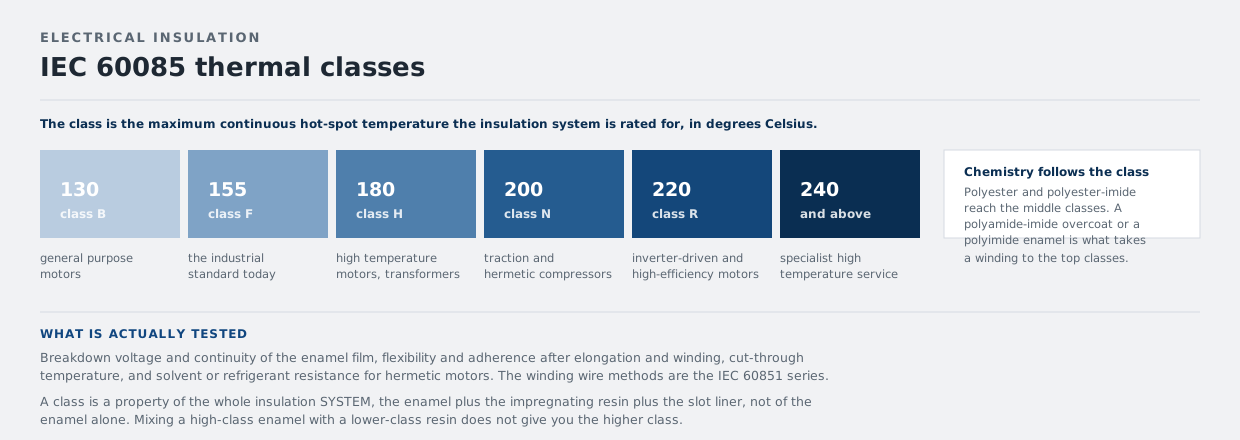
The class belongs to the whole insulation system, not to the enamel on its own.
The Arcwire range
10 products in 7 families. Each is specified against the substrate, the process and the service conditions of the job rather than supplied from a fixed catalogue.
Arcwire PV Polyvinyl Acetal and Polyesterimide Enamels
Base enamels applied directly to the bare conductor on a wire enamelling line. The subfamily runs from phenolic-modified polyvinyl acetal for class 120 E oil-immersed transformer wire up to THEIC-modified polyesterimide for class 180 H motor wire. These grades are used alone where the winding duty allows it, and as the base coat under an Arcwire PA overcoat where it does not.
Arcwire PV 120 Polyvinyl Acetal Wire Enamel
A phenolic-modified polyvinyl acetal base enamel for class 120 E winding wire, the long-established film for oil-immersed transformer wire and for coils that are wound and formed hard. The film is tough, resistant to hot mineral oil and resistant to abrasion during winding, which is what keeps it in service on transformer wire although its thermal class sits at the bottom of the range. It also accepts an Arcwire SB bondcoat cleanly, so it is a usual base under a self-bonding construction.
Substrates Bare round and rectangular copper conductor, and bare aluminium conductor, 0.20 mm to 1.60 mm diameter or the equivalent section.
Process Applied on a wire enamelling line by die or felt in six to ten thin passes. Oven cured in sequence, with the evaporation and curing zones set against line speed. Thermal class 120 E. Not directly solderable: terminations are stripped, welded or crimped.
Arcwire PV 180 Polyesterimide Base Enamel
A THEIC-modified polyesterimide base enamel for class 180 H motor, generator and transformer winding wire, and the general purpose grade of the category. Imide content in the backbone together with the THEIC modification of the polyester is what lifts the temperature index out of the plain polyester range, and the enamel is formulated for fast line speeds, a smooth surface and a low pinhole count. It is specified on its own where the winding duty allows it, and as the base coat under Arcwire PA 200 or PA 220 where cut-through, refrigerant or inverter stress rules a single coat out.
Substrates Bare round and rectangular copper conductor, and bare aluminium conductor, 0.20 mm to 3.00 mm diameter or the equivalent section.
Process Applied on a wire enamelling line by die or felt in eight to twelve thin passes to grade 1 or grade 2 build. Oven cured in sequence. Thermal class 180 H alone, and the base of a dual coat construction at 200 N or 220 R. Not directly solderable.
Arcwire PA Polyamide-imide Overcoat Enamels
Polyamide-imide topcoats applied over a polyesterimide base in the final passes of the same enamelling line, giving the dual coat construction specified where the wire is wound hard or run hot. Polyamide-imide is the conventional choice for abrasion and cut-through resistance, hydrolysis resistance and refrigerant resistance. A filled, corona resistant grade covers inverter-fed and hermetic duty.
Arcwire PA 200 Polyamide-imide Overcoat Enamel
A polyamide-imide overcoat applied over an Arcwire PV 180 base in the final passes of the enamelling line to give a class 200 N dual coat wire. The overcoat carries the abrasion resistance, the cut-through temperature and the hydrolysis resistance while the base carries most of the film build, so the two are specified and cured as a pair and the adhesion between the layers is part of the specification. This is the standard construction for hard-wound stators, pull-in windings and machines that see repeated thermal overload.
Substrates Cured polyesterimide base enamel on round or rectangular copper or aluminium conductor. Not applied directly to bare conductor.
Process Applied as the last two to four passes on the same enamelling line, typically 10 % to 30 % of total film build, and cured in the same oven sequence as the base. The base must be cured enough to carry the topcoat and not so far cured that the two layers fail to bond. Thermal class 200 N as a dual coat system.
Arcwire PA 220 Corona Resistant Polyamide-imide Overcoat
A polyamide-imide overcoat carrying a dispersed inorganic filler, for class 220 R wire on inverter-fed windings and on hermetic compressor motors. The filler slows the erosion of the organic film by repetitive partial discharge in the small air gaps between turns, which is the mechanism that ends the life of an ordinary enamel on fast-rising pulse duty rather than a single breakdown event. The same chemistry gives the refrigerant and hydrolysis resistance that sealed refrigeration and air-conditioning windings are specified against, and the resin is formulated to hold the filler dispersed through the line.
Substrates Cured polyesterimide or polyimide base enamel on round or rectangular copper or aluminium conductor.
Process Applied as the last three to five passes on the enamelling line over a cured base, with agitated circulation in the applicator to keep the filler in suspension. Oven cured in sequence. Thermal class 220 R as a dual coat system. Corona resistance is a property of the wire, while converter-fed endurance is qualified on the insulation system as built.
Arcwire PI Polyimide Enamels
Polyimide enamel for the highest thermal class in the range, used where the continuous conductor temperature, short-term overload or chemical exposure is beyond what polyesterimide and polyamide-imide will hold. The film is built from a single chemistry through the whole pass sequence rather than as a base and an overcoat.
Arcwire PI 240 Polyimide Wire Enamel
A polyimide enamel for the highest thermal class in the range, built from one chemistry through the whole pass sequence, for windings that run at a continuous conductor temperature beyond the reach of polyesterimide and polyamide-imide, and for short-term overload, cryogenic and chemically exposed duty. The film holds its electrical strength at temperature and resists most solvents, but it is not solderable and it is attacked by strong alkali and by prolonged hydrolysis. Where the slot is tight and abrasion during pull-in is the limiting factor, it is overcoated with a polyamide-imide topcoat rather than used bare.
Substrates Bare round and rectangular copper conductor, including silver and nickel plated copper for the highest temperature work.
Process Applied on a wire enamelling line from polyamic acid solution in ten to sixteen very thin passes, with a longer and hotter cure zone than the polyester chemistries require and imidisation completed in the oven. Thermal class 240, which is designated as a bare class number in the winding wire standards and carries no letter.
Arcwire SB Self-bonding Enamels
Bondcoat enamels applied over a cured base enamel, so that a wound coil can be fused into a self-supporting body by hot air, solvent or resistance heating instead of by a former, a tape or an impregnating resin. Used for air-cored coils, voice coils, deflection and sensor coils and small ignition coils.
Arcwire SB 155 Self-bonding Overcoat Enamel
A bondcoat applied as the outermost passes over a cured base enamel, so that the finished coil can be fused into a self-supporting body by hot air, by solvent applied to the wound coil or by injecting current through the winding, with no former, tape or impregnation step. It is used for air-cored and voice coils, deflection and sensor coils, small ignition coils and any assembly where the wound shape has to hold itself. The bondcoat softens well below the thermal class of the base enamel, so it is the bond and not the base film that sets the working temperature of a self-bonded coil, and the activation route has to be agreed before the grade is fixed.
Substrates Cured polyvinyl acetal, polyester or polyesterimide base enamel on fine round copper conductor, typically 0.05 mm to 1.00 mm.
Process Applied as the last two to four passes on the enamelling line and cured without activating the bond. Bond developed later at the coil winder by hot air, by solvent or by resistance heating. Base enamel up to class 180 H, with the bondcoat rated class 155 F, which is what limits the bonded assembly in service.
Arcwire IR Impregnating and Trickle Resins
Resins that displace the air left in the slot after winding, bond the conductors into a solid block and carry heat out of the copper into the iron. The subfamily covers a solvent-borne dip and bake varnish for shops with a tank and an oven, and a solventless resin formulated for trickle and for vacuum pressure impregnation.
Arcwire IR 155 Dip and Bake Impregnating Varnish
A solvent-borne class 155 F impregnating varnish for shops working with a dip tank and a curing oven, which is the lowest plant requirement in the impregnation range and the most tolerant of interruptions and mixed batch sizes. Because the solvent leaves during bake, the film shrinks as it goes and draws back from the slot, so full fill is built over two or three dip and bake cycles rather than one. It penetrates a tight winding readily at ambient temperature and is the practical choice for rewind and repair work, where the geometry varies from unit to unit.
Substrates Wound stators, rotors, armatures, field coils and transformer coils, over enamelled wire, slot liners, tapes and sleeving.
Process Dip, flood or roll dip at ambient temperature, drain, solvent flash-off, then oven cure. Two or three cycles where full slot fill is required. Thermal class 155 F.
Arcwire IR 200 Solventless Trickle and VPI Resin
A solventless class 200 N resin supplied for trickle impregnation on a rotating fixture with preheat by current injection, and for vacuum pressure impregnation in a vessel with a separate storage tank. No solvent leaves the film, so one treatment fills the slot that a solvent-borne varnish needs several cycles to reach, and oven emissions are lower. Pot life, storage temperature, viscosity and gel time govern the process instead of drying, so the grade is set against the shop cycle time and fixture temperature, and a monomer-free version is supplied where reactive monomer extraction is the constraint.
Substrates Wound stators, rotors and armatures, form-wound and random-wound coils, dry-type transformer windings, over enamelled wire and compatible slot insulation.
Process Trickle onto a rotating preheated winding, or vacuum pressure impregnation followed by oven cure. Gel time and viscosity matched to the cycle. Cold storage and controlled pot life required. Thermal class 200 N.
Arcwire CP Casting and Potting Compounds
Two-component systems for encapsulating coils, sensors and control assemblies, where the cured resin is the insulation, the mechanical body of the part and the heat path out of it at the same time. Selection is governed by flow and gel profile against the cavity being filled and by thermal expansion against the conductor and the housing.
Arcwire CP 155 Epoxy Casting and Potting Compound
A two-component class 155 F epoxy system for encapsulating coils, current and position sensors, ignition components, small dry transformers and low voltage control assemblies, supplied for metered mixing and for casting under vacuum where voids cannot be tolerated. Mineral filler loading is set to raise thermal conductivity and to bring the expansion of the cured body closer to that of the conductor and the housing, since the difference in expansion is what cracks an encapsulation under thermal cycling rather than the peak temperature itself. Viscosity and gel profile are specified against the cavity, because the resin has to reach the bottom of the part and release its air before it gels.
Substrates Coil assemblies, magnet wire, ferrite and laminated cores, printed boards, sensor bodies, and thermoplastic, thermoset or metal housings and moulds.
Process Two-component metered mixing, degassing or casting under vacuum, gravity or pressure fill, then oven cure and post cure. Mould release and housing pretreatment set the adhesion. Thermal class 155 F.
Arcwire VA Insulating Varnishes
Finishing and touch-up varnishes that close the surface of a completed or rewound winding against moisture, dust and oil. They are applied after impregnation rather than in place of it, and are matched to the thermal class of the enamel and the impregnating resin below them.
Arcwire VA 180 Insulating Finishing Varnish
A class 180 H finishing varnish for sealing the surface of an impregnated winding against moisture, dust, oil and coolant, applied by brush, dip or spray, and used for touch-up of end windings, terminal boxes and connection leads after a rewind. It is a surface seal and not a substitute for impregnation, since it does not fill the slot or bond the conductors. Air-drying and baking versions are supplied so that the varnish can be applied to a machine that cannot go back into an oven.
Substrates Impregnated windings and end turns, laminated cores, connection leads, sleeving, tapes and flexible laminates, and bare steel frames and terminal boxes.
Process Brush, dip or spray in one or two coats. Air-dry version cures at ambient temperature, baking version oven cured. Thermal class 180 H, matched to the enamel and the impregnating resin below it.
Typical operating window
The figures below are the typical operating window for this range, not a measured result for any one batch. Confirmed values are issued with the Technical Data Sheet and Certificate of Analysis by our laboratory.
| Property | Typical operating window | Method |
|---|---|---|
| Thermal class of the material | 120 E, 155 F, 180 H, 200 N, 220 R and 240 across the range | IEC 60085 for the designation, thermal endurance established to IEC 60216-1 |
| Temperature index, enamelled winding wire | 120 to 240, at the 20 000 h reference | IEC 60172 |
| Film build, increase in conductor diameter | grade 1 typically 0.015 mm to 0.060 mm and grade 2 typically 0.025 mm to 0.090 mm over conductors of 0.20 mm to 1.60 mm | limits per IEC 60317-0-1, dimensions measured to IEC 60851-2 |
| Breakdown voltage, twisted pair at ambient temperature | 3.5 kV to 11 kV on grade 2 wire, rising with conductor diameter and build | IEC 60851-5 |
| Continuity of coating, pinhole faults | 0 to 5 faults over a 5 m sample at the specified test voltage | IEC 60851-5 |
| Dissipation factor transition, used as the degree of cure on the line | tan delta rise typically 10 K to 40 K above the thermal class of the enamel | IEC 60851-5 |
| Flexibility and adherence after elongation | no cracking after 15 % to 32 % elongation followed by winding on a mandrel of 1 to 3 times the conductor diameter | IEC 60851-3 |
| Heat shock | no cracking after 30 min at the class temperature plus 20 K, wound on a mandrel of 1 to 5 times the conductor diameter | IEC 60851-6 |
| Cut-through, softening under load | typically 60 K to 150 K above the rated thermal class, in the range 200 °C to 420 °C across the enamel chemistries in this range | IEC 60851-6 |
| Resistance to solvents and to refrigerants | no film softening, blistering or loss of adhesion after the specified exposure and reheating | IEC 60851-4 |
| Bond strength of the impregnating resin, helical coil | 80 N to 300 N at 23 °C, falling to 15 N to 80 N at the class temperature | IEC 61033 |
| Bond strength of self-bonding wire after activation | typically 10 N to 60 N at 23 °C on 0.20 mm to 1.00 mm conductor, depending on diameter and activation route | IEC 60851-3 |
| Gel time at 100 °C, solventless impregnating resin | 6 min to 30 min, set against the shop cycle | IEC 60455-2 |
| Non-volatile matter | 25 % to 40 % for wire enamels, 40 % to 60 % for solvent-borne impregnating and finishing varnishes, above 97 % for solventless resins | ISO 3251 |
| Electric strength of the cured casting or potting compound | 15 kV/mm to 25 kV/mm at 23 °C on a 1 mm specimen | IEC 60243-1 |
Application
The four parts of this range are applied on four different kinds of plant, and the grade has to be formulated for the plant rather than picked off a list. Wire enamels run on the wire maker’s enamelling line, where the bare conductor passes repeatedly through applicator dies or felts and back through a curing oven. The film is never laid down in one thick coat. It is built in six to sixteen thin passes, each of them a few micrometres and the number set by the chemistry and the build, because a thick wet layer cannot release its solvent from the underside before the surface skins over, and the result is blistering, entrapped bubbles and pinholes that show up directly in the continuity test of IEC 60851-5. Thin passes also let each layer cross-link fully, which is what gives the finished film its flexibility and its adherence after elongation under IEC 60851-3, and they let the build be trimmed to grade 1 or grade 2 by adding or dropping a pass. What decides whether a line runs well is wire speed against oven length, the temperature gradient between the evaporation zone and the curing zone, die or felt condition, and the heat returned by catalytic oxidation of the solvent vapour, which supplies a substantial part of the oven’s energy and shifts the whole profile as the catalyst bed ages. Degree of cure is followed by the dissipation factor transition of IEC 60851-5 rather than by appearance. A dual coat construction adds one more variable, the pass at which the polyamide-imide overcoat starts, because the base has to be cured enough to carry the topcoat and not so far cured that the two layers fail to bond.
Impregnation is done in the winding shop, at three levels of plant. Dip and bake needs only a tank and an oven, penetrates a cold winding well and suits varied one-off work such as rewinds, but the solvent leaves during bake and the film shrinks as it goes, so full slot fill takes two or three cycles. Trickle needs a rotating fixture, preheat by current injection through the winding itself and a controlled dispensing head, and it is the high-volume route: resin is metered onto a turning, already hot stator, drawn into the slot by capillary action and gravity, and gelled before it can run out, which keeps cycle time short and waste low. Vacuum pressure impregnation needs the most plant, a vessel that pulls vacuum and then applies pressure, a separate storage tank to hold the resin between cycles and a cure oven, and it is what is specified when the air has to come out of the slot completely, for high voltage windings, traction machines and anything whose partial discharge behaviour is part of the specification. Whichever route is used, the result is judged on bond strength by the helical coil test of IEC 61033, on how much resin is actually in the slot, and on whether the cured block is free of voids.
Casting and potting call for two-component metering and mixing, degassing of the mix or casting under vacuum, moulds, and an oven for cure and post cure. The failure to design against is mechanical rather than electrical: the cured resin, the copper and the housing expand at different rates, and thermal cycling puts the encapsulation into tension against the stiffest part it is bonded to. Filler loading, cure schedule and post cure are the levers on that, and gel profile against cavity geometry decides whether the resin reaches the bottom of the part and releases its air before it sets. Finishing varnish is the last step, applied by brush, dip or spray over an impregnated winding, and it seals the surface rather than filling anything.
On an inverter drive the electrical duty of the whole stack changes, because the fast-rising pulse divides unevenly along the phase and the first turns take a disproportionate share of it. Type I insulation for converter-fed machines is qualified on the system as built, to IEC 60034-18-41, and that qualification belongs to the machine and not to any single material in it. The same logic governs thermal class: IEC 60085 designates the class of a material, IEC 60216-1 establishes the endurance of one material, and IEC 60034-18-21 establishes the thermal class of a wire-wound rotating machine insulation system, so no enamel, resin or varnish carries a class into a machine on its own. The enamel, the impregnating resin, the slot liner and the finishing varnish are therefore specified together and to the same class, because the system is limited by whichever element sits lowest.
Specifying this range
Grades in this range are formulated against the customer’s process and against the thermal class of the system they go into, so the specification starts with questions about the machine and the plant rather than with a product code. Arctic needs the following before a grade is proposed.
- Thermal class of the finished system. Which IEC 60085 class the machine is written against, 120 E, 155 F, 180 H, 200 N, 220 R or 240, what the expected hot-spot temperature is, and whether short-term overload above the class is part of the duty cycle.
- Supply and waveform. Mains sine wave or inverter drive. For an inverter, the DC link voltage, the pulse rise time and the switching frequency, and whether the winding has to be built as corona resistant.
- Which part of the range is in scope. Wire enamel, impregnating resin, casting compound, finishing varnish, or a matched set. Materials at different classes in the same stack are limited by the lowest.
- For enamels, the conductor and the build. Round or rectangular, copper or aluminium, conductor diameter or section, grade 1 or grade 2 build, and single coat or dual coat.
- For enamels, the enamelling line. Vertical or horizontal, oven length and zone temperatures, maximum line speed, die or felt application, number of passes available, whether catalytic solvent oxidation is fitted, and the solvent system the line is already set up to handle.
- Winding and termination method. Hand wound, machine wound, needle wound or pull-in, how tight the slot fill is, and whether the ends are stripped and soldered, welded or crimped. None of the enamels in this range is directly solderable, so a joint that has to be tinned through the film calls for a different chemistry and a lower thermal class.
- Chemical and environmental exposure. Mineral or synthetic transformer oil, refrigerant and lubricant for a hermetic motor, coolant, fuel, humidity and condensation, and any cleaning solvent used in assembly.
- For impregnation, the plant available. Dip and bake, trickle or vacuum pressure impregnation, the vessel and tank sizes, fixture and preheat arrangement, oven capacity and temperature, target cycle time, and whether solvent emissions or reactive monomer extraction is a constraint on site.
- For casting and potting, the part. Cavity geometry and wall section, the smallest gap the resin has to reach, mixing and metering equipment, whether vacuum casting is available, acceptable pot life and demould time, and the housing material the resin is bonded to.
- For self-bonding wire, the activation route. Hot air, solvent or resistance heating, the coil geometry, and the temperature the bonded coil has to hold in service, which the bondcoat sets and not the base enamel.
- Qualification and documentation. Which test series the material will be judged on, typically the IEC 60851 parts for winding wire and IEC 60455-2 for reactive resins, whether a system evaluation is planned to IEC 60034-18-21 for thermal class or to IEC 60034-18-41 for converter-fed duty, and what documentation is to accompany each delivery. A Technical Data Sheet and a Safety Data Sheet are supplied with every grade, and a compliance dossier is issued on request.
- Volume and supply. Annual offtake, batch size, pack format, shelf life needed at the customer’s storage temperature, and whether cold storage is available for reactive systems.
Documents and specification
The Technical Data Sheet, Safety Data Sheet and regulatory declaration for any grade in this range are issued by our laboratory against the substrate and process you are running. Tell us the job and we will specify against it.