
Aluminium Foil and Lidding Lacquers
Arcfoil is Arctic’s range of lacquers for aluminium foil: heat-seal and peel systems that close a pack on a filling line, protective baking lacquers that survive forming and sterilisation, and primers and varnishes for the foil web. The lacquers are roll coated on a coating line and cured in an oven, and every sealing grade is specified against the polymer it has to seal to.
Overview
Aluminium foil behaves differently from plastic film, and the coating has to be built for it. Foil is non-absorbent, so nothing soaks in: the solvent or the water has to leave through the coated surface, and the film forms and cures at that surface rather than partly in the substrate. Foil also has low thermal mass and high conductivity, so the web heats quickly in the oven and cure is fast, which is why foil coating lines run at high web speeds and short oven dwell. The consequence is that adhesion rests entirely on the lacquer chemistry and on the cleanliness of the foil surface. Foil supplied for lacquering is normally fully annealed and carries little residual rolling oil, but the level still varies between coils and across the width of a coil, and residual oil is the most common root cause of adhesion failure on foil. Confirm the residual oil level on the incoming foil before any coating is blamed.
The defining specification in this range is the seal. A seal is made on a filling line at a jaw temperature, a jaw pressure and a dwell time, and the lacquer has to reach its sealing initiation temperature within that dwell or the seal will not form. Seal strength on a web-to-web seal is measured by ASTM F88, and the peel of a finished lid from a filled container is measured on the pack itself using the supported technique of that method. The result is always specified as a window rather than a maximum: too weak and the pack leaks or opens in transit, too strong and the consumer cannot get into it. Easy-peel and controlled-peel grades are engineered to fail in a predictable way, either cohesively within the lacquer layer or cleanly at the interface, at a controlled force. The single most important selection question is the polymer of the container, because a lacquer formulated to seal to polypropylene will not seal to polystyrene, and a grade for rigid PVC will not serve a PET tray.
The range also covers work where the lacquer is not the seal. Protective baking lacquers carry the foil through forming and filling: retort grades have to survive sterilisation, typically 121 to 135 degrees Celsius under steam and pressure, without delamination, blistering or loss of seal, and deep-drawable grades have to stretch with the foil as it is formed into a tray or a blister cavity without cracking at the corners or the draw radius. Primers give a key on difficult, hard-tempered or oily foil and on foil composite, and overprint and spacer varnishes protect print and control winding on the reel. Pharmaceutical blister lidding is a regulated application, and the qualification sits with the finished pack rather than with the lacquer alone. Arctic issues a compliance dossier and declarations on request with the Technical Data Sheet.
Two boundaries are worth stating. Against Speciality Coatings for Packaging, Arcseal is a sealing coating applied inline by the flexible converter onto plastic film and board, while Arcfoil is a roll-coated, oven-cured lacquer on aluminium foil and foil laminate, including retort and pharmaceutical work. Against Metal Packaging Coatings, that range is for rigid metal, a can body or an end formed from sheet or coil, while Arcfoil is a foil web or a die-cut lid. If the substrate is a foil web that will be printed, formed, filled and sealed, Arcfoil is the range.
The sealing window
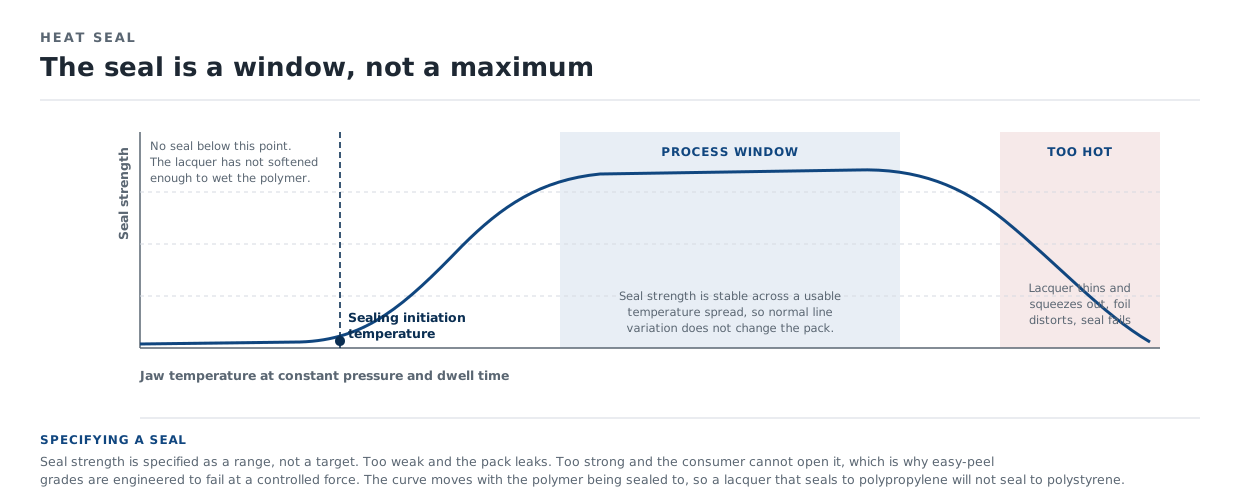
Seal strength is specified as a band, not a maximum.
The Arcfoil range
11 products in 7 families. Each is specified against the substrate, the process and the service conditions of the job rather than supplied from a fixed catalogue.
Arcfoil HS heat-seal lacquers
Heat-seal lacquers for lidding foil, selected by the polymer of the container they have to seal to: polyolefin, styrenic and rigid PVC, or polyester. Each grade is built around a sealing initiation temperature and a seal strength window that suit the filling line.
Arcfoil HS 110 Polyolefin Heat-Seal Lacquer
A heat-seal lacquer for lidding foil that has to seal to polypropylene and polyethylene containers, including cups, pots and injection-moulded trays. It is the lowest film build of the HS grades and is aimed at lines running a moderate jaw temperature where a permanent seal, not a peel, is required. Among its siblings it is the polyolefin grade: it will not seal to polystyrene or to PET, and the container polymer must be confirmed before specification.
Substrates Aluminium foil 20 to 50 micron, hard and semi-hard temper where lids are die cut on the filling line; foil and paper laminate; foil and PET laminate.
Process Roll coated on a web coating line, smooth roll or gravure, oven cured; sealed on a rotary or intermittent cup filler or tray sealer.
Arcfoil HS 220 Styrenic and PVC Heat-Seal Lacquer
A heat-seal lacquer for foil lids sealing to polystyrene and to rigid PVC containers, the pack types common in dairy, dessert and confectionery filling. It carries a higher film build than HS 110 to bridge flange irregularity on thermoformed styrenic pots. It is the styrenic and PVC grade of the HS family and is not interchangeable with the polyolefin or polyester grades.
Substrates Aluminium foil 25 to 50 micron; foil and paper laminate; lacquered or printed foil where the reverse face carries the seal.
Process Roll coated on a web coating line and oven cured; sealed on a rotary cup filler, form-fill-seal line or tray sealer.
Arcfoil HS 330 Polyester Heat-Seal Lacquer
A heat-seal lacquer for foil lids sealing to PET, APET and CPET trays and pots, including packs that are hot filled. It is the highest performance grade in the HS family, formulated for a strong permanent seal at elevated jaw temperature and for seal integrity while the pack is still warm. Where the tray is reheated in a conventional oven, state the oven temperature and whether the lid is removed before reheating, because that stage runs far above any sealing temperature and decides the grade.
Substrates Aluminium foil 30 to 50 micron, hard and semi-hard temper; foil and PET laminate; foil and paper board laminate.
Process Roll coated on a web coating line and oven cured; sealed on a tray sealer or a thermoform-fill-seal line.
Arcfoil LT low sealing-initiation-temperature lacquers
Grades that form a seal at a lower jaw temperature and a shorter dwell, for heat-sensitive fills, thin-wall containers that distort under a hot jaw, and fast lines where dwell is the limiting factor.
Arcfoil LT 120 Low Sealing-Initiation-Temperature Lacquer
A heat-seal lacquer that reaches its sealing initiation temperature at a lower jaw setting and a shorter dwell than the standard HS grades. It is specified for heat-sensitive fills, for thin-wall containers that distort or scorch under a hot jaw, and for fast filling lines where dwell time, not temperature, is the constraint. It seals to polyolefin and styrenic containers and requires a line trial to fix the jaw window.
Substrates Aluminium foil 20 to 40 micron; foil and paper laminate; foil and polymer film laminate where the laminating adhesive limits the seal temperature.
Process Roll coated on a web coating line and oven cured at a moderate peak metal temperature; sealed on high-speed rotary cup fillers and tray sealers.
Arcfoil EP easy-peel and controlled-peel lacquers
Peelable lidding systems engineered to fail at a controlled force, either cohesively within the lacquer or at the interface, so the lid opens cleanly without tearing the foil or lifting the container flange.
Arcfoil EP 140 Easy-Peel Lidding Lacquer
An easy-peel lidding lacquer engineered to fail cohesively within the lacquer layer at a low, consistent force, so the lid lifts cleanly and the split leaves lacquer on both the lid and the flange rather than tearing the foil. It is aimed at consumer packs where opening force matters more than ultimate seal strength, including portion packs and single-serve pots. Against EP 260 it is the lower-force grade, for packs opened by hand without a tab.
Substrates Aluminium foil 25 to 45 micron; foil and paper laminate; sealing to polypropylene, polystyrene and PET flanges depending on the grade variant specified.
Process Roll coated on a web coating line and oven cured; sealed on a cup filler or tray sealer, with the peel force verified on the customer’s own filled pack.
Arcfoil EP 260 Controlled-Peel Lidding Lacquer
A controlled-peel lacquer that gives a higher and tightly bounded peel force with interfacial failure at the flange, for packs that must hold through distribution and still open without tools. The wider sealing window makes it suitable where jaw temperature varies across a multi-lane sealer. It is the higher-force grade of the EP pair and is normally specified with a target peel band rather than a single value.
Substrates Aluminium foil 30 to 50 micron; foil and PET laminate; foil and paper board laminate; sealing to polypropylene and polyester flanges.
Process Roll coated on a web coating line and oven cured; sealed on tray sealers and thermoform-fill-seal lines, with the peel band confirmed on the filling line.
Arcfoil PT protective baking lacquers
Baked protective lacquers for the outer or unsealed face of the foil, including retort-resistant grades for sterilised packs and deep-drawable grades that stretch with the foil during forming.
Arcfoil PT 150 Deep-Drawable Protective Baking Lacquer
A flexible baking lacquer for foil that will be cold formed into a tray, a container or a blister cavity, formulated to stretch with the metal without cracking at the draw radius or the corner. It protects the foil face through forming, filling and handling and accepts overprint where required. Against PT 270 it is the forming grade: it is specified for draw depth, not for sterilisation.
Substrates Aluminium foil 40 to 200 micron for formable trays; the foil web used in cold-form blister laminate; foil and polyamide composite.
Process Roll coated on a web coating line and oven cured; formed on a cold-forming or deep-drawing press, with the draw ratio confirmed by trial.
Arcfoil PT 270 Retort-Resistant Protective Baking Lacquer
A baked protective lacquer for foil packs that are sterilised after filling, typically at 121 to 135 degrees Celsius under steam and pressure. It is formulated to hold adhesion through the retort cycle without blistering, whitening, delamination or loss of seal at the flange. It is the highest performance grade of the PT pair and carries the higher film build of the two.
Substrates Aluminium foil 40 to 150 micron; foil and polyamide or polyester laminate for retort trays and pouched foil components.
Process Roll coated on a web coating line and oven cured at high peak metal temperature; the pack is retorted after filling, and cycle time, temperature and overpressure must be stated at enquiry.
Arcfoil PR primers and wash primers
Thin-film primers that key to foil and foil composite and carry the topcoat, used where a hard temper, a laminate face or a variable residual oil level makes direct adhesion unreliable.
Arcfoil PR 110 Foil and Composite Wash Primer
A thin-film wash primer that keys to aluminium foil and to foil composite and carries the heat-seal, peel or protective topcoat above it. It is specified where direct adhesion is unreliable: hard-tempered foil, a laminate face, or a foil whose residual rolling oil level varies more than the topcoat will tolerate. It is a primer and is not a seal in itself.
Substrates Aluminium foil of all tempers 15 to 200 micron; foil and paper, foil and PET and foil and polyamide composite.
Process Roll coated at low wet film on a web coating line and oven cured, then overcoated inline or on a second pass.
Arcfoil OV overprint and spacer varnishes
Varnishes applied over print on the foil web to protect the image through converting and to control the coefficient of friction and blocking behaviour on the reel and in the die-cutting station.
Arcfoil OV 130 Overprint and Spacer Varnish for Foil
A varnish applied over print on the foil web to protect the image through converting, die-cutting and filling, and to set the surface behaviour of the reel. It is formulated to control the coefficient of friction, measured to ASTM D1894, and to resist blocking when the coated web is wound warm and stored. Used as a spacer varnish, it keeps the wraps apart on the reel and prevents print pick-off on unwind.
Substrates Printed aluminium foil 20 to 50 micron; printed foil and paper laminate; lacquered foil.
Process Roll coated or gravure applied on a web coating line and oven cured, inline after printing or on a separate coating pass.
Arcfoil BL pharmaceutical blister lidding lacquers
Heat-seal lacquers for hard-tempered lidding foil sealing to PVC, PVdC-coated PVC and polypropylene blister bases, formulated for a consistent seal at the high jaw temperatures and short dwell of a blister machine.
Arcfoil BL 180 Pharmaceutical Blister Lidding Lacquer
A heat-seal lacquer for hard-tempered pharmaceutical lidding foil sealing to PVC, PVdC-coated PVC, PCTFE-laminated PVC and polypropylene blister bases. It is formulated for a consistent seal at the high jaw temperature and very short dwell of a blister machine, and for seal integrity through the push-through opening of the finished blister. Pack qualification sits with the pack and with the pack owner, and Arctic issues a compliance dossier and declarations on request with the Technical Data Sheet.
Substrates Hard-tempered aluminium foil 20 to 30 micron, printed or plain; sealing to PVC, PVdC-coated PVC, PCTFE-laminated PVC and polypropylene blister bases.
Process Roll coated on a web coating line and oven cured; sealed on a rotary or platen blister machine, with seal integrity and push-through force confirmed on the customer’s own blister.
Typical operating window
The figures below are the typical operating window for this range, not a measured result for any one batch. Confirmed values are issued with the Technical Data Sheet and Certificate of Analysis by our laboratory.
| Property | Typical operating window | Method |
|---|---|---|
| Non-volatile content | 15 to 45 % by weight, by grade and by carrier | ISO 3251 |
| Supply viscosity, ISO flow cup 4 mm at 23 degrees Celsius | 20 to 60 s; grades that run below the reliable range of the flow cup are measured on a rotational viscometer | ISO 2431, and ISO 2884-1 for rotational measurement |
| Dry coat weight applied | 0.5 to 2 g/m2 for primers; 3 to 12 g/m2 for seal, peel and protective grades | in-house, gravimetric |
| Peak metal temperature in the cure oven | 150 to 220 degrees Celsius, by grade | in-house, travelling thermocouple on the web |
| Sealing initiation temperature | 90 to 180 degrees Celsius, by grade | seals made to ASTM F2029, strength measured to ASTM F88 |
| Seal conditions on test: jaw temperature, jaw pressure, dwell | 140 to 220 degrees Celsius, 0.2 to 0.5 MPa, 0.3 to 2.0 s | ASTM F2029 for web-to-web seals; filling-line settings where the seal is lid to container |
| Seal strength, web to web, specified as a window per pack | 2 to 15 N per 15 mm; easy-peel grades typically 3 to 8 N per 15 mm | ASTM F88 |
| Lid peel from a filled container flange | 2 to 10 N per 15 mm, with the failure mode recorded | supported technique of ASTM F88, on the customer's own pack |
| Adhesion of the cured lacquer | no removal on tape pull, and no removal after a bend over a mandrel; cross-cut classification 0 to 1 where the gauge allows the cut to reach the substrate without cutting the foil | in-house tape pull on thin lidding gauges; ISO 2409 on foil laminate and on foil of 50 micron and above |
| Gloss at 60 degrees, overprint and protective grades | 40 to 90 GU | ISO 2813 |
| Kinetic coefficient of friction, overprint and spacer varnishes | 0.20 to 0.50, coated face to coated face | ASTM D1894 |
| Retort resistance, protective retort grade | 121 to 135 degrees Celsius, 30 to 60 min under steam and pressure, no blistering, whitening or delamination | in-house |
Application
The figures in the table above are the typical operating window for the range, not a measured result for any one grade. Confirmed values are issued with the Technical Data Sheet and Certificate of Analysis by our laboratory.
On the coating line
Arcfoil lacquers are roll coated onto a foil web, by smooth roll, reverse roll or gravure depending on the coat weight, and cured in a hot air oven. The controlling variable is the peak metal temperature the web actually reaches, not the oven air setting. Foil has low thermal mass and heats quickly, but whether it gets to the air temperature depends on web speed, oven length and zone profile, so a change in speed changes the cure as much as a change in the setting. Measure the peak metal temperature with a travelling thermocouple when the line is qualified and after any speed change. Coat weight is set gravimetrically on the running web and should be checked across the width, because a light edge is where seal failures start. Under-cure leaves retained solvent, which shows up later as blocking on the reel, taint in the pack or a seal that drifts with storage. Over-cure embrittles the film and reduces the draw available on formable grades.
Foil surface and adhesion
Adhesion on foil is decided before the lacquer arrives. Foil supplied for lacquering is normally fully annealed, but residual rolling oil from the mill pass still varies between coils and across the width of a coil, and it remains the most common root cause of adhesion failure. Confirm the residual oil level on incoming foil, keep the coils covered and dry, and treat a change of foil supplier as a change of specification that needs a trial. Where the oil level, the temper or a laminate face makes direct adhesion unreliable, prime with Arcfoil PR 110 and coat over it. Test adhesion on the cured web, not on a hand drawdown. On foil laminate and on heavier gauges a cross-cut to ISO 2409 can be made without cutting through the metal; on thin lidding foil the blade cuts or deforms the foil, so the result is a foil failure rather than an adhesion result, and a tape pull, a bend over a mandrel and a solvent rub are the usable checks. Agree the method with Arctic before it is written into a specification.
The seal on the filling line
A seal is made by three variables together: jaw temperature, jaw pressure and dwell time. The lacquer has to reach its sealing initiation temperature at the interface within the dwell available, and on a fast line the dwell is short enough that jaw temperature has to rise to compensate. Heat has to travel through the lid, so lid construction, foil gauge and any laminate layer all change the result. Seal strength on a web-to-web seal is then measured by ASTM F88, and the peel of the finished lid from the container is measured on the filled pack using the supported technique of that method, since a lid peeled from a rigid flange is not the flexible-to-flexible geometry that a T-peel method describes. Judge the result against a window agreed for the pack, not against a maximum. Run the window deliberately: seal a matrix of temperature against dwell at the working pressure, measure the peel force at each point, and set the line in the middle of the plateau rather than at its edge. For peel grades, record the failure mode as well as the force, because a peel that changes from cohesive to interfacial has changed even when the number has not.
Forming, retort and printing
Deep-drawable grades are qualified on the draw itself: form the actual cavity at the actual draw ratio and inspect the radius and the corners for microcracking, since a crack that passes visual inspection can still fail a dye penetration or a corrosion resistance check on the coated face. Retort grades are qualified on the full cycle, at the customer’s own temperature, hold time and overpressure, with the pack examined for blistering, whitening, delamination and flange seal loss after cooling. Where the foil is printed, the overprint or spacer varnish is set by the winding and die-cutting behaviour of the reel, so specify the coefficient of friction target, measured to ASTM D1894, and the storage conditions with the enquiry. Any grade that will be printed by a digital process, whether liquid electrophotographic, dry toner, UV inkjet or aqueous inkjet, needs a press trial on the customer’s own press before specification.
Handling
Stir before use and check the supply viscosity at the working temperature. Reduce only with the thinner named on the Technical Data Sheet, since the solvent blend sets the flow and the release of solvent in the oven. Keep containers closed, store within the temperature range on the label, and do not return line returns to the drum without a viscosity and solids check. Safety Data Sheets are issued with every delivery and apply to storage, handling and disposal.
Specifying this range
A foil lacquer is specified against the pack, not against the foil alone. Arctic needs the following before a grade is recommended, and a line trial at the customer’s own filling or blister machine is part of every specification.
The pack
- What polymer is the container or blister base: polypropylene, polyethylene, polystyrene, rigid PVC, PVdC-coated PVC, PCTFE-laminated PVC, PET, APET, CPET or a composite? This is the first question and it decides the subfamily.
- Is the seal permanent, easy-peel or controlled-peel, and what opening force is acceptable to the end user?
- What seal strength window is required, measured by ASTM F88 on the web-to-web seal and on the filled pack, and what failure mode is acceptable?
- What is the product being filled, and is it hot filled, cold filled, aqueous, oily, acidic or alcoholic?
- What shelf life is claimed, and at what storage temperature?
The foil and the web
- What foil gauge and temper, and is it plain foil, printed foil, or a foil laminate with paper, PET, polyamide or board?
- What is the residual rolling oil level on the incoming foil, and does it vary by supplier or coil?
- Which face carries the lacquer, and what is on the other face?
- Is the lacquer to be printed over, and by which process?
The coating line
- Application method and coating head: smooth roll, reverse roll or gravure, and the anilox or cylinder specification if gravure.
- Target dry coat weight and the tolerance you can hold across the width.
- Web speed, oven length, oven zone temperatures and the peak metal temperature the web actually reaches, measured rather than assumed.
- Winding conditions and storage: how warm is the reel wound, and how long is it held before converting?
The filling or blister line
- Jaw temperature range, jaw pressure and dwell time available, and the number of lanes and their variation.
- Machine type: rotary cup filler, tray sealer, thermoform-fill-seal, or rotary or platen blister machine.
- Cycle rate, and whether dwell or temperature is the limiting factor.
Forming, sterilisation and regulatory
- Is the foil formed, and at what draw depth and draw ratio?
- Is the pack sterilised, and at what temperature, hold time and overpressure?
- Is the pack reheated by the consumer, in what type of oven and at what temperature, and is the lid removed first?
- Which regulations or customer specifications does the finished pack have to satisfy, and in which markets? Arctic issues a compliance dossier and declarations on request with the Technical Data Sheet so that you can complete the pack assessment; the qualification of the finished pack sits with the pack owner.
- For pharmaceutical lidding, what push-through and seal integrity criteria apply, and what documentation does your quality system require at change control?
Documents and specification
The Technical Data Sheet, Safety Data Sheet and regulatory declaration for any grade in this range are issued by our laboratory against the substrate and process you are running. Tell us the job and we will specify against it.