
Label and Shrink Sleeve Coatings
Arcweb is Arctic’s coating range for the label converter, covering pressure-sensitive, wet-glue, shrink sleeve and in-mould work on narrow and mid-web presses. Each format sets a different failure mode, from matrix break on a die-cut liner to crazing in a shrink tunnel, and the range is built around those failure modes rather than around gloss alone.
Overview
A label is a small piece of print that has to survive a disproportionate amount of mechanical handling. It is die-cut and matrix-stripped, rewound under tension, fed from a magazine or a reel into a labeller at speed, and then stuck, shrunk or moulded onto a container that may afterwards be filled hot, chilled, condensed on, washed or refilled. The overprint varnish is the layer that meets all of that. Arcweb is the Arctic range written for those conditions: twelve grades across six subfamilies, formulated for narrow and mid-web application and for the four label formats a converter is asked to produce.
The four formats do not share a coating. A pressure-sensitive label is printed on face stock over a release liner, then die-cut and matrix-stripped, so the coating has to sever cleanly at the kiss cut and let the matrix lift away in one piece. A wet-glue label is applied by a labeller with water-based glue onto glass or tinplate, so the coating has to tolerate glue pick-up and moisture from the reverse, and on a returnable bottle it has to survive a hot caustic wash without lifting in sheets or greying. A shrink sleeve is printed reverse or surface on PVC, PETG or OPS film, then shrunk in a steam or hot-air tunnel, so the coating has to move with the film. An in-mould label is placed in the mould and the polymer is injected or blown behind it, so the surface behaviour of the coated face is one of the things that decides whether the label de-nests from the stack and seats correctly in the cavity.
The shrink sleeve subfamily asks the most of the coating. It has to shrink with the film without crazing, which rules out any hard, highly crosslinked film at the shrink ratios PETG and PVC reach. It has to give a controlled slide angle so that sleeves leave the magazine one at a time, neither sticking to the sleeve behind nor avalanching down the stack. It has to resist scratch pick-up where sleeved containers rub on conveyor rails and guide plates. It has to carry enough static control that flattened sleeves separate and open rather than clinging. It also has to handle condensation: a sleeve that absorbs moisture in a chill chain or a wet filling hall goes cloudy and patchy at the surface, the wet-look defect converters report as blotching that clears as the container dries. Arctic’s position on this range is that shrink performance cannot be judged on a drawdown card. It can only be judged in a tunnel, on the customer’s film, at the customer’s line speed and heat profile, and qualification is carried out there.
Where this range sits: Speciality Coatings for Packaging serves the flexible packaging and carton converter, coating the film and board webs that become the pack itself, while Arcweb serves the label converter, coating label stock and sleeve film that is applied to a pack made elsewhere. Web width overlaps at the mid-web end, so the division is by construction and end format, not by press width. Against the proposed Arcray narrow-web UV flexo inks the division is simpler still, in that Arcweb is the coating and Arcray is the ink. Compliance dossiers and declarations for a given grade and end use are issued on request with the Technical Data Sheet.
Four label formats
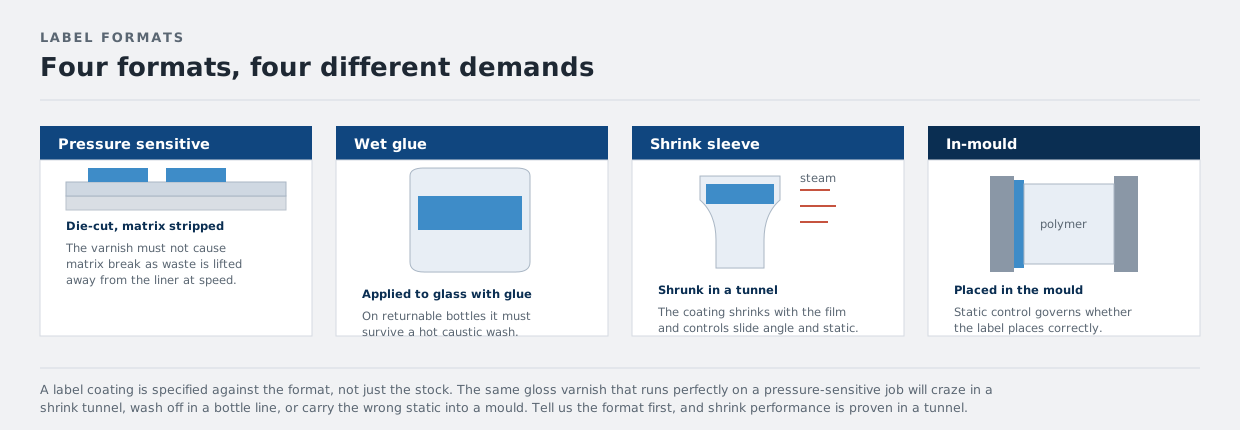
Each format fails in a different way, so each needs a different coating.
The Arcweb range
12 products in 6 families. Each is specified against the substrate, the process and the service conditions of the job rather than supplied from a fixed catalogue.
Arcweb PS pressure-sensitive label overprint varnishes
Water-based and UV overprint varnishes for self-adhesive label stock, formulated to sever cleanly at the kiss cut so the matrix strips in one piece, and to rewind without blocking, from everyday gloss protection through to chemical and abrasion resistant durable grades.
Arcweb PS 110 Water-Based Gloss Overprint Varnish
A water-based gloss overprint varnish for self-adhesive label stock, applied in line by flexo over water-based or UV inks. It is the general-purpose protective layer of the range, giving rub and scuff resistance for handling and dispensing at a film build low enough to sever cleanly at the kiss cut. It is the lowest film build and the fastest drying grade in the subfamily, chosen where the label sees ordinary retail handling rather than chemical exposure.
Substrates Coated and uncoated paper face stock, cast-coated label paper, PP and PE film face stock with suitable surface energy
Process Flexo, chambered doctor blade with anilox, narrow-web; hot air and IR drying
Arcweb PS 220 UV Gloss Overprint Varnish
A UV-curing gloss overprint varnish for pressure-sensitive work that needs higher gloss and immediate handling strength than a water-based film gives. It cures to a hard, glossy surface that resists marking on the rewind and in the dispenser, and the cure response is set so that the film is neither tacky enough to re-bond across the cut nor brittle enough to chip at the die edge. It differs from PS 110 in that the finished label is ready for conversion the moment it leaves the lamp.
Substrates Paper and filmic self-adhesive face stock, including PP, PE and PET
Process UV flexo, narrow-web; mercury or UV LED curing
Arcweb PS 330 UV High-Build Durable Overprint Varnish
A high-build UV varnish for durable label work where the print has to resist abrasion, water and common cleaning chemicals over the exposure and service period the customer specifies. It is applied at a heavier film weight, usually by rotary screen or a high-volume anilox, and gives the toughest surface in the subfamily. Where a published durability protocol such as BS 5609 Section 3 has to be satisfied, the converter runs that qualification on their own face stock, ink set and adhesive, because the result is a property of the whole construction and not of the varnish alone.
Substrates Synthetic filmic face stock, primarily PP and PET, and heavyweight coated paper
Process Rotary screen or high-volume anilox UV flexo, narrow-web; mercury or UV LED curing
Arcweb WG wet-glue label varnishes
Varnishes for cut-and-stack wet-glue labels applied to glass and tinplate with water-based adhesive, including a caustic-wash resistant grade for returnable bottles that must come back through a hot alkaline wash without the coating lifting in sheets, greying or shedding into the bath.
Arcweb WG 110 Water-Based Wet-Glue Label Varnish
A water-based varnish for cut-and-stack wet-glue labels applied to glass and to tinplate cans with water-based adhesive. It protects the print through stacking, magazine feed and glue pallet contact, and is formulated to keep the reverse of the sheet glueable so that adhesive transfer is not disturbed. It is the single-trip grade of the subfamily, intended for containers that are not returned for washing.
Substrates Wet-strength label paper, metallised label paper, machine-glazed paper
Process Flexo or gravure in line, and offset press coater units; hot air drying, sheeted or cut-and-stack conversion
Arcweb WG 220 Caustic-Wash Resistant Wet-Glue Varnish
A wet-glue varnish for returnable glass, formulated to hold the print together through a hot caustic wash so that the adhesive releases and the label leaves the bottle as a whole sheet, rather than the coating fragmenting, greying or shedding a residue film into the wash bath. It carries a higher crosslink density and higher alkali tolerance than WG 110, and it is specified by wash temperature, caustic concentration and contact time rather than by gloss. Wash behaviour is confirmed on the customer’s paper, ink set and wash cycle before release.
Substrates Wet-strength and alkali-releasable label paper for returnable glass
Process Flexo or gravure in line, and offset press coater units; hot air drying
Arcweb SL shrink sleeve coatings
Coatings for reverse and surface printed sleeves on PVC, PETG and OPS that shrink with the film without crazing, and that set slide angle, static behaviour and scratch resistance so sleeves feed from the magazine and survive the conveyor.
Arcweb SL 110 Shrink Sleeve Slide and Anti-Static Coating
A sleeve overprint coating whose main job is feeding behaviour: it sets a controlled slide angle so sleeves release one at a time from the magazine, neither sticking to the sleeve behind nor avalanching, and it carries static control so that flattened sleeves separate and open on the mandrel. It shrinks with PVC, PETG and OPS at moderate shrink ratios without crazing. It is the lighter-build grade of the subfamily, used where handling behaviour rather than abrasion is the limiting factor.
Substrates PVC, PETG and OPS sleeve film, reverse and surface printed
Process Narrow and mid-web gravure or UV flexo; steam or hot-air tunnel shrinking
Arcweb SL 220 High-Shrink Scratch and Tunnel Resistant Coating
A sleeve coating for high shrink ratios and hard downstream handling, formulated to move with the film through the full shrink without crazing, blushing or cracking at the shoulder and the base of the container. It adds scratch and scuff resistance for conveyor rails, guide plates and case packing, and it reduces the wet-look defect where a sleeve absorbs condensation in a chill chain or a wet filling hall and goes cloudy until the container dries. Shrink and scratch performance cannot be read from a drawdown card, so every specification is qualified in the customer’s tunnel on the customer’s film.
Substrates High-shrink PETG, PVC and OPS sleeve film, reverse and surface printed
Process Gravure or UV flexo; steam and hot-air tunnels, including two-stage tunnels
Arcweb IM in-mould label coatings
Coatings for in-mould labels on polyolefin face stock, where the coated face has to retain the charge applied at the placement head, or hold against vacuum, while still de-nesting cleanly from the stack.
Arcweb IM 110 In-Mould Label Coating, Injection Moulding
A coating for in-mould labels used in injection moulding, where the coated face governs whether a label lifts singly from the stack, travels on the vacuum plate and sits flat against the cavity wall. Charge is applied at the placement head by an electrostatic bar or pin, and the coating is formulated to a surface resistivity that holds that charge for the length of the moulding cycle while not letting stray charge build in the magazine, which is what causes double picks. It protects the print against the heat and pressure of the injected polymer without softening or hazing.
Substrates BOPP and cavitated BOPP in-mould face stock, PE in-mould stock
Process Narrow and mid-web UV flexo or gravure; robotic placement into the mould, electrostatic or vacuum hold
Arcweb IM 220 In-Mould Label Coating, Blow Moulding
A higher-specification in-mould coating for extrusion blow moulding, where the label is set into the open mould, the parison is extruded between the mould halves, the mould closes and the container is then blown against the label, giving longer heat contact and more stretch at the label edge than injection work. It holds a tighter resistivity window than IM 110 and resists edge lift and print distortion as the polymer flows. It is the grade specified where the container geometry is deep or the label wraps a shoulder.
Substrates BOPP and PE in-mould face stock for HDPE and PP containers
Process UV flexo or gravure; extrusion blow moulding with in-mould placement
Arcweb TT thermal-transfer and laser-imprintable coatings
Receptive coatings that let a printed label take variable data downstream, either from a thermal-transfer ribbon at the packing station or from a laser marking unit on the line.
Arcweb TT 110 Thermal-Transfer Receptive Coating
A receptive coating that lets a preprinted label take variable data from a thermal-transfer ribbon at the packing station, anchoring the transferred image so the code stays dense and sharp and does not smudge under later abrasion. It is tuned to the anchorage of wax-resin and resin ribbons on filmic and paper face stock, where an ordinary gloss varnish gives voids, ribbon sticking and an image that lifts. It is the print-receptive grade of the subfamily, used for barcodes, batch codes and weigh-price data.
Substrates Coated paper and filmic face stock, PP and PET
Process Flexo, water-based or UV, narrow-web; imprinting by thermal-transfer printer with wax-resin or resin ribbon
Arcweb TT 220 Laser-Imprintable Coating
A coating that develops a legible dark mark when struck by a laser marking unit on the filling line, so that date and batch data can be applied without a ribbon or a consumable. It is matched to the marking process by wavelength and by energy density, and the mark contrast is set during qualification on the customer’s marking unit. It differs from TT 110 in that the image is formed in the coating itself rather than transferred onto it.
Substrates Coated paper, PP and PET face stock, and sleeve film where the line marks after sleeving
Process Flexo or gravure, narrow-web; downstream laser marking, qualified by wavelength and energy density
Arcweb MT matt and soft-touch label finishes
Low-gloss and tactile finishes for premium label work, where the finish has to hold its matt level and its hand feel through die-cutting, rewinding and dispensing rather than only on the printed sheet.
Arcweb MT 110 Soft-Touch Matt Label Finish
A UV matt finish with a soft, dry hand feel for premium label work on spirits, personal care and household products. It holds its matt level and its texture through die-cutting, matrix stripping, rewinding and dispensing, which is where most tactile finishes lose their character. Because a soft-touch surface marks more readily than a gloss one, it is specified together with the handling route, and a scuff check on the finished construction forms part of qualification.
Substrates Coated paper and filmic self-adhesive face stock, primarily PP and PET
Process UV flexo or rotary screen, narrow-web; mercury or UV LED curing
Typical operating window
The figures below are the typical operating window for this range, not a measured result for any one batch. Confirmed values are issued with the Technical Data Sheet and Certificate of Analysis by our laboratory.
| Property | Typical operating window | Method |
|---|---|---|
| Non-volatile content | 30 to 45 per cent for water-based grades, 96 to 100 per cent for UV grades | ISO 3251 |
| Supply viscosity at 23 degrees C | 20 to 45 s, 4 mm flow cup, for water-based grades | ISO 2431 |
| Supply viscosity at 25 degrees C | 150 to 900 mPa.s, rotational, for UV grades | ISO 2884-1 |
| pH, water-based grades | 7.5 to 9.0 | ASTM E70 |
| Applied dry coat weight | 0.8 to 2.5 g/m2 by flexo, 4 to 12 g/m2 by rotary screen | in-house, gravimetric |
| Gloss | 75 to 92 GU at 60 degrees for gloss grades, 6 to 18 GU for matt and soft-touch grades, read at 85 degrees where the 60 degree value falls below 10 GU | ISO 2813 |
| Coefficient of friction, coated face to reverse face | static 0.20 to 0.50, kinetic 0.15 to 0.45, set by grade for magazine feed and slide angle | ASTM D1894 |
| Surface resistivity, antistatic sleeve and label grades | 1 x 10^9 to 1 x 10^12 ohm per square, to dissipate charge so blanks separate | ASTM D257 |
| Surface resistivity, in-mould grades holding an applied charge | 1 x 10^12 to 1 x 10^14 ohm per square, to retain charge for the moulding cycle | ASTM D257 |
| Rub and scuff resistance | 200 to 500 cycles under a 2 lb, 0.91 kg, weight without pick or print removal | ASTM D5264 |
| Block resistance, rewound reel and stacked sheet | no picking or transfer after 16 h at 40 degrees C under 10 kPa | ISO 4622 |
Application
How the range is applied
Arcweb is a narrow and mid-web range. Water-based grades are applied by chambered doctor blade flexo with an anilox chosen for the target coat weight, typically 4 to 8 cm3/m2 for a protective gloss film and more where the finish has to fill a textured stock, and are dried with hot air and IR between stations. UV grades are applied by flexo for normal film builds and by rotary screen where high build is needed, and are cured with mercury or UV LED lamps. Gravure is used on sleeve film and on longer runs where coat weight has to be held very tightly across the web. Wet-glue varnishes are also run through offset press coater units on cut-and-stack work.
The figures in the table above are the typical operating window for the range, not a measured result for any single grade. Confirmed values are issued with the Technical Data Sheet and Certificate of Analysis by our laboratory.
What governs a good result on the line
Four variables decide most outcomes on a label line. The first is coat weight. Too little varnish leaves the ink exposed to scuff, and too much stiffens the face stock and raises the load the die has to cut through. The second is cure or dry state at the die. A UV film that is over-cured is brittle and chips at the die edge, and one that is under-cured stays tacky, re-bonds across the cut and blocks in the rewind; both faults look like a varnish problem and are usually a lamp, speed or anilox problem. Matrix break itself is first a die, strip tension and matrix width problem, and the coating contributes by two opposite routes, a heavy or elastic film the kiss cut does not sever cleanly so the matrix stays tied to the label, or an under-cured film that bonds back across the cut behind the die. Checking cut depth and strip tension before changing varnish saves most of these jobs. The third is surface energy. Filmic face stock and sleeve film that is not top-coated should be corona treated in line at the time of coating rather than relied on from film manufacture, because treatment decays, and a low-energy surface shows as fisheyes, pinholes and poor anchorage. The fourth is friction. Slide angle is a static friction property and is set deliberately on sleeve and in-mould grades, and changing a varnish without re-checking both static and kinetic friction is the common cause of magazine feed faults.
Shrink sleeve qualification
Shrink performance cannot be judged on a drawdown card. A coating that looks sound flat will still craze, blush or crack once the film has moved 50 or 60 per cent, and the shoulder and base of a container are where it shows first. Sleeve grades are therefore qualified in the tunnel, on the customer’s film, at the customer’s line speed, with the customer’s steam or hot-air profile, and the assessment covers crazing, gloss loss, ink anchorage after shrink, slide angle from the magazine, scratch pick-up on the conveyor and behaviour under condensation. Arctic supplies coated material for that trial and reviews the results with the converter before a specification is fixed.
Digital and hybrid presses
Label work is increasingly printed by digital process, and Arcweb grades are used over digital print as protective and functional layers. Behaviour differs by process, because a liquid electrophotographic image, a dry toner image, a UV inkjet image and an aqueous inkjet image each present a different surface to the coating. Anchorage over any digital print is confirmed by a press trial on the customer’s press, ink set and substrate before a grade is specified.
Documentation
Every grade is supplied with a Technical Data Sheet and a Safety Data Sheet, and a Certificate of Analysis is issued with the batch. Compliance dossiers and declarations covering the end use a customer has to satisfy are issued on request with the Technical Data Sheet.
Specifying this range
What we need to know to specify correctly
Label coatings are specified against the construction and the line, not against a gloss figure. The following answers let Arctic recommend a grade and set the trial.
- Which label format? Pressure-sensitive, wet-glue, shrink sleeve or in-mould. Each one leads to a different subfamily.
- What is the face stock or film? Paper grade, or film type and thickness, whether it is coated or top-coated, and whether it is corona treated at your end.
- What ink set is underneath? Water-based flexo, UV flexo, offset, or digital, and for digital which process: liquid electrophotographic, dry toner, UV inkjet or aqueous inkjet.
- How is the coating applied? Flexo with what anilox volume, gravure with what cylinder, or rotary screen, and what drying or curing is available, including lamp type and installed power.
- What is the line speed and the web width? Both set the dwell time you have for drying or cure.
- For pressure-sensitive work: what is the die, the cut depth setting and the matrix strip speed, and are you seeing matrix break now? What is the rewind tension and the storage temperature of finished reels?
- For wet-glue work: is the container single-trip or returnable, glass or tinplate, and if returnable, what is the caustic concentration, wash temperature and contact time? What adhesive does the labeller run?
- For shrink sleeve work: what film and thickness, what shrink ratio in each direction, steam or hot air, what tunnel profile and line speed, reverse or surface printed, and what magazine and mandrel does the applicator use?
- For in-mould work: injection or blow moulding, what polymer, what is the placement system, is the label held by an electrostatic charging bar, by vacuum or by both, and what de-nesting behaviour does the current label give you?
- What downstream marking is applied? Thermal transfer with which ribbon class, or laser marking at which wavelength and power.
- What end use and exposure? Chilled, wet, frozen, hot fill, outdoor, chemical or cleaning agent contact, the service period the label has to last, and any durability protocol you have to satisfy.
- What finish is required? Gloss level, matt level, tactile effect, and whether a coefficient of friction or slide angle target is already specified on your line.
- What documentation do you need? Technical Data Sheet, Safety Data Sheet, Certificate of Analysis, and any declaration required for the end use you are supplying.
With those answers Arctic issues a recommended grade, a coat weight window and a trial plan. Sleeve and in-mould grades are only released to a specification after the trial on your own film, tunnel or moulding line.
Documents and specification
The Technical Data Sheet, Safety Data Sheet and regulatory declaration for any grade in this range are issued by our laboratory against the substrate and process you are running. Tell us the job and we will specify against it.