
Protective and Marine Coatings
Steel that sits in seawater, holds fuel, runs hot or has to hold its load through a fire needs a coating system chosen against the exposure it will face and the interval before the next maintenance window. Arctic makes coatings for structural steel, tanks and vessels, marine areas, fire-protected structure and hot service, specified in the language of ISO 12944 and applied over surface preparation assessed to ISO 8501-1.
Overview
Protective and Marine Coatings is the severe-service range, and it is specified differently from Industrial and Infrastructure Coatings. That range protects general plant steel, machinery, buildings and infrastructure assets, where the decision is led by finish, colour and ordinary atmospheric exposure. Here the decision is led by an exposure category, by a service duty such as immersion, fire protection or hot service, and by the maintenance interval the asset owner is prepared to accept. One question routes most enquiries: where the specification names an ISO 12944 corrosivity or immersion category, a period of fire resistance or a service temperature, the work belongs in this range, and where it names a colour, a gloss level and a general industrial environment, Industrial and Infrastructure Coatings covers it. The unit of specification here is the system, primer, intermediate and finish together, rather than the individual coat.
ISO 12944 supplies the language. It classifies atmospheric corrosivity from C1 to C5 and CX, adds the water and soil categories Im1 to Im4, and defines durability ranges of low, medium, high and very high against the expected time to first major maintenance. Those categories and ranges belong to the standard and are not Arctic results, and the category for a given asset is set by the specifier. Evaluation uses recognised methods: ISO 9227 and ASTM B117 neutral salt spray, which rank systems and control quality rather than predict service life, ISO 12944-6 for the laboratory tests behind the atmospheric categories, ISO 12944-9 for the cyclic ageing of systems for offshore and related structures in CX, ISO 2812-1 and ISO 2812-2 for resistance to liquids and to water, ISO 4624 and ASTM D4541 for pull-off adhesion, and ASTM D5162 for holiday detection on lined steel.
Surface preparation governs the outcome. A heavy-duty system applied over a poorly cleaned surface fails at the interface whatever the coating, so each system is written against a preparation grade to ISO 8501-1, Sa 2½ or Sa 3 where abrasive blasting is available and St 2 or St 3 where only hand and power tools can reach, with surface profile to ISO 8503 and soluble salts checked to ISO 8502-6 and ISO 8502-9. The grade also decides which system is available. Zinc-rich primers and most immersion-grade linings need a blast-cleaned surface with a measured profile, and a hand-prepared surface calls for a surface-tolerant product instead of the same system applied at reduced quality.
Some duties in this field are led by certification rather than by specification. Ballast tank systems under the IMO performance standard, biocidal antifouling, rated fire protection and potable water linings turn on test evidence, type approvals and product registrations issued by third parties and held for an individual product, so that status is confirmed against the enquiry rather than assumed from the product type. The products are developed at the technical centre and laboratory in Greater Noida, Uttar Pradesh, and made on a production line built for batch-to-batch consistency, so a repeat order of the same product is made to the same formulation as the one already applied. Matching a maintenance coat to an aged system remains a site question of compatibility, overcoating interval and preparation.
ISO 12944 corrosivity categories
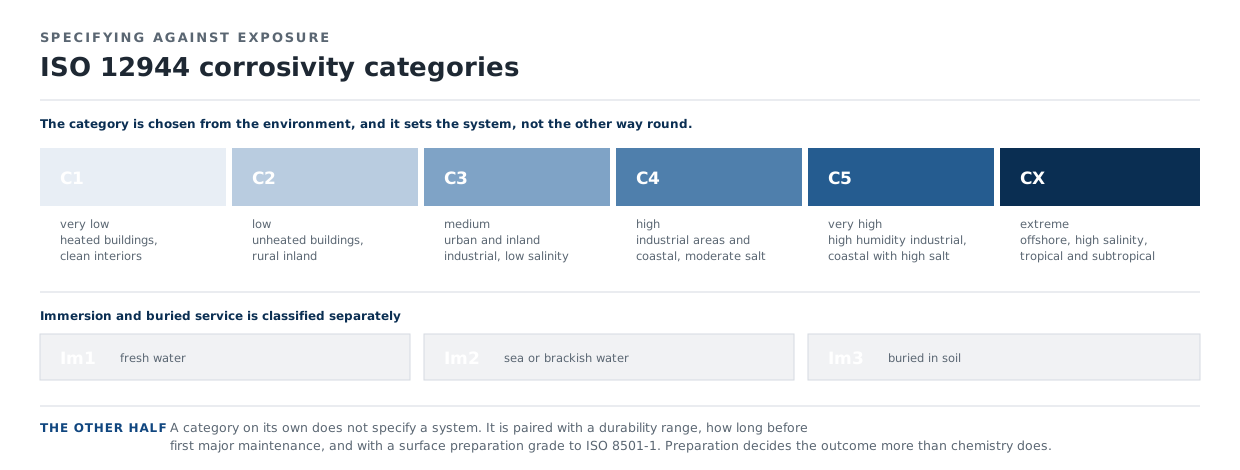
The environment sets the category, the category sets the system.
The Arcshield range
12 products in 6 families. Each is specified against the substrate, the process and the service conditions of the job rather than supplied from a fixed catalogue.
Arcshield ZN Zinc-Rich Primers
Galvanically active primers for blast-cleaned carbon steel, in organic epoxy and inorganic silicate binders. These sit at the base of systems written for ISO 12944 C4, C5 and CX exposure at high or very high durability, and the binder choice follows the overcoating interval, the service temperature and the application conditions on the job.
Arcshield ZN 210 Organic Zinc-Rich Epoxy Primer
A two-pack epoxy primer heavily pigmented with zinc dust, giving galvanic protection to the steel at coating defects and barrier protection across the film. The epoxy binder is more tolerant of variable application conditions and of long or short overcoating intervals than a silicate binder, which makes it the usual choice for fabrication shops and site work on bridges, transmission structures, process steelwork and tank exteriors. It is the base coat for three-coat and multi-coat systems written for ISO 12944 corrosivity categories C4 and C5 at high or very high durability.
Substrates Abrasive blast cleaned carbon steel to Sa 2½ or better with an angular profile to ISO 8503. Not applied over hand or power tool cleaned steel, over hot-dip galvanising or over non-ferrous metal, where a surface-tolerant epoxy or a primer formulated for zinc is used instead.
Process Airless spray at a 45:1 or higher pump ratio with a 0.017 to 0.021 in tip, and brush for stripe coats on edges, welds and bolt heads. Continuous agitation is required to keep the zinc in suspension. Overcoat after the stated minimum interval once the film is through-dry, and wash zinc corrosion products off weathered films before overcoating.
Arcshield ZN 340 Inorganic Zinc Silicate Primer
A solvent-borne ethyl silicate primer that cures by reaction with atmospheric moisture to form a hard, inorganic zinc-bearing matrix. It carries higher heat resistance and higher solvent resistance than the organic grade, and is specified under systems for CX exposure, as a holding primer for fabrication, and beneath high-temperature finishes where an organic primer would degrade. Cure depends on ambient humidity, and film thickness control is critical because over-application causes mud-cracking and delamination.
Substrates Abrasive blast cleaned carbon steel to Sa 2½ or Sa 3 with a measured profile. It requires a clean, dry, salt-free surface and is not suitable over hand-prepared steel or over aged coatings.
Process Airless spray with continuous agitation, applied in a single pass to the specified thickness rather than built up wet on wet. Cure needs atmospheric moisture, so relative humidity is held at or above roughly 50 % during cure and the film is checked by solvent rub to ASTM D4752 before overcoating. A mist coat or a tie coat is used to prevent bubbling when a high-build epoxy is applied over a porous zinc silicate film.
Arcshield EP High-Build Epoxy Barrier Coats
Intermediate and single-coat barrier films that carry most of the dry film thickness in a protective system. The range covers a surface-tolerant grade for maintenance and drydock work over hand-prepared or aged surfaces, and a glass-flake grade for splash zone, buried and immersed duty where thickness and edge retention decide the outcome.
Arcshield EP 220 Surface-Tolerant High-Build Epoxy Mastic
An aluminium and micaceous iron oxide pigmented two-pack epoxy that wets and adheres to hand-prepared, power tool cleaned and marginally prepared steel, and to sound aged coatings. It is the maintenance and drydock product, used where blast cleaning is not available and where the alternative would be a zinc-rich system applied at reduced quality. The lamellar pigmentation lengthens the diffusion path through the film and improves resistance to moisture. It screens the binder and slows chalking between coats, but no epoxy is ultraviolet stable, so a polyurethane or polysiloxane finish is applied where appearance is part of the specification.
Substrates Carbon steel prepared to St 2 or St 3 to ISO 8501-1, blast cleaned steel, hot-dip galvanising after degreasing and sweep blasting or abrading with zinc salts removed, thermally sprayed metal, and sound aged epoxy or alkyd coatings after adhesion and compatibility testing on the actual surface.
Process Airless spray, brush or roller, applied in one or two coats with stripe coats to edges, welds, rivets and back-to-back angles. Induction time after mixing is observed before spraying, and a reduced overcoating window applies at low temperature where cure slows.
Arcshield EP 380 Glass-Flake Reinforced Epoxy Barrier Coat
A high-solids epoxy reinforced with chemically resistant glass flake, applied at high film build in one or two coats. The aligned flakes reduce permeability and restrict film shrinkage, which suits splash zone steelwork, jetty legs, buried pipe, valves and the ISO 12944 immersion categories Im1 to Im4. It is also used as a heavy build repair and rebuild coat where abrasion and impact would damage a conventional epoxy.
Substrates Abrasive blast cleaned carbon steel to Sa 2½ or Sa 3 with a coarse profile, over a zinc-rich or surface-tolerant primer or applied directly to blast-cleaned steel in immersion duty. It is also used as a build coat over thermally sprayed aluminium, applied after the sprayed layer has been sealed with a thinned, low-viscosity sealer, because a flake-loaded film is too viscous to penetrate the porosity of sprayed metal and would bridge it instead.
Process Airless spray at high pump ratio with a wide tip and a short, large-bore hose, because glass flake raises the applied viscosity. Brush application is limited to stripe coats. Wet film thickness is checked during application, and the specified dry film thickness is confirmed to ISO 2808 before the next coat.
Arcshield TL Tank and Vessel Linings
Internal linings for storage tanks, process vessels and pipe interiors, selected by stored medium, service temperature and the thermal gradient through the wall. Fuel and water service and aggressive chemical service take different chemistries, and continuity is proved by holiday detection before the tank returns to service.
Arcshield TL 230 Solvent-Free Epoxy Tank Lining
An amine-cured, solvent-free epoxy lining for the internal surfaces of fuel and water storage tanks, applied in two coats to a high total build with no solvent retention in the film. Typical service is diesel, gas oil, jet fuel, crude oil, produced water and industrial water storage. A lining for potable water is a separate matter: drinking water contact is a regulated approval held for a specific product under the regime that applies at the point of use, and that status is confirmed against the enquiry rather than assumed from the chemistry.
Substrates Abrasive blast cleaned carbon steel to Sa 2½ or Sa 3 with a profile to ISO 8503 and soluble salts within the limit set for immersion service. Welds are dressed and sharp edges radiused before priming, because the lining will not hold thickness over an unprepared edge.
Process Plural component or single-leg airless spray at controlled material temperature, with stripe coats to welds, nozzles and internal corners. Each coat is applied within the maximum overcoating interval, and continuity is proved by holiday detection to ASTM D5162 and adhesion by pull-off to ISO 4624 before the tank is returned to service.
Arcshield TL 410 Novolac Epoxy Chemical-Resistant Lining
A solvent-free epoxy phenol novolac lining with a higher crosslink density than a standard epoxy, giving resistance to solvents, oxygenated fuels, acids and hot produced water, and a higher wet service temperature. It is specified for chemical storage, process vessels, secondary containment and hot immersion duty where a bisphenol A epoxy would soften or blister. Selection is made against the actual medium and concentration, the service temperature and any thermal gradient through the wall, because a hot wall with a cooler exterior drives blistering that the medium alone would not cause.
Substrates Abrasive blast cleaned carbon steel to Sa 2½ or Sa 3, and concrete bunds and floors after mechanical preparation and moisture testing. Where the medium is oxidising or strongly acidic beyond the novolac window, a reinforced vinyl ester system is specified instead.
Process Plural component spray for large areas, roller and brush for detail and repair, applied in two coats with the reinforcement mat laid in where the specification calls for it. Post-cure at elevated temperature is applied where the service temperature requires it, and immersion service is not commissioned before full cure is confirmed.
Arcshield MR Marine Systems
Coatings for the areas of a vessel or offshore structure, each of which fails in a different way: ballast tanks by pitting and coating breakdown at edges and welds, underwater hull by corrosion and fouling, boot top by abrasion and alternating wet and dry exposure, decks by mechanical damage, and topsides by chalking and colour loss. Products are specified by area and by whether the work is newbuild or drydock.
Arcshield MR 250 Ballast Tank and Underwater Hull Epoxy
A light-coloured, pure epoxy anti-corrosive for water ballast tanks, void spaces and the underwater hull, applied in two coats with stripe coats to edges, welds and fabrication details. The light shade is there so that inspection can find breakdown early in a confined space. Where a specification calls for compliance with the IMO Performance Standard for Protective Coatings, that is a regime covering preparation grade, soluble salt limit, nominal thickness, stripe coating and inspection, and it requires a type approval or statement of compliance issued by a recognised body for the individual product, which is confirmed at enquiry rather than claimed here.
Substrates Abrasive blast cleaned steel to Sa 2½ for newbuild, and mechanically prepared steel with sound aged coating for drydock repair where the surface-tolerant grade is used instead. Shop primed plate is overcoated after assessment of the primer condition and any welding and burning damage.
Process Airless spray with brush-applied stripe coats before and after each spray coat. Steel temperature is held at least 3 °C above dew point during application and cure, and dry film thickness is verified to ISO 19840 for the blast-cleaned steel surface. Under an antifouling or foul-release topcoat the hull scheme takes the tie coat specified for that topcoat.
Arcshield MR 420 Deck, Boot Top and Topside Finish
A finish range for the above-water areas, supplied either as an acrylic polyurethane or a polysiloxane topside and superstructure finish with gloss and colour retention, or as an abrasion-resistant deck grade that accepts anti-slip aggregate for working decks, gangways and cargo areas. The boot top sits between these duties and takes alternating immersion, wash and impact from berthing and ice, so it is coated with the abrasion-resistant grade over the anti-corrosive scheme. Antifouling is a separate, biocidal product category whose supply depends on registration of the actives at the point of sale, and it is not covered by this grade.
Substrates Over Arcshield EP or MR anti-corrosive coats on carbon steel, over aluminium superstructure with the appropriate etch or epoxy primer, and over sound aged polyurethane finishes after preparation and adhesion testing.
Process Airless or conventional spray for finish quality, roller for decks and for aggregate broadcast work. Application is closed out inside the recoat window of the coat beneath, and colour-critical work is applied in a single continuous operation across a visible area to avoid banding.
Arcshield IN Intumescent Coatings
Reactive coatings for structural steel fire protection. On heating the film chars and expands to many times its applied thickness, forming a low-conductivity insulating layer that delays the rise of the steel to its critical temperature for a stated period of fire resistance. The range separates cellulosic exposure from hydrocarbon pool fire and jet fire exposure.
Arcshield IN 260 Thin-Film Intumescent for Cellulosic Fire
A thin-film intumescent basecoat, in solvent-borne or water-borne acrylic chemistry, for columns, beams and bracing exposed to a cellulosic fire, used with a compatible primer beneath and a sealer topcoat above for colour and for exposure durability. Applied thickness is not calculated from first principles: it is read from loading tables generated by third-party furnace testing of the specific product and indexed to the section factor of the member, the critical steel temperature and the required period of fire resistance. A period of fire resistance is certified for a tested system on a tested section, and it is not a property of a product on its own.
Substrates Blast cleaned or shop primed structural steel sections, over a compatible anti-corrosive primer. Internal dry, semi-exposed and exposed positions each require the sealer and system specified for that exposure, and cellular beams, hollow sections and connections are treated according to the assessment that accompanies the test evidence.
Process Airless spray in multiple passes with intermediate drying, brush and roller for touch-up and detail. Wet film thickness is logged pass by pass and the dry film thickness is verified against the loading table for each member, with records kept per section, because the thickness record is the evidence for the rated period.
Arcshield IN 450 Epoxy Intumescent for Hydrocarbon and Jet Fire
A two-pack epoxy intumescent for structural steel, vessel skirts, pipe racks and blast-exposed structure where the hazard is a hydrocarbon pool fire or a jet fire rather than a cellulosic fire. It builds far thicker than the acrylic grade, is normally reinforced with carbon or glass mesh at the thicknesses used for jet fire, and holds its char under the erosive force of a jet flame. Thickness comes from the loading tables of the tested system, and the applicable fire test regime, hydrocarbon pool fire or jet fire, is stated in the specification because the two give different loadings.
Substrates Abrasive blast cleaned structural steel over a compatible epoxy or zinc-rich primer, with mesh reinforcement and fixings installed to the tested detail. Offshore, exposed and weathering positions take a durability topcoat over the intumescent. It is a topsides and exposed-structure product and is not specified for splash zone or immersed steel.
Process Plural component or heated single-leg airless spray, with trowel application for detail and repair. Mesh is embedded between passes to the tested arrangement, thickness is recorded per member against the loading table, and the system is inspected and documented as a whole rather than coat by coat.
Arcshield HT High-Temperature Coatings
Coatings for hot service, in silicone chemistry for dry uninsulated steel and in inert multipolymeric chemistry for insulated and cyclic service where corrosion under insulation is the real failure mechanism. Selection turns on the operating temperature range, whether the asset cycles or sits at temperature, and whether water can reach the wall.
Arcshield HT 270 Heat-Resistant Silicone Coating
A single-pack silicone or silicone acrylic coating pigmented with aluminium or heat-stable pigment, for exhaust stacks, flare lines, steam and process pipework, boiler casings and other hot, dry, uninsulated steel. The film air dries to a handleable state and develops its final hardness and heat resistance on first heating in service, so the cure schedule is part of the specification. It is suited to steel that runs hot and stays dry, and it is not suited to insulated lines or to wet cyclic exposure.
Substrates Abrasive blast cleaned carbon steel and stainless steel, and over an inorganic zinc silicate primer where the system requires one. It is not applied over organic anti-corrosive primers that will degrade at the service temperature.
Process Airless or conventional spray at low film build, because thick films of silicone crack on heating. Two thin coats to the specified total thickness, air dry, then cure by ramping the asset to service temperature according to the stated schedule. Colour range is limited by the pigment stability at temperature.
Arcshield HT 480 Inert Multipolymeric Coating for CUI Service
An inert multipolymeric matrix coating for insulated and cyclic hot service, where corrosion under insulation is the actual failure mechanism. Water held against the wall by wet insulation during shutdowns, intermittent operation and cycling through the dew point attacks steel that a dry-service silicone would never be asked to resist, so this grade is formulated for wet and dry cycling across a wide temperature range rather than for steady dry heat. It can be applied to steel that is already in service and hot, which removes the shutdown that a conventional coating would require, and it is used on insulated pipework, vessels, reactor skirts and sub-zero to hot transitions within the stated service range.
Substrates Abrasive blast cleaned carbon steel and austenitic stainless steel, including stainless under insulation where chloride stress corrosion cracking is the concern. Applied over blast-cleaned steel with no separate primer in most schemes, and over prepared aged coating only after adhesion testing.
Process Airless spray in one or two coats, brush and roller for detail, applied to cold or hot steel within the stated application temperature range. Thickness is verified to ISO 2808 and holiday detection is used where the specification calls for it. Qualification for this duty is assessed against the CUI classes in ISO 19277.
Typical operating window
The figures below are the typical operating window for this range, not a measured result for any one batch. Confirmed values are issued with the Technical Data Sheet and Certificate of Analysis by our laboratory.
| Property | Typical operating window | Method |
|---|---|---|
| Surface preparation grade, blast cleaned | Sa 2½ for atmospheric systems, Sa 2½ to Sa 3 for zinc silicate, immersion linings and CX systems | ISO 8501-1 |
| Surface preparation grade, hand and power tool cleaned | St 2 to St 3, surface-tolerant products only | ISO 8501-1 |
| Surface profile, Rz | typically 30 to 50 µm for thin-film primers, 50 to 85 µm for high-build and immersion systems, 75 to 100 µm for thermally sprayed metal | ISO 8503-2, ASTM D4417 |
| Soluble salts on prepared steel, as chloride | typically 50 mg/m² or less for atmospheric service and 20 mg/m² or less for immersion and lining service | ISO 8502-6 sampling with ISO 8502-9 conductivity |
| Volume solids | typically 55 to 80 % for high-solids epoxy, 95 to 100 % for solvent-free linings | ISO 3233 |
| Zinc dust content of the dry film, zinc-rich primers | 80 % or more by mass of the non-volatile portion where the specification calls for a zinc-rich primer to ISO 12944-5, with lower-zinc barrier grades stated as such and not described as zinc-rich | content declared in the product data, zinc dust pigment to the classes of ISO 3549 |
| Dry film thickness per coat | typically 40 to 80 µm for zinc primers, 100 to 250 µm for high-build epoxy, 250 to 500 µm per coat for solvent-free linings | ISO 2808, ISO 19840 for blast-cleaned steel |
| Pull-off adhesion | typically 3 to 8 MPa for atmospheric systems on blast-cleaned steel, with a minimum of 5 to 7 MPa commonly set as the acceptance level for immersion linings | ISO 4624, ASTM D4541 |
| Neutral salt spray, classification testing of coating systems | typically 480 h for C3, 720 h for C4 and 1440 h for C5 and CX at high durability, with degradation rated after exposure | ISO 9227 exposure, durations set in ISO 12944-6, rated to ISO 4628-2, ISO 4628-3 and ISO 4628-8 |
| Cyclic ageing for offshore and CX systems | 4200 h test cycle for systems offered to the offshore regime | ISO 12944-9 |
| Resistance to liquids and to water for lining qualification | immersion at service temperature, typically 28 to 90 days, followed by adhesion and blistering assessment | ISO 2812-1, ISO 2812-2 |
| Holiday detection on linings | low-voltage wet sponge up to 500 µm, high-voltage spark testing above 500 µm at the voltage set for the thickness | ASTM D5162 |
| Abrasion resistance, deck and boot top grades | typically 60 to 150 mg loss, CS-17 wheel, 1000 cycles, 1 kg load | ISO 7784-2, ASTM D4060 |
| Dry heat resistance, high-temperature grades | continuous service up to about 540 °C with short excursions towards 600 °C for aluminium-pigmented silicone, minus 45 °C to 650 °C for inert multipolymeric systems | ASTM D2485 |
| Corrosion under insulation qualification | classes CUI-1 to CUI-3 according to the service temperature range and cycling regime | ISO 19277 |
| Application conditions | steel temperature at least 3 °C above dew point, relative humidity normally 85 % or less, and around 50 % or above for inorganic zinc silicate cure | ISO 8502-4 for condensation, ISO 8502-3 for dust |
Application
A protective system succeeds or fails at the interface, so the sequence on site is preparation, inspection, application, inspection. Steel is degreased before blasting, welds are dressed and sharp edges radiused, and the prepared surface is checked for cleanliness grade to ISO 8501-1, for profile to ISO 8503, for dust to ISO 8502-3 and for soluble salts to ISO 8502-6 with ISO 8502-9. Prepared steel is primed within the same working shift, and before flash rusting begins, because a rust bloom lifts the first coat off the profile that was just paid for.
Two-pack products are mixed at the stated ratio by volume, in full units where possible, and given the induction time before spraying. Thinning is limited to the stated solvent and the stated maximum addition: over-thinning a high-build epoxy costs film thickness on vertical surfaces and makes the specified build unreachable in the number of coats allowed. Solvent-free linings and epoxy intumescents are applied by plural component equipment with heated lines, where the ratio is controlled at the gun rather than in the pot.
Stripe coating is a requirement, not a refinement. Edges, welds, bolt heads, back-to-back angles, nozzles and internal corners take a brush-applied stripe coat before and after each spray coat, because film thickness thins over an edge by the same geometry that makes the edge attractive to corrosion. Wet film thickness is checked during application with a comb to ISO 2808, and the dry film thickness is verified over the whole area against the acceptance rule in the specification, using ISO 19840 and its reading and acceptance rules where the substrate is blast-cleaned steel.
Conditions govern the window. Steel temperature is held at least 3 °C above the dew point during application and through cure, relative humidity is normally kept at 85 % or below, and inorganic zinc silicate is the exception because it needs atmospheric moisture to cure and will stall in dry air. Epoxy cure slows sharply below 10 °C, and a low-temperature grade is specified rather than heating the material and hoping. Amine blush is removed by fresh water washing before overcoating. Minimum and maximum overcoating intervals are observed in both directions: an epoxy left beyond its maximum interval is abraded or swept blasted before the next coat, and a polyurethane finish applied inside the minimum interval will trap solvent.
Thermally sprayed metal is a separate discipline. The sprayed layer is porous, so it is sealed with a thinned, low-viscosity sealer that penetrates the pores before any high-build or flake-reinforced coat is applied over it. A high-build film applied straight onto unsealed sprayed metal bridges the porosity and lifts later.
Linings and intumescents carry their own close-out. A lining is holiday tested to ASTM D5162 and pull-off tested to ISO 4624 on test plates or an agreed area, and it is not commissioned before full cure, with post-cure applied where the service temperature requires it. An intumescent is recorded member by member against the loading table for the tested system, because the thickness record, not the product, is what supports the rated period of fire resistance. Silicone high-temperature coatings are cured by ramping the asset through the stated heating schedule on first start-up.
Specifying this range
Arctic specifies from the exposure and the duty, not from the substrate alone. The following answers allow a system to be written rather than a product to be suggested.
- Exposure category and durability. Which ISO 12944 corrosivity category applies, C3 to C5, CX or the immersion categories Im1 to Im4, and which durability range is required, low, medium, high or very high. The category and the durability range are separate axes and both are stated. Where the specifier has already set these, they are used as written.
- Surface preparation available. Can the surface be abrasive blast cleaned to Sa 2½ or Sa 3 with a measured profile, or is the work limited to hand and power tool cleaning at St 2 or St 3. This single answer decides whether a zinc-rich primer or an immersion lining is available at all.
- Newbuild or maintenance. Is the steel bare, shop primed, hot-dip galvanised, thermally sprayed or already coated. Galvanised and sprayed metal surfaces need their own preparation and, for sprayed metal, a penetrating sealer. For an existing coating, what is it, what condition is it in, and has compatibility and adhesion been tested on the actual surface.
- Service temperature and cycling. The continuous and peak operating temperature, whether the asset cycles, and whether the steel is insulated. Insulated and cycling service is a corrosion under insulation problem and takes a different chemistry from dry hot service.
- For linings, the contents. The stored medium, concentration, temperature, whether service is continuous immersion or fill and empty, and whether there is a thermal gradient through the wall. Potable water service is a regulated approval held for an individual product, so the requirement and the regime that applies at the point of use are stated at enquiry.
- For marine work, the area. Ballast tank, underwater hull, boot top, deck or topside, and whether the work is newbuild or drydock. Where the ballast tank specification invokes the IMO performance standard, or where an antifouling or foul-release topcoat is required, the certification and registration status of the individual product is confirmed before it enters the scheme.
- For fire protection, the tested system. The required period of fire resistance, the fire type, cellulosic, hydrocarbon pool or jet, the section factor and critical temperature of each member, and the exposure position, internal, semi-exposed or exposed. Thickness comes from the loading table of the tested system, and a rating is held for a tested system on a tested section, not for a product.
- Application conditions and access. Shop or site, temperature and humidity range during the work, spray equipment available, confined space or live plant, and whether the asset can be shut down or must be coated hot.
- Inspection and documentation required. Which tests are to be witnessed, holiday detection, pull-off adhesion, thickness records, salt testing, and what dossier, declaration or third-party evidence has to accompany the delivery. Arctic issues a compliance dossier on request for the products supplied.
- Maintenance interval. The period the asset owner will accept before first major maintenance, and whether future overcoating will be done in place. A system that cannot be overcoated at the next shutdown is the wrong system, however it performs on test.
Documents and specification
The Technical Data Sheet, Safety Data Sheet and regulatory declaration for any grade in this range are issued by our laboratory against the substrate and process you are running. Tell us the job and we will specify against it.