
Scratch-Off, Security and Coding Coatings
Arcveil is Arctic’s range of functional coatings that hide, reveal or authenticate: scratch-off systems, thermochromic indicators, ultraviolet-fluorescent security coatings, inkjet-writable coding varnishes and tamper-evident void coatings. Every grade in the range is sold on a behaviour that has to be demonstrated on the customer’s own substrate and line, not on its appearance in the container.
Overview
The Arcveil range covers coatings whose job is functional rather than decorative. A scratch-off panel has to conceal data under transmitted light and then come away cleanly under a coin. A thermochromic coating has to change colour at a stated threshold. A security coating has to stay invisible in daylight and fluoresce under a 365 nm lamp. A coding varnish has to accept inkjet characters legibly and fix them before the sheet reaches the first nip. A void coating has to leave a message behind when a label is lifted. None of these properties can be judged by eye on a drawdown alone, so each grade is specified against a test the customer can repeat.
The neighbouring Arctic category is Arcvista, the decorative and special-effect coatings range. Arcvista LU is a luminescent coating sold for visual effect and accepted by eye against an agreed sample. Arcveil SF is an authentication coating sold on a measured response under a defined excitation source and detector, with the substrate’s own background fluorescence forming part of the specification. Arcveil is the Arctic range specified on concealment, reveal and authentication behaviour rather than on finish.
Arcveil SO scratch-off is supplied and specified as a two-layer system, not as a single coating. A release undercoat is printed over the concealed data first, and an opaque scratch layer is printed over the undercoat. The undercoat is what allows the top layer to lift away completely under a coin without smearing, without leaving residue in the panel and without damaging the print underneath. The two layers are matched to each other, and substituting one of them changes the release behaviour of the pair, so Arctic quotes and qualifies them together.
Lottery, gaming and high-value document security carry their own qualification and vendor-audit regimes, with controlled premises, chain-of-custody requirements and approved supplier lists set by the issuing authority. Arctic positions the Arcveil range at promotional games, telecom recharge and airtime cards, pharmaceutical and consumer-goods authentication, and temperature and tamper indication. Arctic holds no security accreditation and makes no claim to one, and the resistance figures quoted for these coatings are comparative bench checks rather than a security rating. Where a compliance or regulatory dossier is needed for the intended end use, a declaration is issued on request with the Technical Data Sheet.
The scratch-off system
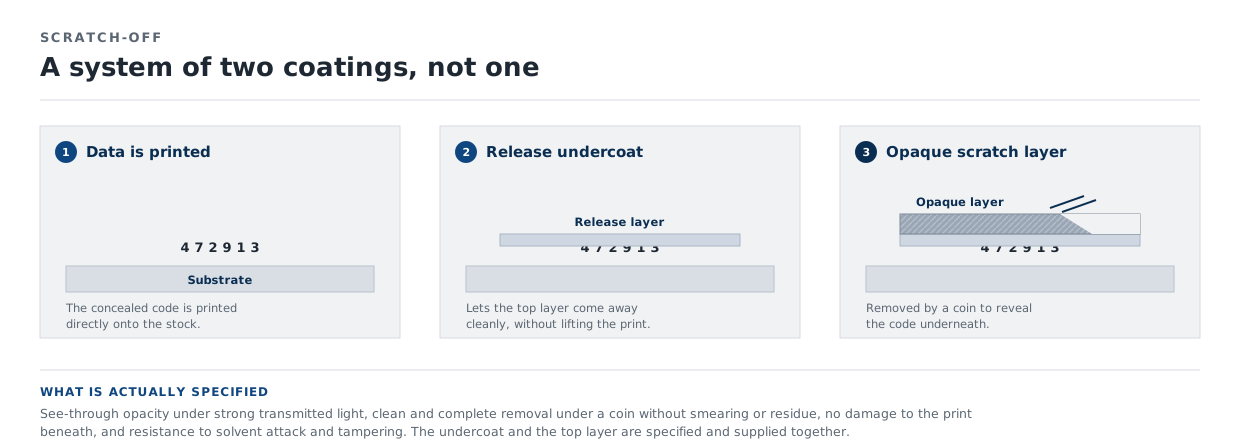
The release undercoat is what lets the opaque layer come away cleanly.
The Arcveil range
6 products in 5 families. Each is specified against the substrate, the process and the service conditions of the job rather than supplied from a fixed catalogue.
Scratch-off systems
A matched pair supplied together: a release undercoat printed over the concealed data, and an opaque scratch layer printed over it. Specified on read-through under transmitted light, clean coin removal, and comparative bench resistance to solvent rubbing and mechanical lifting.
Arcveil SO 110 Scratch-Off Release Undercoat
A low-build water-based undercoat printed over the concealed data and under the scratch layer, where it sets the release level of the panel. It protects the underlying variable print from the coin and controls whether the top layer lifts as a clean flake or smears. It is the lower film build of the pair and is not a stand-alone coating: it is always specified with Arcveil SO 220.
Substrates Coated and uncoated paper and board, cast-coated and one-side-coated board, label paper and card used for recharge and promotional panels. The concealed data is normally toner, thermal-transfer or inkjet print, and the undercoat is matched to that print.
Process Flexo coating unit with a chambered doctor blade and anilox, in-line on a narrow-web or sheet-fed line, or a gravure coating station. Hot-air drying between units. A press trial on the customer’s own substrate and imaging method is required.
Arcveil SO 220 Opaque Scratch-Off Layer
A heavily pigmented opaque top layer printed over Arcveil SO 110, applied in two passes to build the coat weight the panel needs. It is specified on read-through under transmitted light, on clean and complete removal under a coin, and on comparative resistance to solvent rubbing and to mechanical lifting, measured as a bench check to a stated procedure rather than as a security rating. It carries the higher film build of the pair and cannot be run without the undercoat.
Substrates The same paper and board grades as Arcveil SO 110, applied over a fully covered undercoat panel. It is not specified for direct application to filmic facestock.
Process Two passes on a flexo coating unit with a chambered doctor blade and anilox, or rotary screen where a heavier deposit is wanted, supplied water-based for flexo and water-based or ultraviolet-curing for screen. Full interstation drying or curing between passes. Panel read-through and coin removal are checked on the trial sheets.
Thermochromic temperature-indicating coatings
Coatings that change colour at a nominated threshold temperature, supplied in a reversible form for current-temperature indication and promotional reveal, or an irreversible form that records that a threshold has been crossed at the coating. Neither form integrates time against temperature.
Arcveil TC 110 Thermochromic Threshold Coating
A coating that changes colour at a threshold temperature nominated by the customer, supplied in a reversible form or an irreversible form. The reversible form indicates the temperature at the coating when it is read and returns to its original colour, so it does not show that a cold chain was maintained. The irreversible form changes once and stays changed, so it records that the threshold was crossed at that point on the pack and for long enough to switch the pigment, and that is the distinction on which the form is selected. Neither form integrates time against temperature and neither is a validated cold-chain monitoring device. The cleared state of a leuco system retains a residual tint, and light fastness is low, so both are agreed at the design stage.
Substrates Coated paper and board, label papers, and corona-treated PE and PP filmic facestock. The coating is applied over a light or white ground so that the colour change is legible against the residual tint of the cleared state.
Process Flexo or rotary screen, water-based only, with drying held below the activation threshold of the grade. The grade is not run under ultraviolet lamps, because lamp radiant heat and ultraviolet exposure both act on the pigment system. Oven temperature, dryer dwell and any downstream heat, including shrink tunnels and hot-melt application, are agreed before the trial.
Ultraviolet-fluorescent security and taggant coatings
Coatings that are invisible on the printed sheet in daylight and fluoresce under a 365 nm lamp, used for covert marks, authentication panels and taggant coding read by a handheld or in-line detector.
Arcveil SF 110 Ultraviolet-Fluorescent Security Coating
A coating that is invisible on the printed sheet in daylight and fluoresces under a 365 nm lamp, used for covert marks, authentication panels and taggant coding. It is supplied as a plain fluorescent grade or with a taggant for reader-based verification. What distinguishes it in this range is that the response is read against a defined excitation source and detector rather than judged by eye, so substrate fluorescence and the chosen emission colour are both part of the specification.
Substrates Coated and uncoated paper and board, label papers and corona-treated filmic facestock. Substrates carrying optical brightening agents absorb in the same 365 nm band and emit in the blue, so they raise the background against a blue-emitting mark, and the substrate is assessed and the emission colour selected before the grade is confirmed.
Process Flexo, gravure or screen, applied as a spot or a full-sheet coating. Verification is by 365 nm lamp or by the customer’s own reader, using a signed reference sheet from the trial as the acceptance standard.
Coding and encoding varnishes
Full-sheet varnishes that give a receptive surface for inkjet coding and encoding, so that variable data prints legibly and fixes fast enough to run at line speed without smearing at the first nip or stacker.
Arcveil CD 110 Inkjet-Writable Coding Varnish
A full-sheet varnish that gives a receptive surface for inkjet coding and encoding, so that batch codes, dates and variable data print with sharp edges and no feathering. It is formulated to fix the code fast enough for the line, so that the print is smear-free at the first nip, turn bar or stacker. Unlike the other Arcveil grades it is applied over the whole sheet rather than as a panel, and it is specified on code legibility rather than on concealment.
Substrates Coated and uncoated paper and board, carton board and label stock, including sheets already carrying a printed design. Filmic substrates are assessed individually for wetting and code fix.
Process Offset coater unit, flexo coating unit or gravure station in-line, followed by hot-air drying. The grade is matched to the coding technology in use, whether thermal drop-on-demand, piezo drop-on-demand or continuous inkjet, and to the ink chemistry those systems carry.
Tamper-evident and void coatings
Coatings for label constructions that reveal a message or leave a patterned residue when the label is lifted, so that removal and reapplication are visible after the event.
Arcveil TE 110 Tamper-Evident Void Coating
A coating for label constructions that reveals a message or leaves a patterned residue on the substrate when the label is lifted, so that removal and reapplication remain visible. The effect is one of differential release across the construction, so the coating, the facestock, the adhesive and the application surface are qualified together rather than the coating on its own. It is the only grade in the range whose performance is set by the laminate around it as much as by the film itself, and it makes removal visible after the event rather than preventing it.
Substrates Self-adhesive label constructions on paper and on PE, PP and PET facestock, applied to the substrates the label will be used on, including carton board, glass, rigid PP and PET. The release and adhesive system is stated at enquiry.
Process Flexo or rotary screen, water-based or ultraviolet-curing, with the void pattern imaged in the plate or screen. Performance is confirmed by lifting trial labels from the actual application surface, at both temperature extremes of the end use and at the real dwell times.
Typical operating window
The figures below are the typical operating window for this range, not a measured result for any one batch. Confirmed values are issued with the Technical Data Sheet and Certificate of Analysis by our laboratory.
| Property | Typical operating window | Method |
|---|---|---|
| Supply viscosity, water-based flexo and gravure grades | 18 to 40 s, 4 mm flow cup at 23 degrees C | ISO 2431 |
| Supply viscosity, pigmented screen grades and ultraviolet-curing grades | 300 to 2,500 mPa.s at 25 degrees C, cone and plate | ISO 2884-1 |
| Non-volatile content | 35 to 45 per cent for unpigmented water-based grades, 45 to 60 per cent for the pigmented water-based scratch layer, 98 to 100 per cent for ultraviolet-curing grades | ISO 3251 |
| Density at 23 degrees C | 0.98 to 1.15 g/cm3 for unpigmented grades, 1.05 to 1.35 g/cm3 for the pigmented scratch layer | ISO 2811-1 |
| pH, water-based grades | 7.5 to 9.5 | ASTM E70 |
| Applied coat weight | 1.5 to 3.0 g/m2 dry for the release undercoat, 8 to 16 g/m2 dry for the scratch layer over two passes, 1.0 to 4.0 g/m2 dry for the TC, SF, CD and TE grades | in-house, gravimetric |
| Dry film thickness | 1 to 15 micrometres, according to grade and number of passes | ISO 2808 |
| Contrast ratio of the dried or cured scratch layer, on a black and white contrast chart at the stated spreading rate | 0.97 to 0.99 | ISO 6504-3 |
| Read-through of the finished panel | concealed data not legible under transmitted light at the agreed illuminance, assessed against the signed reference sheet | in-house, transmitted light |
| Adhesion | cross-cut classification 0 to 1 on filmic and other non-fibrous substrates; on paper and board no pick on tape removal, since fibre tear governs and the cross-cut classification does not apply | ISO 2409 on filmic and non-fibrous substrates; tape pick and rub, in-house, on paper and board |
| Thermochromic activation temperature | nominated between minus 10 and 45 degrees C, tolerance 2 to 3 K | colour measured against temperature on a controlled heating stage, in-house, with the melting transition of the pigment system by DSC to ISO 11357-3 |
| Light fastness, thermochromic and ultraviolet-fluorescent grades | blue wool 2 to 4, according to grade | ISO 12040, filtered xenon arc |
| Coded symbol quality on Arcveil CD | grade 1.5 or better at the agreed aperture and wavelength, confirmed on the trial sheets | ISO/IEC 15416 for linear barcodes, ISO/IEC 15415 for 2D symbols |
Application
The figures published for this range are the typical operating window for the range, not a measured result for any one batch. Confirmed values are issued with the Technical Data Sheet and the Certificate of Analysis by our laboratory.
Scratch-off panels
The sequence is fixed: the concealed data is imaged first, the release undercoat is printed over it as a full, unbroken panel, and the opaque scratch layer is printed over the undercoat in two passes. The undercoat must be at least as large as the scratch layer and in register with it, because any area of scratch layer that reaches the substrate directly will key down and tear rather than flake. Coat weight governs both properties that matter: too little and the panel reads through under transmitted light, too much and the layer becomes brittle and powders under the coin. Interstation drying or curing between the two passes of the scratch layer is what prevents the second pass from softening the first.
Two checks belong on the trial sheet and then on every run. The first is read-through, judged by holding the finished panel against a transmitted light source at the agreed illuminance and confirming the concealed data cannot be read. Contrast ratio to ISO 6504-3 supports that check but does not replace it, because the standard is measured on a black and white contrast chart at a stated spreading rate and not on the finished panel over variable print. The second is the coin test, in which the panel is removed under normal hand pressure and the operator confirms complete removal, no smearing, no residue in the panel and no damage to the print underneath.
Solvent and tamper checks are made by rubbing the panel with the solvents likely to be available, and by attempting to lift the panel as a whole film, and the panel is required to disrupt rather than to clear or to come away intact. These are comparative bench checks run to a stated procedure. They rank one panel against another, and they are not a security rating and not a prediction of what a determined attacker will achieve. Where the end use is audited, the issuing authority sets the test and the acceptance level.
Thermochromic grades
Arcveil TC is limited by heat on the line rather than by coat weight. Dryer temperature, dryer dwell and any downstream heat process must stay below the activation threshold of the grade, or the coating will be delivered already switched or, in the case of the irreversible form, already spent. The grade is supplied water-based and is not run under ultraviolet lamps, because the radiant heat of the lamp and the ultraviolet exposure both act on the pigment system. Two points are agreed before the trial. The cleared state of a leuco system is not fully colourless, so a residual tint remains and the design has to tolerate it. Light fastness is low, typically blue wool 2 to 4 by ISO 12040 according to grade, so extended light exposure in distribution or at point of sale shortens the working life of the indication.
The reversible form indicates the temperature at the coating at the moment it is read. The irreversible form records that the threshold was crossed at that point on the pack, for long enough to switch the pigment. Neither form integrates time against temperature, and neither is a validated cold-chain monitoring device. Where a qualified monitor is required for the end use, the customer specifies it separately.
Ultraviolet-fluorescent grades
Arcveil SF is limited by the background rather than by the coating. Optical brightening agents in paper and in some filmic facestocks absorb in the same 365 nm band and emit in the blue, so a blue-emitting covert mark is the one most easily masked. The substrate is assessed before the grade is confirmed, and where the background is high, an emission colour away from the blue is selected. The acceptance standard is a signed reference sheet read under the customer’s own lamp or reader, not a visual judgement made in the laboratory under a different source. Fluorescent grades also carry limited light fastness, so exposure in distribution is stated at enquiry.
Coding varnishes
Arcveil CD is governed by the match between the varnish and the coding technology. Thermal drop-on-demand, piezo drop-on-demand and continuous inkjet lay down different ink chemistries at different drop volumes, and the same varnish will not serve all three. The measures that matter are edge definition, absence of feathering, and time to smear-free, tested at the actual line speed and at the actual distance from the coder to the first nip, turn bar or stacker. Where the code is a linear barcode or a 2D symbol, grading to ISO/IEC 15416 or ISO/IEC 15415 gives an objective acceptance figure instead of a visual judgement.
Void and tamper-evident grades
Arcveil TE is governed by the whole construction. The coating, the facestock, the adhesive, the liner and the surface the label is applied to together decide whether the message appears cleanly, because the effect is one of differential release and not a property of the coating alone. Trials are run by lifting labels from the real application surface after the real dwell time and at the real service temperature, and both extremes of temperature are included, because adhesive behaviour at 5 degrees C and at 40 degrees C is not the same. The coating makes removal visible after the event. It does not prevent removal, and no claim is made that it does.
Across the range
Every Arcveil grade is qualified by a press trial on the customer’s own substrate, press and line speed, and the trial sheets become the reference standard for production. Stacking, winding and reel storage are agreed as part of that trial, because a functional panel that blocks in the pile is a failure even when the coating itself is correct. Storage conditions and shelf life for the wet product are stated on the Technical Data Sheet, and thermochromic grades are stored below their activation threshold.
Specifying this range
Arctic specifies from the behaviour required and the line the coating has to run on, so the following are answered at enquiry.
The application and the end use
- What is the function required: concealment, temperature indication, covert authentication, coding receptivity or tamper evidence?
- What is the end use, and does it fall under a qualification or vendor-audit regime set by an issuing authority, for example lottery, gaming or high-value documents?
- Is a compliance or regulatory dossier needed for the pack, and which regulation does the converter have to satisfy?
- What is the expected shelf life of the finished item, and what temperature, humidity and light exposure will it see in distribution and at point of sale?
Substrate and construction
- What is the substrate, and is it coated, uncoated, cast-coated or filmic, and is it corona treated?
- Does the substrate carry optical brightening agents, which emit in the blue under a 365 nm lamp and mask a blue-emitting mark?
- For scratch-off, how is the concealed data imaged: toner, thermal transfer, inkjet or conventional print?
- For tamper-evident work, what is the full label construction, including facestock, adhesive and liner, and what surface will the label be applied to?
Press and line
- Which coating method is available: flexo with chambered doctor blade and anilox, offset coater unit, gravure or rotary screen?
- Is the process water-based, ultraviolet-curing, or both, and what curing or drying capacity is installed?
- What anilox volumes are available, how many coating stations are free, and is there interstation drying or curing between them?
- What is the line speed, and what are the dryer temperatures and dwell times, including any downstream heat such as lamination, shrink tunnels or hot-melt application?
- How are the finished sheets or reels stacked, wound and stored?
The functional specification
- For thermochromic work, is the change to be reversible or irreversible, at what threshold temperature, what tolerance is acceptable, and can the design tolerate the residual tint of the cleared state?
- For fluorescent work, what excitation source and detector will be used in the field, what emission colour is wanted, and is a taggant response required?
- For coding work, which technology is in use, thermal drop-on-demand, piezo drop-on-demand or continuous inkjet, which ink chemistry does it carry, what is the distance from the coder to the first nip, and is the code a human-readable date, a linear barcode or a 2D symbol?
- For scratch-off work, what illuminance is used for the read-through check, and which solvents and lifting attempts must the panel be checked against?
Acceptance
- What test will the customer use to accept the job, and who signs the reference sheet from the press trial?
- What batch documentation is needed with each delivery, and is a Certificate of Analysis required at every consignment?
Documents and specification
The Technical Data Sheet, Safety Data Sheet and regulatory declaration for any grade in this range are issued by our laboratory against the substrate and process you are running. Tell us the job and we will specify against it.