
Paper, Board and Corrugated Coatings
Arcfibre is the Arctic water-based coating range for paper, board and corrugated fibre. It covers sheet-fed offset overprint varnish, flexo preprint and postprint coatings, grease and moisture barriers for fibre-based food service, and blister-board coatings that bond printed board to a thermoformed plastic blister.
Overview
Fibre is porous and absorbent, and that single fact governs the range. A coating applied to board does not simply sit on the surface: part of it is drawn into the sheet before it sets. Holdout, setting speed, gloss development and rub resistance are therefore decided by the board surface at least as much as by the coating itself. A closed, well sized coated sheet will hold a thin film at high gloss, while an uncoated kraft or a recycled-content test liner will absorb the same film and return low gloss and weaker rub. Arcfibre grades are built as families so that the same chemistry can be specified at different solids and film build, and the coat weight can be raised on absorbent stock rather than the product changed.
The range is drawn against the Speciality Coatings for Packaging range by the job the coating does, not by the substrate it sits on. Where the coating exists to create a decorative or tactile finish on a folding carton, soft feel, textured, drip-off matt against gloss, high build or metallic effect, the specification stays with the Arclear family and its siblings, Arctouch, Arcguard, Arcglide, Arcresist, Arcbar and Arcseal. Arcfibre exists to protect and to perform a measured function on fibre: rub and scuff protection on sheet-fed offset commercial print, coating quality on corrugated preprint and postprint, a defined coefficient of friction for stacking, grease and moisture resistance on fibre-based food service, and a heat-seal bond on blister board. The same sheet of carton board can therefore be finished from either range, and the deciding question is whether the coating is there to look a particular way or to meet a number.
Two of the subfamilies are barrier coatings, and they need an honest description. Arcfibre GB and MB are specified where a converter is working to remove extruded polyethylene from cups, trays, wraps and food-service board, with the objective of recovering the fibre in a standard repulping stream. A water-based barrier coating does not match extruded polyethylene on water vapour transmission. It trades barrier performance for the prospect of fibre recovery, and the recyclability or repulpability of any given structure is a property of that structure, not of the coating, so it has to be tested on the finished article under a named scheme before anything is claimed for it. Barrier properties are measured, not asserted: Cobb water absorption to ISO 535, grease and oil resistance by the KIT test to TAPPI T559, and water vapour transmission rate to ASTM E96 or ISO 2528, with the test climate always quoted alongside the value.
Arcfibre BL is a different problem and is not a barrier. It is a bonding coating that joins printed paperboard to a thermoformed plastic blister under heat and pressure, or by ultrasound, on the converter’s own sealing machine. Recycled PET and PETG soften at different temperatures from virgin PET and vary between lots, so a sealing window proved on virgin sheet does not transfer and each film type is trialled separately.
Arctic makes no compliance claim for any grade in this range. Where an application is food contact, food service or toy packaging, the converter remains responsible for qualifying the finished structure against the regulation that applies in the market of sale, and a compliance dossier or declaration for the supplied coating is issued on request with the Technical Data Sheet. The figures published for this range are the typical operating window for the range, and confirmed values are issued with the Technical Data Sheet and Certificate of Analysis by our laboratory.
Preprint and postprint
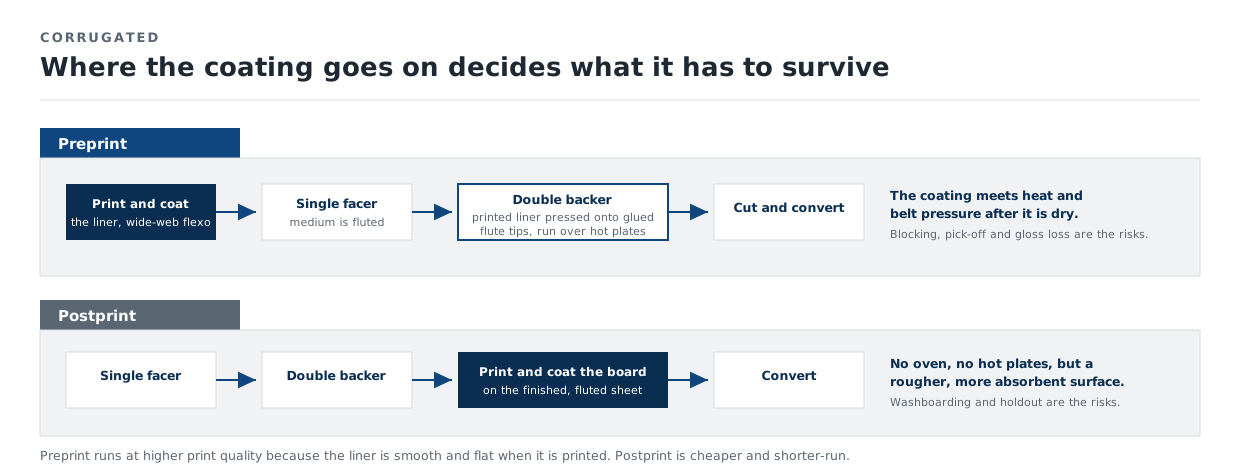
Where the coating goes on relative to the corrugator decides what it has to survive.
The Arcfibre range
14 products in 7 families. Each is specified against the substrate, the process and the service conditions of the job rather than supplied from a fixed catalogue.
Sheet-fed offset gloss and high-gloss overprint varnish
Inline and offline coater varnish for commercial sheet-fed offset work, giving rub protection, fast setting in the delivery pile and gloss build on coated and uncoated stock.
Arcfibre OG 110 Gloss Overprint Varnish
A general-purpose water-based gloss overprint varnish for sheet-fed offset coaters, built for fast setting and clean delivery-pile behaviour on long runs. It is the working grade of the subfamily, applied at low film build to give rub protection and a clean gloss without slowing the press. Compared with OG 140 it runs at lower solids and lower coat weight, so it is the choice where throughput and pile stability matter more than peak gloss.
Substrates Coated and uncoated offset paper and board, folding boxboard, cast-coated stock, recycled-content board
Process Roller or chambered doctor blade coater inline on a sheet-fed offset press, or an offline coater, with IR and hot air drying
Arcfibre OG 140 High-Gloss Overprint Varnish
A higher-solids sheet-fed overprint varnish formulated for maximum gloss build on closed, well sized coated stock. It carries more dry film at the same anilox volume and holds it on the surface rather than losing it into the sheet, which is what produces the gloss. It is the high-gloss option of the subfamily and needs a coated substrate and adequate drying to reach its window, so it is not the grade for absorbent uncoated board.
Substrates Coated art paper and board, cast-coated board, well sized folding boxboard
Process Chambered doctor blade coater inline on a sheet-fed offset press, higher anilox volume, IR and hot air drying
Matt, satin and dull-matt overprint varnish
Low-gloss finishes for the same sheet-fed offset coaters, where the requirement is a controlled sheen and a dry hand feel rather than gloss, with rub protection retained.
Arcfibre OM 210 Satin and Matt Overprint Varnish
A water-based low-gloss overprint varnish for sheet-fed offset coaters, giving a satin to matt sheen with the rub protection of a gloss varnish. It is the adjustable grade of the subfamily, sitting in the mid sheen band where most commercial matt work is specified. Where a deeper, flatter finish is wanted, OM 240 goes further down the gloss scale.
Substrates Coated and uncoated offset paper and board, folding boxboard, recycled-content board
Process Roller or chambered doctor blade coater inline on a sheet-fed offset press, or an offline coater, with IR and hot air drying
Arcfibre OM 240 Dull-Matt Overprint Varnish
A dull-matt overprint varnish for work that has to read as flat and uncoated while still resisting rub and marking in the pile and in transit. It carries more matting structure than OM 210 and therefore a higher film build, and it is the grade used behind spot-gloss contrast work. Matting structure raises the surface roughness, so scuff and marking behaviour should be checked to ASTM D5264 on the actual stock before the run is committed.
Substrates Coated and uncoated offset paper and board, folding boxboard, textured and speciality papers
Process Chambered doctor blade coater inline on a sheet-fed offset press, higher anilox volume, IR and hot air drying
Corrugated preprint flexo coatings
Wide-web flexo coatings applied to the liner before it is combined on the corrugator, where the smooth, unfluted liner allows higher print and coating quality than postprint can reach.
Arcfibre CP 310 Preprint Flexo Gloss Coating
A water-based flexo coating for liner preprint, applied on a wide-web press before the liner is combined on the corrugator. It is formulated to dry fast at web speed and to stay flexible and free of blocking and pick-off at the double backer, where the printed liner is pressed onto the glued flute tips and carried across the hot plates with the coated face in contact with them. It is the standard gloss and holdout grade of the subfamily, used where the finished case needs a printed, coated liner of a quality that postprint cannot reach.
Substrates Coated and uncoated kraft liner, white top liner, test liner, recycled liner for corrugating
Process Wide-web central impression or stack flexo press, anilox applied, hot air and IR drying, the reel then combined on a corrugator
Arcfibre CP 340 Preprint High-Holdout Scuff-Resistant Coating
A higher film build preprint coating for liners that will be handled hard, with stronger holdout on absorbent recycled liner and higher dry rub resistance measured to ASTM D5264. It is the grade to specify where the case is scuffed in transit, where the graphic is heavily inked, or where the liner is open enough that CP 310 loses gloss into the sheet. It demands more drying capacity than CP 310, and a heavier film is more exposed to hot plate contact at the double backer, so line speed, dryer loading and hot plate temperature should be confirmed on trial.
Substrates Recycled and test liner, kraft liner, white top liner, lower-grammage absorbent liners
Process Wide-web flexo press at higher anilox volume, extended hot air and IR drying, the reel then combined on a corrugator
Corrugated postprint and board coatings with defined slip
Coatings printed on finished board, formulated to a specified coefficient of friction so that cases stack, palletise and travel without sliding or scuffing.
Arcfibre CB 410 Postprint Board Coating with Defined Slip
A water-based coating printed directly on finished corrugated board, formulated to a defined coefficient of friction so that stacks hold on a pallet and cases still feed reliably down a conveyor. It is the mid-slip grade of the subfamily, giving protection and a controlled surface without the slippery, low-friction face that a gloss overprint varnish leaves on a case. Friction is measured to ASTM D1894 coating against coating and to TAPPI T815 board face against board back. Postprint runs on a formed, fluted surface at low pressure, so coverage and gloss are always below what the same coating gives in preprint.
Substrates Finished single and double wall corrugated board, kraft and test liner facings, white top liner
Process Flexo postprint on a corrugated case press, low impression pressure, anilox applied, hot air drying
Arcfibre CB 440 High-Slip-Control Stacking Coating
A postprint coating set for a narrower and higher friction window than CB 410, for heavy cases, tall pallet stacks and export loads where slide between layers is the failure mode. It carries a higher film build, which also raises scuff resistance on the printed face. Friction is a property of the pair of surfaces in contact, not of the coating alone, so the value is confirmed board face against board back to TAPPI T815 on the actual case construction and at the actual stack height.
Substrates Heavy-duty single, double and triple wall corrugated board, kraft and test liner facings
Process Flexo postprint on a corrugated case press, higher anilox volume, low impression pressure, hot air drying
Grease and oil barrier for fibre-based food service
Water-based grease and oil resistance for boxes, wraps, liners and trays, screened by the KIT test, specified where a converter is moving away from fluorochemical treatments and extruded films.
Arcfibre GB 510 Grease and Oil Barrier Coating
A water-based grease and oil barrier for fibre-based food service, applied on flexo or a coater and screened by the KIT test to TAPPI T559. It targets the mid KIT band and is the lower coat weight option of the subfamily, used for ambient and warm dry foods such as baked goods, wraps and box liners. KIT is a room-temperature screening test with a graded castor oil, toluene and heptane series, so it ranks grease resistance but does not predict behaviour against hot oil. Grease resistance depends on continuous coverage, so an absorbent or rough base board will need a higher coat weight or a second pass.
Substrates Food-service board, greaseproof and kraft paper, cup and tray board, and moulded fibre parts where the coating is spray applied
Process Flexo, gravure or blade coater at the converter, size press at the base-paper mill, or spray application on formed moulded fibre, single or double pass, hot air and IR drying
Arcfibre GB 550 High-KIT Grease and Oil Barrier Coating
A higher film build grease barrier for oily and fatty foods, formulated to reach the upper KIT band under TAPPI T559 and to hold a continuous film at higher coat weight. It is the grade for fried food boxes, pizza liners and oily bakery applications where GB 510 breaks through. A high KIT rating is a bench screen at room temperature and does not by itself predict hot oil performance, so a hot oil or hot grease hold test at the actual contact temperature and time is required. Creasing, scoring and forming stress the film, so the test is run on the formed part and not only on a flat sheet.
Substrates Food-service board, cup and tray board, kraft and greaseproof paper, and moulded fibre parts where the coating is spray applied
Process Flexo, gravure or blade coater, or spray application on formed moulded fibre, typically double pass or higher coat weight, extended hot air and IR drying
Moisture barrier and heat-sealable barrier
Water vapour and liquid-water resistance for cups, trays and wraps, including a heat-sealable grade, specified where a converter is removing extruded polyethylene and intends to test the finished structure for fibre recovery.
Arcfibre MB 610 Moisture Barrier Coating
A water-based moisture barrier for cups, trays, wraps and food-service board, specified where a converter is working to remove extruded polyethylene with the objective of recovering the fibre in a standard repulping stream. It reduces liquid water penetration, measured as Cobb 60 to ISO 535, and water vapour transmission, measured to ASTM E96 or ISO 2528 with the test climate quoted alongside the value. It does not match extruded polyethylene on water vapour transmission and is not offered as an equivalent. It is the non-sealing grade of the subfamily, for structures that are formed, folded or glued rather than heat sealed.
Substrates Cup and tray board, food-service board, kraft and machine-glazed paper, and moulded fibre parts where the coating is spray applied
Process Flexo, gravure, curtain or blade coater, or spray application on formed moulded fibre, single or double pass, hot air and IR drying
Arcfibre MB 650 Heat-Sealable Moisture Barrier Coating
A heat-sealable version of the moisture barrier, giving a coating-to-coating or coating-to-board seal on cup seaming, tray lidding and wrap closing equipment as well as the barrier performance of MB 610. Seal initiation temperature, dwell and jaw pressure are all set on the customer machine, and seal strength is confirmed on the finished structure to ASTM F88. Blocking in the reel or the stack is the usual constraint on a sealable coating, so reel tension, stack height and storage temperature should be agreed before a full run.
Substrates Cup and tray board, lidding and wrap paper, food-service board
Process Flexo, gravure or blade coater, hot air and IR drying, followed by heat sealing on the converter’s forming, seaming or lidding line
Blister-board bonding coatings
Heat-seal and ultrasonic-seal coatings that bond printed paperboard to thermoformed PET, RPET, PETG and PVC blisters for retail packs. These are adhesive seal coatings, not barriers.
Arcfibre BL 710 Blister-Board Coating for PVC and PET
A water-based blister-board coating that bonds printed paperboard to a thermoformed PVC or virgin PET blister under heat and pressure. It is the standard bond grade of the subfamily, set for conventional platen sealing at moderate dwell and jaw temperature. Board grammage, moisture content and print coverage under the seal area all change the bond, and the target is consistent fibre tear on peel, so the window is established on the customer sealing machine.
Substrates Folding boxboard and solid bleached board for blister cards, sealing to thermoformed PVC and virgin PET blisters
Process Flexo, gravure or offset coater applied, hot air drying, sealed on a platen heat-seal blister machine
Arcfibre BL 740 High-Bond Blister-Board Coating for RPET and PETG
A higher film build blister-board coating formulated for recycled PET and PETG, which soften at different temperatures from virgin PET and can distort or under-bond in a window set for virgin material. It is also the grade for ultrasonic sealing and for short-dwell, high-throughput lines where BL 710 gives inconsistent fibre tear. Recycled sheet varies between lots, so a bond trial on the actual sheet and the actual sealing tool, assessed as percentage fibre tear on peel, is required before specification.
Substrates Folding boxboard and solid bleached board for blister cards, sealing to thermoformed RPET, PETG, PET and PVC blisters
Process Flexo, gravure or offset coater applied at higher coat weight, hot air drying, sealed by platen heat seal or ultrasonic seal
Typical operating window
The figures below are the typical operating window for this range, not a measured result for any one batch. Confirmed values are issued with the Technical Data Sheet and Certificate of Analysis by our laboratory.
| Property | Typical operating window | Method |
|---|---|---|
| Non-volatile content | 28 to 48 per cent by weight | ISO 3251 |
| Flow time, 4 mm flow cup at 20 degrees C | 18 to 65 seconds | ISO 2431 |
| pH at 20 degrees C | 7.5 to 9.5 | ISO 976 |
| Applied dry coat weight | 1.5 to 14 g per square metre, subfamily dependent | ISO 536, grammage difference |
| Gloss at 60 degrees | 5 to 92 gloss units across gloss and matt grades | ISO 2813 |
| Coefficient of friction, static and kinetic | 0.25 to 0.70 | ASTM D1894 coating against coating, TAPPI T815 board face against board back |
| Dry rub resistance, Sutherland, 2 lb weight | 100 to 500 cycles without visible transfer | ASTM D5264 |
| Water absorption, Cobb 60, on moisture barrier grades | 2 to 15 g per square metre | ISO 535 |
| Grease resistance, KIT rating, on grease barrier grades | 5 to 12, room-temperature screening test only | TAPPI T559 |
| Water vapour transmission rate, 23 degrees C and 50 per cent RH, on moisture barrier grades | 30 to 300 g per square metre per 24 hours, and substantially higher at 38 degrees C and 90 per cent RH | ASTM E96 or ISO 2528 |
| Heat seal strength on sealable grades, 15 mm strip | 2 to 8 N per 15 mm | ASTM F88 |
| Blister card bond, assessed as fibre tear on peel | Target consistent fibre tear across the seal area | Peel assessment on the customer sealing tool, no single international method applies |
Application
How the range is applied
The figures published for this range are the typical operating window for the range, and confirmed values are issued with the Technical Data Sheet and Certificate of Analysis by our laboratory. Coat weight is the main control the converter holds. Within a subfamily the chemistry is common, so an absorbent or open board is answered by raising anilox volume or adding a pass rather than by changing product.
Sheet-fed offset coater, Arcfibre OG and OM
Overprint varnish is applied inline through a roller or chambered doctor blade coating unit after the last printing unit, or offline on a dedicated coater. The result on the line is governed by four things: anilox volume and cell condition, viscosity at the coater rather than in the drum, dryer loading and air knife setting, and the temperature of the delivery pile. A hot pile blocks and marks even when the coating is dry to the touch, so pile temperature and stack height matter as much as the drying section. Fresh offset ink underneath is a second variable: heavy solids and unset ink films slow the varnish and can shift gloss and rub.
Corrugated preprint, Arcfibre CP
Preprint coats the liner on a wide-web flexo press before the board is made. The liner at that point is smooth and unfluted, which is why preprint reaches print and coating quality that postprint cannot. The coated reel then goes to the corrugator. The medium is fluted at the single facer and bonded to the inner liner. The preprinted liner is brought in at the double backer, pressed onto the glued flute tips and carried across the hot plate section with the coated face running in contact with the hot plates under the holddown belt. The coating therefore has to stay flexible, must not block or pick off against the hot plates and belt, and must not lose gloss at hot plate temperature. Starch adhesive bonds to bare fibre, so the coating is kept off the glue side. Web tension, anilox volume, dryer capacity and the absorbency of the liner set the line speed on the printing press, and hot plate temperature and belt pressure set the limit on the corrugator.
Corrugated postprint, Arcfibre CB
Postprint runs on finished board, so impression pressure has to stay low to avoid crushing the flutes, and the fluted structure causes washboarding that limits coverage and gloss. Coefficient of friction is the specified property here, not appearance. Friction is a property of the two surfaces in contact, so it is confirmed board face against board back to TAPPI T815 on the actual case construction, at the actual stack height, and not from a coating-against-coating laboratory value alone.
Barrier coatings, Arcfibre GB and MB
Barrier performance depends on continuous, pinhole-free coverage, which is why a second pass often achieves more than a single heavier pass. Creasing, scoring, forming and die cutting all stress the film, so Cobb 60 to ISO 535, KIT to TAPPI T559 and water vapour transmission rate to ASTM E96 or ISO 2528 are measured on the formed part rather than on a flat coated sheet, and every water vapour figure is quoted with its test climate. KIT is a room-temperature screen and ranks grease resistance only, so hot and fatty food applications are qualified separately by a hot oil or hot grease hold test at the real contact temperature. Moulded fibre parts are spray coated after forming, since a three-dimensional part cannot be roll, blade or curtain coated. Where the reason for the coating is fibre recovery, the repulpability or recyclability of the structure is established by testing that structure under a named scheme, and it is not inferred from the coating.
Blister-board coatings, Arcfibre BL
The bond is formed on the customer’s sealing machine, by platen heat seal or by ultrasound, and it is defined by temperature, dwell and pressure together. Recycled PET and PETG soften differently from virgin PET and vary between lots, so a window proved on virgin sheet does not transfer. The target is consistent fibre tear on peel, assessed on the actual board, the actual thermoformed sheet and the actual sealing tool. Where a numerical seal strength is required on a sealable structure, it is measured to ASTM F88.
Trials
Every grade in this range is specified from a press or machine trial on the customer’s own substrate and line. Arctic supplies the coating, the Technical Data Sheet and, on request, a compliance dossier or declaration, and the converter qualifies the finished structure for the market of sale.
Specifying this range
What we need to know to specify correctly
Arcfibre is specified from the substrate and the line, not from a product list. The following answers allow our laboratory to nominate a grade and a starting coat weight.
Substrate
- What is the board or paper: coated or uncoated, virgin or recycled content, grammage, and the supplier grade name.
- For corrugated, is the coating going on the liner before corrugating or on finished board, and what is the liner and flute combination.
- For a moulded fibre part, what is the forming process and is spray application available after forming.
- What is the Cobb value or sizing level of the base board, if it is known.
Process and line
- Which application method: inline sheet-fed offset coater, offline coater, wide-web flexo, gravure, curtain, blade, size press at the mill or spray.
- Anilox volume and cell count available, or roller settings, and whether a second coating unit is available for a double pass.
- Line speed and drying capacity: hot air, IR, dryer length and available temperature.
- For preprint, the corrugator hot plate temperature, belt pressure and combining speed the coated liner will see at the double backer.
- What is printed underneath, in which process, and how much time passes before the coating is applied.
Required performance
- Target gloss at 60 degrees to ISO 2813, or the required matt sheen band.
- Required rub and scuff performance to ASTM D5264, and whether it is assessed dry, wet or both.
- For corrugated, the required coefficient of friction board face against board back to TAPPI T815, the stack height and whether the load is palletised or exported.
- For grease barrier, the required KIT rating to TAPPI T559, and separately the food type, the contact temperature and the hold time, so that a hot grease test can be set where it is needed.
- For moisture barrier, the required Cobb 60 to ISO 535, the required water vapour transmission rate to ASTM E96 or ISO 2528 together with the test climate it is quoted at, and the storage climate in service.
- For sealable grades, the required seal strength to ASTM F88 and the available temperature, dwell and pressure on the sealing machine.
- For blister board, the thermoformed material, whether it is virgin PET, RPET, PETG or PVC, its thickness, the seal method and the required fibre tear on peel.
End use and downstream
- Is the coating being specified to replace extruded polyethylene, and which recovery or repulpability scheme will the finished structure be tested against.
- What converting follows the coating: creasing, die cutting, folding, gluing, forming, seaming or lidding.
- Which regulation the finished article must satisfy in the market of sale, and whether a compliance dossier or declaration is required with the Technical Data Sheet.
- Pack size, batch frequency and whether reel or stack storage is the constraint on blocking.
Documents and specification
The Technical Data Sheet, Safety Data Sheet and regulatory declaration for any grade in this range are issued by our laboratory against the substrate and process you are running. Tell us the job and we will specify against it.