
Research and Development
Arctic’s research and development work begins with a constraint a customer is already living with: a raw material withdrawn, a substrate that will not bond, a line speeded up, a specification tightened. We formulate against that constraint at our technical centre and laboratory in Greater Noida, Uttar Pradesh, measure the result by published test methods, and qualify it on the customer’s own substrate and line before it goes into production.
Development starts with a constraint, not a product idea
Coatings and ink development rarely begins with a blank page and a product concept. It begins with something that has stopped working, or is about to. A raw material is withdrawn or moves onto a restricted list, and a formulation that has run for years can no longer be supplied in the same form. A recycler or a brand owner refuses a laminate structure, and a multi-layer job has to be rebuilt as a mono-material one without losing bond strength, heat resistance or rub resistance. A substrate changes grade and will not accept the existing cure schedule, so the film stays soft at the same oven setting or the part distorts before the coating crosslinks. A converter raises line speed, and drying and setting windows that used to be generous close up. In none of these cases does the customer want a new product category. They want the same job done inside a boundary that has moved.
We therefore develop against a brief rather than pushing a catalogue. The difference is in which side is asked to change. Selling from a catalogue asks the customer to adapt the line, the substrate or the specification to the product that exists. Developing against a brief fixes the customer’s constraints first, writes them down, and treats them as the specification the formulation has to satisfy. The work that follows is narrow and testable: candidate resin and pigment systems are screened against the stated conditions in the laboratory, reproduced on the substrate the customer sent, and only then put on a line. The laboratory is the cheapest place to discover that a brief cannot be met on the terms given, and a press trial is the most expensive one.
A brief that can be worked with answers five things.
- The substrate, named and sampled. Grade and supplier, not just the polymer or metal family. Surface treatment and, on plastic film, the measured wetting tension to ASTM D2578, whether corona or flame treatment is inline or was applied weeks earlier, slip and anti-block additives already present in the film, pretreatment and cleanliness on metal, moisture content and species on wood. A sample of the material actually being run matters more than the description, because two deliveries under one trade name can wet and bond differently after storage.
- The process and line conditions. Application method and the equipment behind it: anilox volume and cell count, roller or gravure cylinder specification, spray setup, dip or curtain geometry. Applied viscosity with the measurement method stated (ISO 2431 flow cup or ASTM D2196 rotational), film weight or wet film thickness, line speed, dryer air temperature and dwell time, oven schedules expressed as time at substrate temperature rather than air setpoint, UV dose and peak irradiance measured with a radiometer in mJ/cm² and mW/cm². What happens immediately downstream is part of the process: lamination, slitting, forming, assembly, or stacking while the work is still warm.
- The service environment. Where the coated part spends its life, stated as exposure that can be measured or specified rather than as a general description such as outdoor or harsh. Interior, exterior, buried or immersed. Corrosivity category to ISO 12944-2 for structural and infrastructure work, salt spray to ISO 9227, accelerated weathering to ISO 16474-2 for xenon arc or ISO 16474-3 for fluorescent UV, thermal cycling range, contact with fuels, cleaners, disinfectants or hand creams, abrasion and handling in service, and the service life the customer is quoting to their own buyer. Cabinet exposures belong in the specification, but they are not a substitute for the service conditions, so the brief has to carry both.
- The failure being solved. What went wrong, where on the part, after how long, and what it looked like. Adhesion loss at a cross-cut to ISO 2409 or ASTM D3359, blocking in the stack, blushing, chalking, gloss loss to ISO 2813, solvent sensitivity by MEK double rub to ASTM D5402, chipping under impact to ASTM D2794, cracking on a cylindrical mandrel bend to ISO 1519, edge creep, ink bond failing on a peel or tape test, slip out of range by coefficient of friction to ISO 8295. Retained failed samples and photographs are worth more than a description, and the counter-sample that passed is worth almost as much.
- The compliance regime. Which restricted substance regimes the finished article is sold under, and who signs the declaration for it. This typically covers REACH candidate list and restriction entries, RoHS with element screening to the IEC 62321 series, heavy metal limits for packaging under Directive 94/62/EC, EN 71-3 migration limits where the article reaches toys, and the customer’s own restricted substances list, which is often tighter than any of them. The regime decides which chemistries are available before any performance work starts, so it belongs at the beginning of the brief and not at the end.
Products across our range, which now runs to over 550 products, began this way: a customer describing a constraint rather than requesting a product. Where the answer to one brief turns out to solve the same constraint for other plants, it is developed into a range item with a data sheet behind it. Where it stays specific to one line, it stays with that line. In both cases the brief is only satisfied if a later batch behaves on the press like the first, so the conditions recorded in it become the conditions the product is supported under. If a constraint set cannot be met, we say so while it is still a document, and we say which part of it would have to move.
From brief to qualified supply
A brief becomes a project when it is written down with a set of acceptance criteria against it, and both are agreed before any formulation work begins. The acceptance criteria turn the brief into a pass mark: each property is tied to a named test method and a stated limit, for example cross-cut adhesion to ISO 2409 at an agreed classification, specular gloss to ISO 2813 at 60 degrees within a tolerance band, or colour difference against an agreed standard, measured under the conditions set out in ISO 13655 and expressed as ΔE against a stated limit. The criteria are fixed first because a coating with no defined pass mark cannot be signed off. Without them a trial produces opinions rather than a result, and every later review reopens the same argument.
With the target fixed, the work moves to screening. Binder chemistry is selected against the service requirement rather than by habit, and candidate resins, crosslinkers, pigments, dispersants and additives are shortlisted with the incompatible combinations eliminated on paper before they consume bench time. Laboratory batches are then made at small scale and characterised before any performance testing: non-volatile content to ISO 3251, viscosity by flow cup to ISO 2431 or by rotational viscometer to ISO 3219 where shear dependence matters, density, fineness of grind to ISO 1524, and dry film thickness on drawdowns to ISO 2808. Characterisation comes before performance work because a performance result only means something when the film that produced it is defined. A coating that fails adhesion at 40 microns is a different problem from the same coating failing at 12 microns, and without the thickness on record the two are indistinguishable.
Testing then runs against the criteria agreed at the start, by the methods named in them and not by substitutes chosen later. The set differs by product family: mechanical and resistance properties on coatings, with abrasion to ASTM D4060 and resistance to liquids to ISO 2812 where the service calls for them; humidity and salt spray on protective systems; and on inks, rub resistance, coefficient of friction, laminate bond strength to ASTM F904 and seal strength, measured on prints prepared to ISO 2834-2. What each of these methods can and cannot tell you is set out further down this page. Every result is recorded as a measured value against its limit, with the batch, the substrate lot and the film thickness attached, so that a later change can be traced to what changed.
A formulation that meets every criterion on a drawdown is still only a laboratory result, so it goes next to a pilot batch or a press trial made under production conditions on production equipment. Scale changes dispersion energy, heat history, order of addition and let-down time, and a system that is stable in a half-litre can be unstable in a full batch.
Qualification then moves onto the customer’s own substrate and their own line, and this is where most of the surprises appear. Substrate lots vary between deliveries, corona treatment decays in storage so the wetting tension measured at the press to ASTM D2578 is not the figure on the certificate, dryer capacity caps the line speed that was assumed in the brief, plant temperature and humidity differ from laboratory conditions, and chemistry already running on the line can interact with the new product. Trials are therefore run on the customer’s material, at their speed, with their operators, and the acceptance criteria from the first stage are applied unchanged rather than renegotiated to fit the result. Anything that fails returns to formulation with an identified cause, not a general impression.
Once the product is qualified it transfers to production with the controls that hold it there: a retained reference sample, batch testing by the same methods against the same limits, the batch result issued on the certificate of analysis, the Technical Data Sheet as the controlled specification, and change control so that no raw material is substituted without requalification. Our production line is built for batch-to-batch consistency, and that consistency is what the qualification result rests on in the tenth batch as well as the first.
Development path
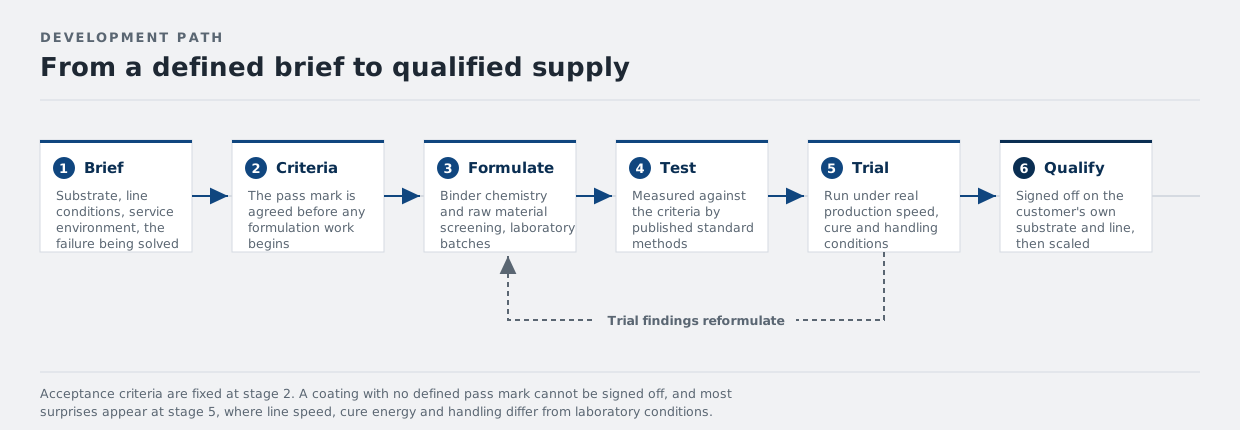
Acceptance criteria are fixed before formulation begins, and trial findings feed back into the formulation rather than forward into supply.
Inside the technical centre at Greater Noida
The technical centre and laboratory sit at Greater Noida, Uttar Pradesh, alongside the production line, so a formulation that behaves on the bench can be checked against the vessel that will make it. The same benches serve new formulation and reformulation, batch control against an approved reference, and fault diagnosis on samples returned from customer plants.
For pigmented products the work starts as a dispersion problem. Pigment is wetted into the binder system and taken through a mill until agglomerates are broken down and the particles are stabilised, with progress followed on a grindometer to ISO 1524 or ASTM D1210 and, where gloss or colour strength targets demand a full distribution rather than a top-end reading, by laser diffraction to ISO 13320. A mill base is released on fineness, colour development on let-down and storage stability, not on residence time, because under-dispersion surfaces later as low gloss, weak colour strength and settlement. Clear and unpigmented systems skip the mill and go straight to rheology and cure.
Rheology is measured next, since how a material flows decides how it can be applied. Flow cup times to ISO 2431, Krebs units to ASTM D562 and rotational measurement across a shear-rate sweep to ISO 3219 give three views of the same product: the low-shear end governs sagging and levelling, the high-shear end governs behaviour under spray, roller and press, and structure recovery after shear shows whether pigment stays suspended in a drum through storage and transport.
Colour is fixed instrumentally and confirmed visually. Spectrophotometric readings are converted to CIELAB coordinates and reported as a colour difference against the approved standard to ASTM D2244, with metamerism checked by comparing results under more than one illuminant rather than a single reading, and a controlled light booth kept as the second opinion, because the eye still finds faults that one number hides.
Films are applied by drawdown to a set wet thickness to ASTM D823, cured on the schedule the customer will run, and measured dry to ISO 2808 or ASTM D7091, because almost every property that follows is thickness dependent and a result quoted without film build means little. Drying and cure studies separate surface dry, through dry and full cure, using recorded drying time to ASTM D1640 or ASTM D5895, solvent rub for crosslink development to ASTM D5402, and hardness build tracked over days rather than hours. The cured film is then treated as a mechanical object and taken through the gloss, hardness, adhesion, bend and impact set described below. Insulating and electrical grades carry an electrical programme as well: varnish properties to IEC 60464-2 and thermal endurance to IEC 60216, because a material that passes a hardness and adhesion set can still fail on the property the winding needs.
Durability work runs on the same panels: accelerated weathering, condensing humidity, neutral salt spray, and chemical and stain exposure using the fluids the customer names, at working concentration. Gloss, colour and chalking are recorded at intervals rather than only at the end, a control of known behaviour is exposed on the same cycle, and film and adhesion are rated together, since a coating that survives while the bond beneath it fails has not passed.
For the ink ranges the laboratory ends in print rather than in a panel. Proofs are prepared under controlled conditions to ISO 2834 and assessed for colour and transparency against ISO 2846 before any press time is booked, then trials move onto the customer’s own substrate, since the same ink behaves differently on coated board, uncoated paper and treated film. Trials cover density and colour consistency through the run, tack and water balance where the process requires it, drying and setting speed, blocking and set-off under stack pressure, rub resistance to ASTM D5264, and resistance of the print to the agents listed in ISO 2836. Substrate surface energy is checked to ASTM D2578 before adhesion is judged, because a tape failure on untreated film is a substrate result and not an ink result. Retained samples, the drawdowns and the raw test records are kept with the batch reference, so that a question raised months later is answered from data rather than from memory.
Laboratory capability
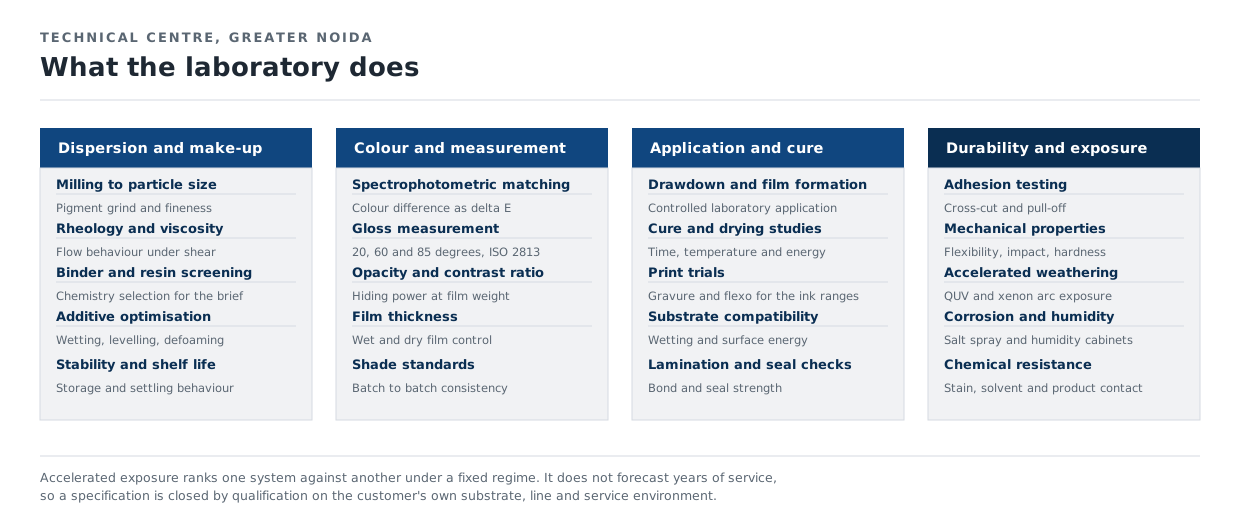
The four domains the bench work is organised around.
How a coating or an ink is proven
A result means nothing without the method that produced it. Every property we quote for a coating or an ink is tied to a published test method and to the conditions around it: the substrate and its surface preparation, the application method, the measured dry film thickness, the cure schedule, and the conditioning period before the panel is tested. Change any one of those and the number changes. The methods below are the ones our specifications and test reports are written against. A project specification normally selects from them rather than running all of them, and that selection is agreed with the customer before work starts. Where a method is run at an external laboratory, the report names that laboratory and the version of the standard used.
- Adhesion, cross-cut, ISO 2409. A lattice is cut through the film to the substrate, tape is applied and removed, and the result is classified 0 to 5 by how much coating lifts at the cut edges. It is a rapid screen, most useful for finding pretreatment and cure faults. The standard covers films up to about 250 micrometres, and the cut spacing is set by film thickness and substrate hardness. Above that range, use pull-off instead.
- Adhesion, pull-off, ISO 4624. A dolly is bonded to the surface and pulled perpendicular to it. The result is a stress in MPa together with the failure mode: adhesive at the coating-to-substrate interface, cohesive within the film, between coats, or failure of the adhesive itself. The failure mode carries more information than the number. A cohesive failure in the substrate is not a measurement of the coating.
- Flexibility, conical mandrel, ISO 6860. A coated panel is bent over a cone and the point of first cracking or detachment is read as a mandrel diameter. It ranks how much deformation a cured film tolerates.
- Flexibility, T-bend, EN 13523-7. The coil coating equivalent, where the coated strip is folded back on itself and rated 0T, 1T, 2T and so on, with a tape pull at the bend. This is the relevant test whenever the metal is formed after it is coated.
- Impact resistance, ISO 6272-1 and ISO 6272-2. A falling weight is dropped on the panel, direct and reverse, and the energy in joules at which cracking or loss of adhesion appears is recorded. Part 1 uses a large-area indenter and part 2 a small-area indenter, so the two do not give interchangeable energies and the part must be stated. Reverse impact is the more severe case because the film is stretched from behind.
- Pencil hardness, ISO 15184. Graded leads are pushed across the film at a fixed angle and load, and the hardest lead that does not gouge is reported. It is a quick indicator of cure state and is not a substitute for a mar, scratch or abrasion test.
- Gloss, ISO 2813. Measured at 60 degrees for general finishes, at 20 degrees to separate high gloss surfaces that all read near the top of the 60 degree scale, and at 85 degrees for matt and satin, where sheen is the property that matters. A drift in gloss is often the first measurable sign of weathering.
- Colour difference, CIELAB. Reported as ΔE*ab or ΔE00 to CIEDE2000, with the illuminant, observer, measurement geometry and backing stated, because the same pair of samples gives different numbers under different conditions. The acceptance tolerance is agreed in writing before production, since a ΔE with no tolerance behind it decides nothing. For print, ISO 12647 sets the process control framework: solid colorimetry, tone value increase and the tolerances that govern a repeat run.
- Accelerated weathering, QUV, ISO 16474-3. Fluorescent UV lamps cycled with condensation, which drives binder degradation, gloss loss, chalking and colour drift quickly. Lamp type and cycle must be stated, since UVA-340 and UVB-313 are not interchangeable.
- Accelerated weathering, xenon arc, ISO 16474-2. A filtered full spectrum including visible and near infrared, closer to real daylight or to daylight behind glass depending on the filter set, and the better choice where colour stability of the pigment system is the question.
- Neutral salt spray, ISO 9227. Continuous neutral 5 per cent sodium chloride fog at 35 degrees C, assessed for blistering to ISO 4628-2, rust grade to ISO 4628-3 and delamination and corrosion around a scribe to ISO 4628-8. Salt spray ranks systems against each other under one constant condition. It does not reproduce wet and dry cycling, ultraviolet exposure or pollutant chemistry, and cabinet hours do not convert to service years. Where the service environment cycles, a cyclic corrosion test to ISO 11997-1 produces a ranking that agrees more often with field behaviour, and we will say when the continuous test is the wrong one for the application. The cyclic test also ranks; it does not predict either.
- Humidity, ISO 6270-1 and ISO 6270-2. Part 1 is continuous condensation, part 2 a controlled condensation climate. Panels are assessed for blistering, softening and loss of adhesion. It is run early because it exposes pretreatment and undercure faults before a long corrosion or weathering exposure is committed to.
- Coefficient of friction, ASTM D1894. Static and kinetic friction of a film or coated surface against itself or a defined sled. This is the number that decides whether a printed or lacquered web feeds, stacks and runs on a packing line rather than blocking or slipping. Slip level moves as additive migrates, so the conditioning time and temperature before the test are part of the result.
- Seal strength, ASTM F88. The force required to separate a heat seal, reported per unit width with the failure mode recorded as peel, delamination or material tear. The sealing temperature, dwell time and jaw pressure are reported with it, because the same structure gives a different force under a different seal window. It is the relevant test wherever an ink or a lamination adhesive sits inside the seal area.
- Light fastness, blue wool scale, ISO 12040. Prints are exposed to filtered xenon light alongside blue wool references and rated 1 to 8, where 8 is the most resistant. The rating belongs to that ink on the stated substrate at the stated film weight: a tint rates lower than the solid, because the rating falls as pigment concentration falls. Pigment selection dominates the result. An overprint varnish carrying a UV absorber shifts it, but it does not rescue a fugitive pigment.
Accelerated tests compare, they do not forecast. An acceleration factor is not a constant: it shifts with binder chemistry, pigment loading, film build, substrate and the actual exposure site, so hours in a cabinet cannot be translated into years on a structure. What a cabinet does well is rank. For that reason a control system of known behaviour is exposed in the same chamber, on the same cycle, at the same time as the candidate, and the exposure standard, the cycle, the hours and the endpoint criteria are reported alongside the result. A statement that one system held gloss and resisted scribe creep better than another under a stated regime is defensible. A statement of service life derived from the same data is not, and we will not write one.
How projects are chosen
A laboratory can work on anything, so the governing question is what is worth the bench time. Six principles decide which projects enter the development programme. They are written as constraints, not ambitions: each one is a test a proposal has to pass before work starts.
- Formulate against the restriction that is coming, not only the one in force. Restricted substance lists move in one direction. Development tracks the REACH candidate list of substances of very high concern, OEM and retailer restricted substance lists, and Indian rules on solvent emissions and heavy metals, and replacement work starts while a substance is still permitted, so a customer’s requalification can be finished before a restriction date rather than begun after it.
- Design for the recycler and for end of life. By mass a coating or an ink is a small fraction of a pack or a component, and it is often the part that decides whether the rest can be reprocessed. Development assesses de-inking behaviour, alkali wash-off, whether an ink or an adhesive keeps a laminate mono-material, and whether a film contaminates polyolefin recyclate in the melt. Where a print is designed to come off at the wash step, resistance to that step is a defect and not durability.
- Remove the emission at the customer’s plant, not from the datasheet. Solvent in a coating is released in the customer’s booth, oven or press hall, not at the point of manufacture. Work is directed at water-based and high-solids replacements for solvent-borne systems, at UV and electron beam cure where the substrate tolerates it, and at lowering stoving schedules so an existing oven can run cooler, or a line can run faster on the same energy input.
- Substitute raw materials of concern, and prove the whole property set. Toluene, ketone blends, chlorinated adhesion promoters, cobalt driers, formaldehyde donors and heavy-metal pigments are the standing targets. A substitution is accepted only when the replacement has been run against the full specification: adhesion, block resistance, rub, yellowing, pot life and recoatability. A substitution fails in the property nobody thought to measure.
- Settle performance by method and number, not by assertion. A proposal has to say which properties decide the job, which published method will measure each one, and what the limit is, all of it written down before the first laboratory batch is made. A performance claim that cannot be tied to a named method and a recorded result does not enter the programme, and does not leave it either.
- Develop with one customer, not for an average customer. The average customer has an average substrate, an average line speed and average process water, and does not exist. A project is taken on where a real plant will run the trials, on its own substrate lots and through its own cure equipment, and pilot quantities are made on the production line that will supply the commercial material.
The principles overlap, and a project that satisfies one by ignoring another has usually moved a problem rather than solved it. A solvent removed by pushing cure temperature up moves an emission into an energy bill. A faster-drying ink that resists the de-inking chemistry buys press throughput at the cost of recyclability. Each proposal is assessed against all six together, and where they conflict the decision and the reasoning behind it are recorded with the formulation, so the next chemist to open the file can see what was traded and why.
Where this work shows up
The development programme feeds two places on this site. The innovation pages set out the platforms being worked on and the direction the industry is moving in. The product pages carry the ranges that came out of it.
Bring us a constraint
Tell us the substrate, the line you run, the service the part has to survive and the specification you are being held to. Our technical centre in Greater Noida will work the brief and issue the Technical Data Sheet, Safety Data Sheet and regulatory documentation for whatever it proposes.