
Can-End and Seam Sealing Compounds
Arcseam is a range of water-based elastomer sealing compounds for ends for two-piece beverage cans, food can ends, general line and aerosol ends, and pail and drum ends. The compound is lined into the curl, dried, and then compressed in the double seam, where it fills the void the metal cannot close.
Overview
A can-end sealing compound is not a coating. It is a water-based elastomer dispersion that is injected or flowed into the curl of a can end, dried to a resilient film, and then compressed when the end is seamed onto the can body. Arcseam grades are gaskets, and they are specified, applied and qualified in a way that has nothing in common with a lacquer.
The double seam is formed in two operations. The first operation rolls the curl of the end and the flange of the body together so that they interlock, giving five thicknesses of metal, three from the end and two from the body. The second operation tightens and flattens that hook against the body wall. Metal alone cannot close the space that remains between those layers, particularly at the juncture where the side seam of a three-piece can body passes through the double seam. The compound fills that remaining void. Without it the seam leaks. To do the job the compound has to flow into the curl cleanly at the lining machine, dry without skinning or cratering, stay compressible and elastic through the seaming operation, and then hold a seal through filling, processing and the whole of shelf life.
Against our Metal Packaging Coatings range: same customers, different job. A coating protects the metal and carries the decoration. A sealant is a compressible gasket that makes the seam hermetic. The two are sold as a system and bought by different people, the end-line engineer and the coatings buyer, and they are qualified by different tests. The honest constraints follow from that. The compound must be compatible with whichever internal lacquer the end maker runs, because the dried film sits on that lacquer and is expected to release cleanly from the lining chuck and, at the filler, from the seaming tooling. Qualification is by double-seam teardown and by pack integrity after processing, on the customer’s own line and with the customer’s own end stock. It is a line trial, not a bench result, and we do not quote a seam performance figure in advance of one.
Duty divides the range. Retort grades must survive sterilisation, typically 121 to 131 degrees Celsius under overpressure, without softening out of the seam or losing elasticity. Beverage grades must hold carbonation pressure in a very thin deposit applied at very high line speed, and on beer packs they must also come through tunnel pasteurisation. Pail and drum grades are usually lined and cured at ambient, because the ends are large and oven drying them is not practical. The table below is the typical operating window for the range, and confirmed values are issued with the Technical Data Sheet and Certificate of Analysis by our laboratory.
The double seam
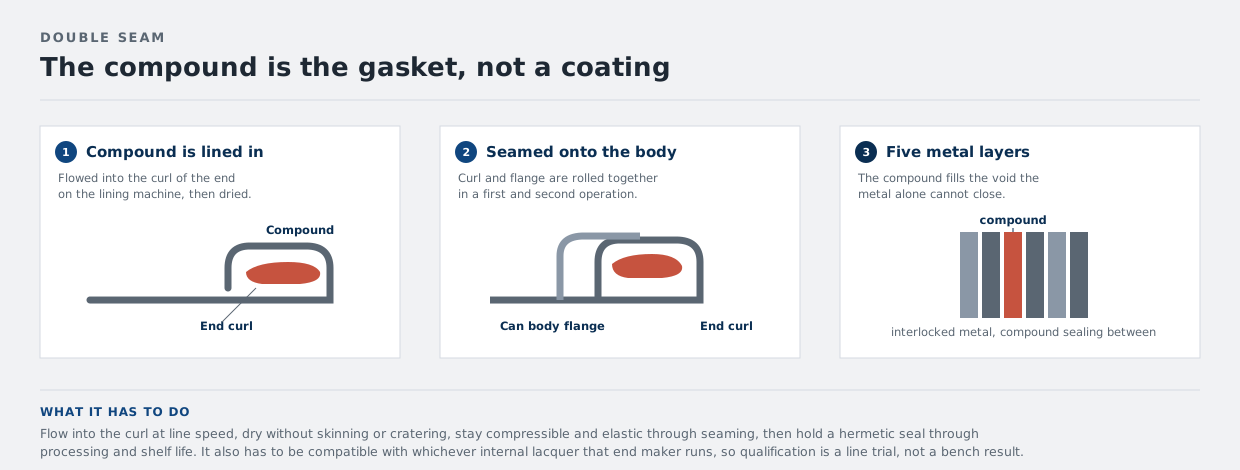
Five interlocking layers of metal, with the compound filling what is left.
The Arcseam range
5 products in 5 families. Each is specified against the substrate, the process and the service conditions of the job rather than supplied from a fixed catalogue.
Arcseam BV Beverage End Compounds
Thin-deposit compounds for aluminium ends for two-piece beverage cans, lined on high-speed rotary equipment, where the seal has to hold carbonation pressure.
Arcseam BV 110 High-Speed Beverage End Sealing Compound
A low-deposit water-based elastomer compound for aluminium ends for two-piece beverage cans, lined on high-speed rotary nozzle equipment. It is built for a short, clean cut-off at the nozzle and for fast water release, so that a thin, even bead dries within the short oven dwell a beverage end line allows. Among the Arcseam grades it carries the lowest deposit weight and the highest recovery after compression, because a carbonated pack loads the seam continuously, and on beer packs the seam is loaded again while warm during tunnel pasteurisation.
Substrates Internally lacquered aluminium beverage end stock, shells formed and curled before lining and converted to easy-open ends after drying.
Process Rotary nozzle lining at high speed, forced hot air drying in line.
Arcseam FR Round Food End Compounds
Nozzle-injected compounds for round food can ends that are processed, including retort sterilisation under overpressure.
Arcseam FR 330 Retort Food End Sealing Compound
A nozzle-injected compound for round food can ends that will be processed, including retort sterilisation under overpressure. During the cycle the pack pressurises from inside as the contents heat, and the seam is loaded at the point where the compound is softest, so the grade is formulated to resist extrusion out of the seam at process temperature and to recover its sealing force as the pack cools. Deposit weight is higher than the beverage grade because a food end curl leaves more void to fill.
Substrates Internally lacquered tinplate and ECCS round food ends, including easy-open ends, which are lined and dried as shells and scored and tabbed afterwards in conversion.
Process Rotary nozzle lining on round ends, oven drying.
Arcseam FN Non-Round Food End Compounds
Compounds formulated for die-liner or showerhead application, where a rotating nozzle cannot follow a rectangular, oval or oblong curl.
Arcseam FN 340 Non-Round Food End Sealing Compound
A compound rheologically matched to die-liner and showerhead application, for rectangular, oval and oblong food ends that a rotating nozzle cannot follow. It is shear thinning enough to flow evenly along a straight run and around a tight corner radius, then to recover quickly so the bead does not slump in the corners before drying. Retort duty matches the round food grade, with the difference being how the compound is laid down rather than what it has to survive.
Substrates Internally lacquered tinplate and ECCS non-round ends, including fish, meat and pet food formats.
Process Die-liner or showerhead application, oven drying.
Arcseam GL General Line Compounds
General line ends and the cone and dome ends of three-piece aerosol cans, where the seam has to hold internal propellant pressure and come through the hot water bath test the format requires.
Arcseam GL 220 General Line and Aerosol End Sealing Compound
A general purpose nozzle-applied compound for general line ends and for the cone and dome ends of three-piece aerosol cans. It is formulated for pressure duty at moderate temperature rather than for sterilisation, and it holds its elasticity through the hot water bath test, where internal pressure and temperature load the seam together. It stays sealed where the body side seam passes through the double seam, which is the usual leak path on a three-piece can, and it suits end makers running mixed diameters on one lining machine because it tolerates a wide deposit weight window without stringing or cratering.
Substrates Internally lacquered tinplate and ECCS (electrolytic chromium coated steel, tin-free steel) ends, and lacquered aluminium general line ends.
Process Rotary nozzle lining, hot air drying.
Arcseam DR Pail and Drum Compounds
High-deposit compounds for large pail and drum ends that are lined and cured at ambient temperature rather than in an oven.
Arcseam DR 450 Pail and Drum End Sealing Compound
A high-deposit compound for pail and drum ends that are lined and left to cure at ambient temperature, where oven drying a large end is impractical. It is formulated to build a thick, coherent bead in one pass without cracking as the water leaves, and to reach handling strength within a working shift so the ends can be stacked. It carries the highest dry deposit weight in the range, matched to the large curl volume and the heavier gauge of industrial ends.
Substrates Lacquered and unlacquered tinplate and steel pail and drum ends.
Process Nozzle or flow lining on large-diameter equipment, ambient cure.
Typical operating window
The figures below are the typical operating window for this range, not a measured result for any one batch. Confirmed values are issued with the Technical Data Sheet and Certificate of Analysis by our laboratory.
| Property | Typical operating window | Method |
|---|---|---|
| Non-volatile matter (solids) | 40 to 62 % by weight, grade dependent | ISO 3251 |
| Viscosity, rotational, at 23 degrees Celsius | 500 to 15,000 mPa.s, grade and application method dependent, with high-deposit and die-liner grades at the top of the range | ISO 2555 |
| pH as supplied | 8.0 to 11.0 | ISO 976 |
| Density at 20 degrees Celsius | 0.98 to 1.30 g/cm3, filled grades at the top of the range | ISO 2811-1 |
| Sieve residue (grit) on a 100 micrometre mesh | below 0.05 % by weight | ISO 4576 |
| Volatile organic compound content | typically below 50 g/l, water is the principal carrier | ISO 11890-2 |
| Dry deposit weight per end | from about 18 mg on a small beverage end to about 1,500 mg on a large drum end, set by end diameter, end type and curl volume | In-house, gravimetric, end weighed before and after lining and drying |
| Drying schedule | air 60 to 180 degrees Celsius, dwell from under one minute on a high-speed beverage line to about 10 min on heavy-gauge ends; Arcseam DR is ambient cure, handling strength typically within one working shift | In-house |
| Compression set of the dried compound | 15 to 40 % | In-house, on cast test pieces, adapted from ASTM D395 Method B |
| Storage and shelf life | 5 to 35 degrees Celsius, protect from frost, 6 to 12 months in unopened containers | In-house |
Application
Before the lining machine
Arcseam grades are supplied ready for use and are not thinned as a matter of routine. Stir slowly before use to redisperse anything that has settled, and avoid high-shear stirring, which aerates the compound and produces bubbles that dry as craters in the bead. Do not allow the material to freeze. Circulate or agitate gently in the day tank so that solids stay uniform across a shift, because deposit weight drifts with solids content.
Laying the bead down
Application method is what separates the products, not chemistry alone. A round end is lined on a rotary machine: the shell spins on a chuck and a nozzle injects a bead into the curl in a single revolution, with cut-off timed so the bead closes on itself without an overlap lump. Easy-open ends are lined and dried as shells, and scoring and tab attachment follow in the conversion press, so the lining and drying settings are set on an unscored panel. A non-round end cannot be spun against a fixed nozzle, so it is lined either with a die-liner, which presents the whole curl profile at once, or with a showerhead, which floods the curl and relies on the compound’s rheology to level. A beverage end is lined at very high speed, which shortens both the injection window and the drying window. A pail or drum end is lined on large-diameter equipment and cured at ambient.
What governs a good result on the line
- Curl geometry. Deposit weight is set by the void the curl leaves, not by a general rule. Measure the curl and set the weight to fill it, then check-weigh ends at intervals through the shift.
- Nozzle and cut-off condition. A worn or partly blocked nozzle gives an uneven bead and stringing at cut-off. Flush with water before the compound dries in the line; dried compound is far harder to remove.
- Drying, not just heating. Too hot or too fast and the surface skins while water is still trapped underneath, which blisters and leaves a soft core. Too cool and the ends block when stacked. Confirm the dried bead is coherent and tack free across the whole curl.
- Lacquer compatibility. The dried film sits on the end maker’s internal lacquer. Adhesion has to be sufficient that the compound stays put through handling, conversion and seaming, and clean release from the lining chuck and from the seaming tooling has to be confirmed on the actual lacquer in use.
- Stacking and storage of lined ends. Lined ends must not block or transfer compound face to face. Storage conditions and stack height are part of the qualification, not an afterthought.
Qualification
A sealing compound is qualified by double-seam teardown and by pack integrity after processing, on the customer’s own line. Teardown covers seam thickness and height, countersink depth, body hook and cover hook length, overlap, tightness or wrinkle rating of the cover hook, and the distribution of compound across the seam, all measured against the end maker’s own seam specification. Pack integrity is then confirmed on filled and processed packs, by pressure or vacuum leak testing and by incubation where the pack calls for it. Retort grades are assessed after the full sterilisation cycle, beer packs after pasteurisation, and aerosol formats after the hot water bath test the format requires. A bench result does not substitute for this: a line trial is required, and we plan it with the customer’s end-line engineer.
The figures above are the typical operating window for the range, and confirmed values are issued with the Technical Data Sheet and Certificate of Analysis by our laboratory. Where a compliance dossier or declaration is required for the end use, it is issued on request with the Technical Data Sheet.
Specifying this range
Sealing compound cannot be specified from a product name and a can size. Answer these questions and our technical centre in Greater Noida will specify a grade and plan the line trial.
The end
- End type: end for a two-piece beverage can, round food end, non-round food end, general line end, aerosol cone or dome, pail end or drum end.
- End diameter or, for a non-round end, the full format dimensions and the corner radius.
- End stock: aluminium, tinplate or ECCS, and gauge.
- Curl profile and the measured or calculated void volume to be filled.
- Easy-open or plain end, and where conversion, scoring and tab attachment sit in your sequence relative to lining and drying.
The internal lacquer
- Which internal lacquer is run on the end, and its cure schedule.
- Whether more than one lacquer is in use across the formats the compound will cover.
The lining machine
- Application method: rotary nozzle, die-liner, showerhead or flow lining.
- Line speed, in ends per minute.
- Target dry deposit weight per end, and the tolerance the line is held to.
- Drying: oven temperature profile and dwell time, or ambient cure with the space and time available for it.
The pack and the process
- Product filled, and whether it is aqueous, oily, acidic, brine or a propellant-driven formulation.
- Process: no process, pasteurisation, retort, and the temperature, time and overpressure used.
- Internal pressure in service, for carbonated and aerosol packs.
- Filling temperature and whether the pack is hot filled.
- Required shelf life and the storage climate it has to hold through.
The seam and the trial
- Your seam specification and the teardown measurements you hold ends to.
- Seamer type and the first and second operation roll profiles in use.
- The leak or integrity test the pack has to pass, and the acceptance criteria.
- Any regulation your customer requires you to satisfy for the end use, so that the correct documentation is prepared with the Technical Data Sheet.
- Volume, pack size and the delivery point, so supply can be matched to your lining schedule.
Documents and specification
The Technical Data Sheet, Safety Data Sheet and regulatory declaration for any grade in this range are issued by our laboratory against the substrate and process you are running. Tell us the job and we will specify against it.